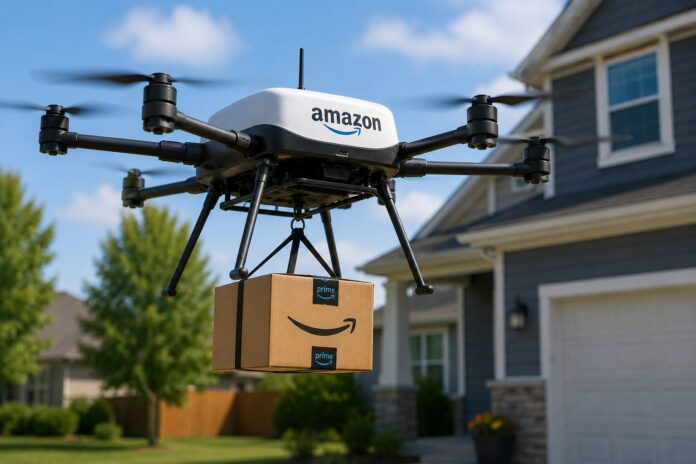
Amazon is preparing for a dramatic expansion of its drone delivery network, with plans to bring the service to suburban communities across nearly 500 U.S. cities by the end of the year, potentially giving millions of additional customers access to packages delivered through the air.
The company says eligible orders could arrive at customers’ homes in as little as 30 minutes.
Amazon’s delivery drones are capable of transporting packages weighing up to five pounds.
The ambitious rollout is expected to further escalate Amazon’s competition with Walmart as the two retail giants race to offer increasingly rapid delivery options.
Both companies are building delivery networks that combine traditional drivers with drones to move customers’ purchases to their homes as quickly as possible.
Under Amazon’s new plans, its drone operation would grow to more than six times its current nationwide footprint. The expansion will reach hundreds of additional communities, including areas around Chicago, Atlanta, Cleveland and Boise.
Flights will largely be concentrated in suburban neighborhoods, avoiding dense downtown areas, skyscrapers and major airports that can complicate drone operations.
Amazon says its drones have already transported hundreds of thousands of packages this year. Even with the planned expansion, however, drones will account for only a small portion of the hundreds of millions of packages the company delivers annually.
The technology also faces significant practical limitations. Beyond the five-pound weight restriction, trees, landscaping, backyard obstacles and even inflatable swimming pools can make it difficult for drones to identify suitable locations to safely lower packages.
Amazon must also navigate regulatory requirements in each community where it intends to establish drone operations.
Another potential obstacle is noise, particularly as the number of flights increases in residential neighborhoods.
“It’s still an experiment. It’s still in test and learn mode,” said Sucharita Kodali, a retail analyst with Forrester.
Kodali said some customers may initially try drone delivery simply for the novelty of seeing a package arrive from the sky. Whether consumers will regularly choose the service remains uncertain, she said, while Amazon continues working to determine whether the economics of widespread drone delivery make sense.
Amazon Prime members placing orders worth more than $50 will be able to use drone delivery at no additional charge. Prime customers with smaller orders will pay $2.99 for the service.
Customers without Prime memberships will be charged $4.99 for a drone delivery.
By comparison, Prime members generally receive standard deliveries for free, while nonmembers pay a flat delivery charge on standard shipments below $35 and can pay as much as $12.99 for same-day delivery where that option is offered.
Kodali said the technology may ultimately prove particularly valuable for lightweight products that customers need quickly, such as prescription medications.
Amazon is far from alone in exploring the possibilities. DoorDash and other delivery companies are also testing drones as a way to transport food and other merchandise directly to consumers.
Amazon CEO Andy Jassy told shareholders in his annual letter in April that the company has gained substantial experience from operating drones at 11 locations spread across Arizona, Florida, Kansas, Louisiana, Michigan, Nebraska and Texas.
At each site, drones depart from an Amazon warehouse and can serve an area of roughly 175 square miles. That means multiple launch facilities are necessary to provide drone coverage throughout a major metropolitan region.
“Prime Air now has a design that’ll scale plans to serve communities with 30 million customers by year-end, and expects to deliver half a billion packages by the end of this decade (with an aim to deliver inside 30 minutes),” Jassy wrote.
At the same time, Amazon is continuing to pour resources into its conventional delivery infrastructure, including warehouses, smaller fulfillment facilities positioned closer to customers and its truck fleet, as it seeks to shrink delivery times from days to hours — or even minutes.
The company has already received certification from the Federal Aviation Administration and has secured waivers permitting its drones to operate beyond the visual line of sight of their pilots.
Amazon has also invested heavily in collision-avoidance and other safety technologies intended to enable its drones to detect and steer clear of aircraft and other potential hazards while making deliveries.
The federal government has proposed broader regulations that would make it easier for drone operators to conduct flights beyond a pilot’s direct line of sight, potentially opening the door to even greater use of delivery drones. Those rules, however, have not yet been finalized.
{Matzav.com}