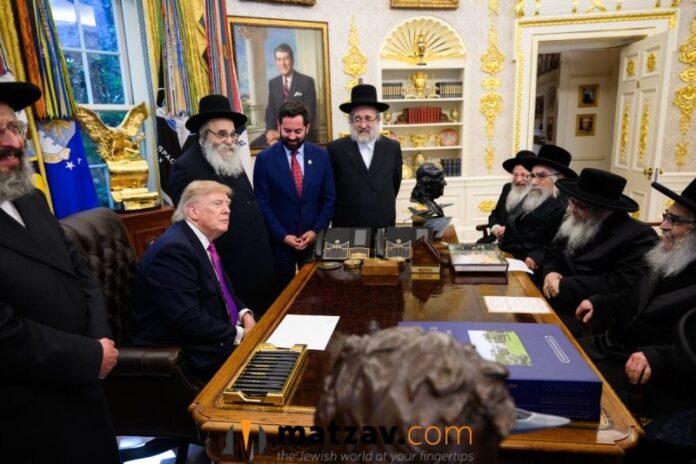
The delegation of Chassidishe Rebbes a rosh yeshiva and communal representatives who met President Donald Trump yesterday personally thanked him for accommodations made for the frum community during the COVID era.
During the Oval Office gathering yesterday, the Satmar Rebbe of Kiryas Yoel expressed appreciation to Trump for his efforts that helped allow batei medrash and Jewish institutions to reopen during the pandemic. The Rebbe stressed the importance that the reopening had for restoring Torah learning, tefillah and communal religious life at a time when religious institutions faced extensive restrictions. Other accounts of the meeting also reported that the Rebbe thanked Trump for his role in helping reopen batei medrash and institutions during COVID.
The delegation brought together prominent rabbinic leaders representing some of the largest Chareidi communities in New York and New Jersey. Participants included the two Satmar Rebbes, the Bobover Rebbe, the Vizhnitzer Rebbe of Monsey, Rav Malkiel Kotler, rosh yeshiva of Beth Medrash Govoha in Lakewood, and Rav Aharon Mendel Twersky, who attended on behalf of his father, the Skverer Rebbe.
Among the communal representatives who participated were Reb Gedalia Segedin and a number of other askanim. The visit included discussions with senior administration officials in the Roosevelt Room before the delegation proceeded to the Oval Office to meet Trump. Vice President J.D. Vance also joined the earlier discussions.
One of the major domestic concerns brought before administration officials involved the kosher food available to Jewish inmates in federal prisons. Members of the delegation described difficulties faced by frum prisoners who rely on the kosher meals supplied by correctional institutions and explained that kosher meat and other products can cost considerably more than the government’s ordinary daily food allowance for each inmate.
To address the problem, the delegation presented a proposal under which prepared kosher meals could be produced in commercial kitchens in Kiryas Yoel. The community has facilities capable of preparing food in large quantities, potentially allowing meals for Jewish inmates to be supplied at a cost near the government’s existing food allocation.
Supporters of the proposal said such an arrangement could provide Jewish prisoners with suitable kosher meals without requiring the federal government to assume dramatically higher food costs. The Kiryas Yoel kosher-meal proposal was among the prison-related matters discussed with Vance and administration officials.
The discussion also turned to vaccination policies affecting children and Jewish schools in New York. The delegation stressed that its concerns should not be interpreted as opposition to vaccination itself. Rather, participants said their objections centered on vaccination schedules and the practical difficulties that existing requirements have created for schools and families.
The representatives thanked Trump for a newly introduced childhood vaccination protocol that reduced the number of shots administered during individual well visits. Some Satmar schools had previously faced fines from New York State over compliance with vaccination requirements, and the delegation said the revised approach would be significantly more workable for schools and the families they serve.
New York politics also came up during the Oval Office conversation. Trump asked the rabbinic leaders about voting patterns in the state and why Democratic candidates continue receiving substantial support in some Chareidi communities.
The response, according to participants, was that the community approaches politics pragmatically. Chareidi voters alone cannot determine the outcome of every state legislative or congressional race, they explained, requiring community leaders to maintain working relationships with the officials who hold power in Albany and Washington. Their political engagement, they said, is therefore often driven by communal needs and practical considerations rather than exclusively by party affiliation.
Trump also reportedly asked the Satmar Rebbes about Israeli Prime Minister Benjamin Netanyahu. According to Segedin’s account, Jared Kushner, who was present, signaled that the Satmar leadership generally does not involve itself with Israeli political leaders. Public accounts confirm that Kushner participated in the Oval Office meeting at Trump’s request, although the specific exchange concerning Netanyahu has not been independently confirmed in the reports reviewed.
Another major subject was the continuing controversy over the military draft of Chareidi yeshiva students in Israel. The rabbinic leaders signed an appeal asking Trump to intervene on religious-freedom grounds on behalf of yeshiva students facing conscription. The letter also addressed American-Israeli dual citizens who have faced arrests or travel restrictions in connection with their draft status. Reports of the meeting confirm that the draft issue was raised directly with Trump.
Rav Malkiel Kotler personally presented the president with a letter during the Oval Office meeting.
Participants also described the preparation Trump and his staff had undertaken before receiving the delegation. According to their account, the president had briefing cards containing photographs and background information about the individual Rebbes and roshei yeshiva and the communities they represented. Those present said the preparation demonstrated that the White House had familiarized itself with the delegation before the meeting.
Trump was also told about the strong electoral support he had received in some of the communities represented at the meeting. Participants told him that he had received approximately 98% of the vote in Kiryas Yoel and 100% in New Square. The same figures were reported in an independent account of the gathering.
Before the full delegation entered the Oval Office, Rav Aharon Teitelbaum met privately with Trump for approximately 10 minutes, accompanied by Segedin. Their conversation focused on pidyon shvuyim, the Chareidi draft crisis in Israel and other pressing communal matters.
The rest of the rabbinic delegation then joined them. During the meeting, Rav Aharon recited Hanosein Teshuah, the traditional prayer for the welfare of the government, while Segedin translated its meaning into English for Trump. Trump requested that Jared Kushner join the gathering, saying that he “has to be here” with such distinguished guests.
The preservation of Jewish cemeteries and kevarim in Europe was another issue presented during the White House visit. Members of the delegation described historic Jewish burial grounds that have suffered from neglect, vandalism or deterioration and sought American assistance in protecting them.
The delegation noted the importance of preserving cemeteries containing the graves of generations of European Jews, including prominent rabbonim and ancestors of today’s Jewish communities. Rav Kotler specifically raised concerns involving the historic Jewish cemetery in Vilna, while other participants discussed threatened cemeteries in Poland.
The representatives also pointed to efforts undertaken by previous U.S. administrations to protect Jewish burial sites and asked the Trump administration to continue supporting such initiatives.
For the delegation, the matter was presented as more than historical preservation. Protecting the burial grounds was described as an obligation of kavod hameis and an effort to safeguard Jewish cemeteries that remain vulnerable throughout parts of Europe.
Participants said the atmosphere inside the White House was markedly different from the political debate that had surrounded the visit beforehand. The planned gathering had generated criticism from some political activists, particularly over the participation of Satmar leaders.
Inside the meetings, however, participants described the atmosphere as cordial and respectful. The discussions centered on specific concerns affecting Jewish communities, with Trump, Vance and other officials engaging with the delegation on the issues presented. Other published accounts similarly described the Oval Office meeting as warm and cordial.
Those involved expressed hope afterward that the unusual access to the president and senior administration officials would ultimately translate into practical results, particularly on matters affecting frum prisoners, religious institutions, yeshivos and Jewish families.
The delegation viewed the gathering as an opportunity extending beyond the symbolism of prominent Rebbes and roshei yeshiva sitting in the Oval Office. Its members sought to use the meeting to present specific communal concerns directly to the highest levels of the federal government.
Participants said the rabbinic leaders represented communities comprising more than 250,000 Jews.
{Matzav.com}