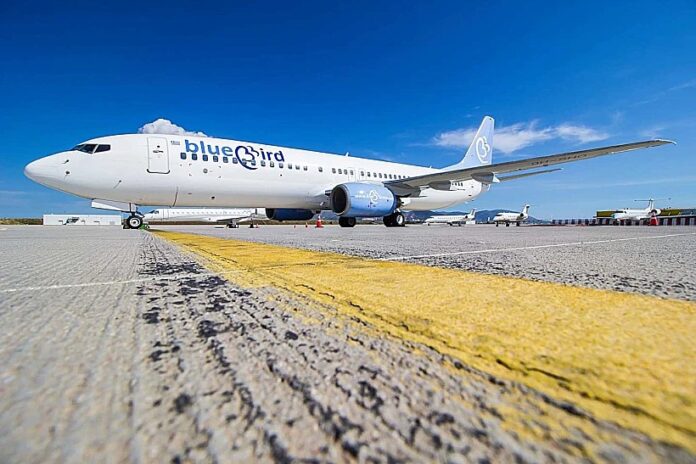
Blue Bird Airways is expected to be summoned to a hearing at Ben Gurion Airport over unusually severe flight delays, with data showing that roughly 80% of flights operated by Blue Bird and TUS fail to depart on time and delays average approximately two hours.
According to a report by Israel’s Channel 13 on Tuesday evening, Blue Bird, currently the fourth-largest airline operating at Ben Gurion Airport, will face scrutiny over its record of delayed departures and arrivals.
Blue Bird and TUS said they had not yet received any official notice from Ben Gurion Airport regarding a hearing.
“We have not received any communication from Ben Gurion Airport. If such a communication is received, it will be reviewed, and we will act accordingly,” the airlines said.
The development comes just two days after Blue Bird passengers endured a particularly difficult delay aboard a chartered aircraft scheduled to fly from Ben Gurion Airport to Crete, Greece.
Passengers had already boarded the plane when they were forced to remain aboard for nearly two hours while the aircraft sat on the tarmac. Compounding the problem, the ventilation system was reportedly not functioning despite the intense August heat.
Several passengers began feeling ill during the lengthy wait, while parents were filmed attempting to cool themselves and their young children with ice and wet wipes.
One passenger described the conditions aboard the aircraft in stark terms.
“We have been inside a closed airplane for an hour and 40 minutes without air conditioning, with small children fainting. I have never seen anything like this in my life,” she said.
The latest controversy comes amid broader disruptions at Ben Gurion Airport during the peak summer travel season.
On Friday, the airport experienced unusually severe congestion, with approximately 90 flights backed up within a period of just three hours.
The Israel Airports Authority attributed those delays to heavy air traffic and restrictions in European airspace, particularly around Greece, as well as the presence and operations of American refueling aircraft.
Airport officials rejected reports that the disruptions were caused by a strike or staffing shortages, maintaining that the delays resulted from air-traffic conditions and other operational constraints.
{Matzav.com}