

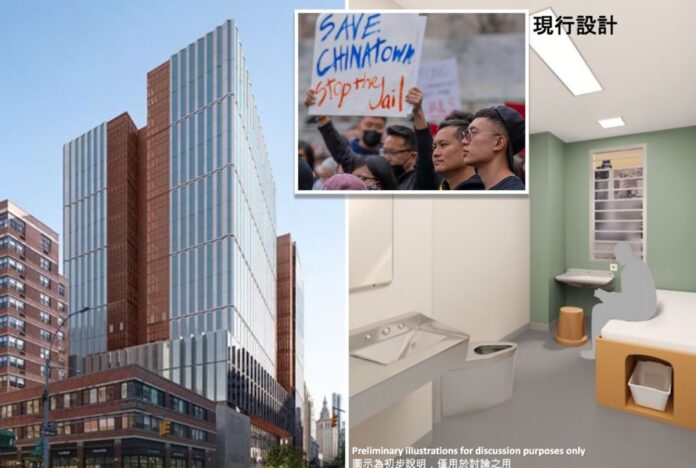
Chinatown community leaders are pressing Mayor Zohran Mamdani to reconsider plans for a massive new jail in the heart of the Manhattan neighborhood, warning that the deep excavation required for the project could cause surrounding ground to sink and potentially threaten nearby buildings.
The proposed 16-story detention facility is one piece of New York City’s $16 billion effort to shutter the Rikers Island jail complex and replace it with four borough-based jails located closer to courthouses. Under the current timetable, the broader project could be completed by 2032.
“The jail site sits on the soft, waterlogged ground of the old Collect Pond,” according to an Aug. 21 letter sent by 18 local leaders to the mayor, Deputy Mayor Julia Kerson, “Close Rikers’ Czar Dana Kaplan and City Council Speaker Julie Menin.
The group argues that construction at the White Street property could pose unusual risks because crews would have to dig deeply beneath the groundwater level.
“The construction plan calls for the deepest excavation ever attempted on its site, digging well below the water table. The city’s report warns that pumping out that water during construction can cause the surrounding ground to sink, and once it sinks, it does not come back,” the letter said.
The controversy centers on the former Manhattan Detention Complex at 124–125 White Street, which has been demolished to make way for the new borough-based jail. The project has faced intense opposition for years from Chinatown residents, merchants and community groups who have objected to the size, location and potential neighborhood impact of the facility.
The borough-based jail initiative dates back to the administration of Mayor Bill de Blasio, who launched the effort to close Rikers Island nearly a decade ago. The project continued to move forward during Eric Adams’ mayoralty and has now become an issue confronting the Mamdani administration.
Opponents are particularly concerned about the foundations beneath some of Chinatown’s older structures. According to the community leaders, numerous nearby buildings stand on wooden pilings installed roughly a century ago that remain structurally sound because they are submerged in groundwater.
The leaders, citing an analysis by architect William Bialosky, contend that lowering the groundwater level could expose those wooden supports to air, accelerating deterioration and potentially compromising the buildings above them.
“The buildings in the danger zone are our homes, our small businesses, the historic buildings along Baxter Street, and Chung Pak senior housing, where some of our most vulnerable neighbors live,” the Chinatown reps said.
City officials, however, have maintained that the project is being engineered with those concerns in mind. Officials said last month that extensive safeguards are being incorporated to ensure “building safely below the [water] table.”
A July 20 report prepared by the city Department of Design and Construction, contractor Tutor Perini, the Department of Correction and other participants in the project detailed the measures intended to protect neighboring properties during excavation.
According to the report, crews will construct a continuous underground retaining barrier using overlapping concrete piles. The wall is designed to support the excavation, restrict movement of the surrounding soil and control groundwater while work proceeds far below street level.
Project officials acknowledged in the report that groundwater management is an essential component of maintaining stability and “protecting surrounding structures.”
The builders nevertheless maintain that the planned pile-wall system will substantially reduce soil movement and protect nearby buildings, underground utilities and other public infrastructure from the effects of construction.
“Only water within the excavation area is managed, minimizing impacts to the surrounding groundwater level,” the report said.
Officials further argued that the sealed retaining-wall approach is specifically intended to isolate the excavation from the neighborhood around it.
“By containing groundwater and excavation effects within the site, the sealed-wall method reduces risks to surrounding properties and infrastructure.”
Similar secant-pile construction techniques have been employed on major projects elsewhere in New York City, including the Gateway Tunnel Project, 100 11th Avenue in Chelsea, the Hudson Square development known as Project Galaxy for the Walt Disney Company, and 120 Fifth Avenue in Brooklyn.
The dispute over the engineering risks comes amid broader complaints about work already taking place at the Chinatown property. During the demolition and dismantling of the old detention complex, nearby residents have complained about recurring dust, trucks operating or traveling uncovered, idling vehicles and persistent construction noise.
The Chinatown Environmental Health Working Group has also reported elevated levels of particulate matter pollution in the vicinity of the construction site.
Among those who signed the Aug. 21 appeal to Mamdani were Vic Lee, CEO and co-founder of Welcome to Chinatown Inc.; Jan Lee, co-founder of Neighbors United Below Canal; Thomas Yu, executive director of Asian Americans for Equality; and Wayne Ho, president and CEO of the Chinese-American Planning Council, Inc.
{Matzav.com}




Wait. Why do we need any sort of jail anyway?! Crime committed because there is a “need” is not a crime!