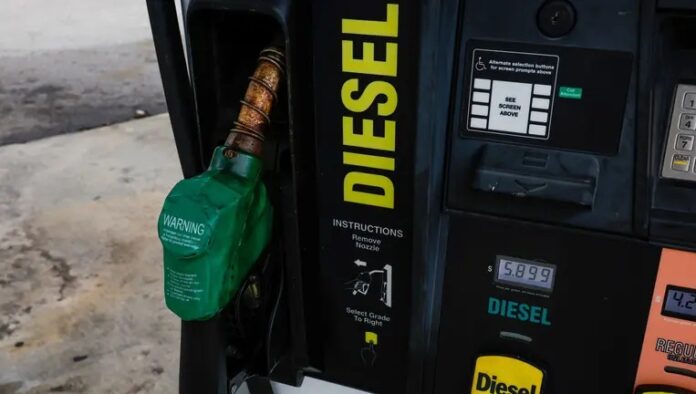
Diesel prices in the United States surged to an all-time high Friday, reaching a national average of $5.85 per gallon as the six-month war with Iran continues to squeeze global fuel supplies and send energy costs sharply higher.
The record is likely to be felt far beyond truck stops and filling stations. Diesel powers much of the nation’s freight and delivery system, meaning rising fuel costs are increasing the expense of moving everything from groceries to furniture. Businesses across numerous industries are facing larger transportation bills, with some already imposing additional charges on deliveries and online purchases. Consumers could increasingly see those costs reflected in prices on store shelves.
The growing burden could also become a political issue ahead of November’s midterm elections, when inflation, energy costs, and the broader economy are expected to weigh heavily on voters.
Among the areas most vulnerable to higher diesel prices is the food industry. Produce, meat, and other perishable products require frequent transportation and restocking, while farms themselves rely heavily on diesel-powered machinery for harvesting and other operations. Although those added expenses do not necessarily reach consumers immediately, they can gradually work their way through the supply chain.
Economists and industry specialists say the longer diesel remains at elevated levels, the greater the likelihood that businesses will have to pass along more of their costs. Diesel is also essential for transporting clothing, cosmetics, furniture, and countless other products by truck, rail, and ship.
Regular gasoline has climbed as well, though its increase has been less dramatic. AAA reported that the national average for regular gasoline stood at $4.15 per gallon Friday, compared with $3.20 at the same point last year.
Diesel was averaging roughly $3.76 per gallon before the United States and Israel began their war against Iran in late February, according to AAA. Prices surged soon afterward as crude oil — the primary raw material used to produce both diesel and gasoline — jumped amid production cuts and disruptions throughout the Middle East. The situation has been compounded by severe restrictions on tanker traffic through the Strait of Hormuz, one of the world’s most important energy shipping routes.
Fuel markets eased somewhat earlier in the summer amid hopes that the conflict could move toward a resolution. Those gains have since been reversed as fighting between the United States and Iran intensified again. Brent crude, the international oil benchmark, was trading above $95 per barrel Friday, compared with approximately $70 before the war began. Changes in crude prices typically make their way to retail fuel prices soon afterward.
The previous period of extraordinarily high fuel prices came in June 2022, when average diesel prices approached $5.82 per gallon. That spike occurred several months after the war in Ukraine began and governments around the world imposed sanctions on Russia, one of the world’s largest oil-producing countries.
In inflation-adjusted terms, however, today’s diesel price is still below some previous peaks. Diesel reached approximately $4.74 per gallon before the 2008 financial crisis, which would equal about $7.20 in 2026 dollars, according to government figures. Similarly, the nearly $5.82 average recorded in 2022 would amount to roughly $6.56 today after adjusting for inflation.
That historical comparison offers little relief to consumers and businesses currently paying record nominal prices, particularly as the impact spreads through the broader economy. Motorists who use gasoline are also facing substantially higher expenses each time they visit the pump.
The current $4.15 national average for regular unleaded gasoline is sharply higher than the $2.98 average recorded before the Iran war began, though it remains below the nationwide record of nearly $5.02 reached in 2022.
Diesel has generally cost more than gasoline for decades and has tended to experience sharper increases during recent energy crises. Analysts attribute the difference to factors including tighter supplies, less flexibility in demand, and diesel’s critical role in international trade and transportation.
Consumers can respond to expensive gasoline by cutting unnecessary trips or driving fewer miles. Businesses that depend on diesel-powered trucks, trains, ships, and machinery have far fewer short-term alternatives when they need to produce and transport goods.
That dependence is particularly pronounced in the food industry. Diesel powers tractors and other agricultural machinery, fishing vessels, freight trains, cargo ships, and the trucks responsible for delivering food to supermarkets.
Fuel expenses represent approximately 15% to 30% of the overall cost of food, according to the Independent Grocers Alliance, which represents 7,500 supermarkets around the world. As a result, higher diesel prices frequently contribute to rising grocery bills, although the effects of an energy shock can take time to move through production and distribution networks.
Refrigerated foods are often among the products that experience increases earliest because of the additional energy needed during transportation, according to David Ortega, a professor of food economics and policy at Michigan State University. Overall U.S. grocery prices in July were 2.7% higher than a year earlier, while seafood prices climbed 7% and fresh fruit increased 4.9%.
Ortega noted that transportation expenses are only one of many forces affecting food prices. Lettuce growers and distributors, for example, faced higher shipping expenses in July, but reduced consumer demand connected to the cyclospora outbreak pushed prices lower.
The longer diesel remains expensive, however, the greater the likelihood that households will ultimately bear more of those additional transportation costs.
“Early on, much of the cost increase gets absorbed along the supply chain through existing freight contracts and retailer margins,” Ortega said. “But as contracts reprice and fuel surcharges take hold, more of that cost makes its way to the grocery store.”
Major shipping and e-commerce companies have already responded to the energy crunch. Amazon introduced a temporary 3.5% fuel and logistics surcharge in April affecting some third-party sellers. United Parcel Service, FedEx, and the United States Postal Service also added charges to certain shipments earlier in the conflict, pointing to rising fuel-related operating expenses.
Ajesh Kapoor, founder and CEO of trucking technology company SemiCab, said transportation companies have some ability to adjust their operations as diesel becomes more expensive, but there are limits to how much of the increase they can absorb.
“Diesel price has a very, very direct impact on everything that moves on pretty much any mode,” Kapoor said.
The impact is not confined to consumer merchandise and commercial shipping. Some buses and trains in public transportation systems rely on diesel, while diesel-powered generators remain an important source of emergency and backup electricity. In some remote regions around the world, those generators are also a primary source of power.
The economic consequences could become particularly severe in parts of Africa and Asia. Many countries in those regions depend heavily on Middle Eastern energy imports and have already suffered some of the most significant effects of the supply disruptions caused by the war.
Neil Atkinson, an energy analyst and senior fellow at the National Center for Energy Analytics, warned that the problem now extends beyond high prices. Supplies of refined petroleum products such as diesel are also becoming increasingly strained.
“This is gradually becoming a major crisis because A) the prices themselves are very high — but the physical stocks of these products are dwindling,” he said during a weekly briefing with maritime data firm Lloyd’s List Intelligence, citing growing pressure on the global refining system. “This cannot go on forever.”
{Matzav.com}