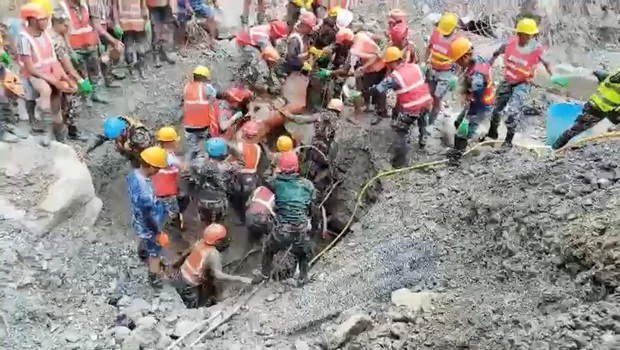
Rescuers in Nepal pulled two hydropower workers alive from a tunnel on Friday, nine days after catastrophic flash floods buried the facility in mud and water, raising hopes that additional survivors could still be found as emergency crews reported hearing voices from deeper inside the complex.
The extraordinary discoveries have given rescue teams new urgency more than a week after the flooding devastated large areas of Nepal and killed more than 1,200 people. CBS News correspondent Ramy Inocencio reported that rescuers believe more people — potentially dozens — could still emerge alive after voices were detected within the partially submerged and mud-covered tunnel system.
The two men were rescued from the Trishuli 3A hydropower tunnel nine days after the disaster. The massive flooding, believed to have possibly been triggered by the collapse of a glacier, destroyed towns and swept away entire villages across parts of Nepal.
Nepalese lawmaker Shri Ram Neupane announced the second rescue on Facebook shortly after army spokesperson Brig. Gen. Raja Ram Basnet confirmed that the first worker had been brought out alive.
Nepalese Foreign Minister Shisir Khanal told Inocencio in a text message that he was “thrilled” about the two rescues and “hoping to see more survivors.” Khanal said officials still did not know how many people might remain alive within the tunnel, but the sound of voices has intensified the race to reach anyone still trapped.
According to Neupane, rescue personnel first detected voices coming from within the tunnel Friday morning. Those sounds helped search teams determine where the two surviving workers were located.
Television footage from the scene showed the first survivor emerging covered in mud and being carried on the shoulder of a member of the rescue team. Authorities said both rescued men were in stable condition and were transported by air to a hospital in Kathmandu for treatment.
Sanjay Shah, a mechanical foreman at the hydropower project, said “thank you” after rescuers brought him out of the tunnel. Because of his weakened physical condition after nine days trapped underground, however, he was advised not to continue speaking, Inocencio reported.
Amir Maharjan, whose brother, mechanical supervisor Kabir Maharjan, was the other worker rescued, described the family’s overwhelming reaction to learning that he was alive. He told The Associated Press he “can’t explain what we are feeling at the moment. We are just grateful to God.” Maharjan said relatives were traveling to the hospital to reunite with him.
Kabir Maharjan’s wife, Hirashova, described the ordeal the family had endured while waiting for news of her husband.
“We couldn’t properly eat or drink for 10 days,” she told CBS News partner BBC News. “We were very scared. Now we are all happy. We are even crying.”
Despite Friday’s remarkable rescues, hundreds of employees from the Trishuli 3A hydropower project remain unaccounted for. At least 557 workers are still missing, and approximately 115 are believed to be trapped inside the project’s main tunnel, according to the Independent Power Producers Association of Nepal.
An energy adviser in Nepal told Inocencio that the structure where the workers are believed to be trapped is far more complicated than a single tunnel extending underground beside the Trishuli River. Instead, it consists of an interconnected network of chambers and rooms extending in different directions and at varying levels, making the rescue operation considerably more difficult.
The adviser said many of the people trapped inside are among Nepal’s most highly skilled engineers and suggested they have likely spent the past nine days attempting to devise ways to escape and maintain access to oxygen. A lack of breathable air remains the greatest danger for those who may still be alive inside.
The nationwide toll from the disaster remains staggering. Nepal’s disaster management agency said at least 1,287 people have been killed and more than 5,000 others remain missing. Across the border in Tibet, Chinese authorities said as of late Wednesday that 21 people had died and another 541 remained unaccounted for.
The flooding has also devastated Nepal’s hydropower industry. Local authorities said approximately 900 workers remain missing from 12 hydropower projects across the country, with an estimated 500 of them believed to be trapped inside tunnels.
{Matzav.com}