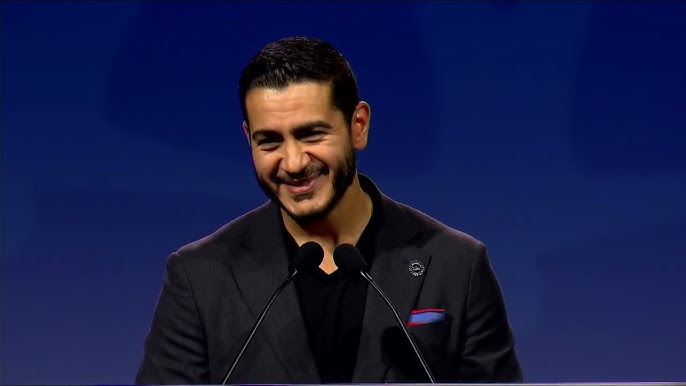
Michigan Democratic Senate candidate Abdul El-Sayed is facing a wave of criticism from conservative commentators after defending his position on Sharia law and comparing the Islamic legal tradition to Catholic canon law during a contentious Fox News interview Monday night.
The controversy erupted after Fox News host Jesse Watters confronted El-Sayed over previous remarks in which the candidate opposed efforts to prohibit Sharia law and connected such bans to White supremacy.
“Getting rid of Sharia law is White supremacy?” Watters said to El-Sayed, bringing up past comments from the Michigan candidate opposing a ban on Sharia law and comparing those efforts to White supremacy. “Can you explain that one?”
El-Sayed responded by drawing a parallel between Sharia, the body of Islamic religious law derived from religious sources, and the rules and governance of the Catholic Church.
“Nobody is trying to push Sharia law on anyone else, just like I hope nobody is trying to push canon law on anybody else, because we live in an America where you should have the freedom of your religion,” El-Sayed said.
That comparison quickly generated criticism on social media, where conservative commentators argued that Sharia and Catholic canon law differ significantly in their scope and historical application.
“He lies and says no one is trying to push Sharia (they are), and draws a false equivalency to Christian Canon law,” Andrew Kolvet, executive producer of “The Charlie Kirk Show,” posted on X. “Canon law determines how Christian leaders, churches, and Christians should live, but Canon law is limited to affairs of the Church (spiritual penalties). Canon law grants great autonomy to the state.”
Kolvet continued, “Sharia law is MUCH more comprehensive, governing all aspects of life, and historically, and according to many contemporary Islamic clerics, dictates the affairs of the state.”
Political commentator Carl Jackson also criticized El-Sayed’s position, arguing that Sharia is fundamentally incompatible with Western society.
“Sharia law is incompatible with Western Civilization,” political commentator Carl Jackson posted on X. “I’m tired of El-Sayed playing the victim card in attempt to avoid legitimate scrutiny of Islam.”
Fox News contributor Kaylee McGhee White predicted that the exchange could prove politically damaging for El-Sayed in his Senate campaign.
“Yeah, it’s over for him,” Fox News contributor Kaylee McGhee White posted on X. “Rogers by 6.”
Conservative commentator and radio host Dana Loesch rejected El-Sayed’s characterization of Sharia as simply a matter of individual religious observance.
“@AbdulElSayed doesn’t get to bloviate about sharia being a mere ‘practice’ of faith when it’s Islamic jurisprudence used to supplant western jurisprudence,” conservative commentator and radio host Dana Loesch posted on X.
Michael Knowles responded sarcastically to El-Sayed’s comparison between Sharia and Catholic canon law.
“‘Jesse, the Catholic Church requires ministers to use plant oils in sacraments with the blessings of a bishop, so why shouldn’t courts allow Muslim men to have four wives?'” conservative commentator Michael Knowles posted on X.
Pamela Geller similarly argued that Catholic and Jewish religious law apply voluntarily within their respective religious communities, while asserting that Sharia has historically claimed broader authority.
“Canon law applies to Catholics,” conservative commentator Pamela Geller posted on X. “There is no compulsion is Canon law. Jewish law applies only to Jews. There is no compulsion in Jewish law. It is voluntary. The sharia is a comprehensive legal system governing every aspect of human life, and asserts authority over non-Muslims.”
Republican communications strategist Matt Whitlock said he was surprised that El-Sayed chose to defend his position rather than distance himself from his previous comments.
“This was a very strange prepared defense from Abdul,” GOP communicator Matt Whitlock posted on X. “I expected him to say it was out of context, not reflective of current views, etc. Instead he accepted the premise and defended promoting Sharia Law – opening that lane up to more attacks.”
Fox News Digital contacted El-Sayed’s campaign seeking a response to the criticism.
El-Sayed has discussed his personal adherence to Sharia-compliant practices in the past. In a 2009 interview with The New York Times, he described following such practices as a religious obligation that would ultimately matter when he stood before God.
“Ultimately, the question is, when I die and I stand before God and go through everything I did in my life, I don’t want to say I did it the easy way instead of the Shariah-compliant way,” El-Sayed told the Times.
“Not because of fear but because of obligation,” he said.
Traditional interpretations of Sharia have included severe penalties for apostasy, significant restrictions on women and provisions permitting child marriage.
El-Sayed has also previously criticized legislative attempts to ban Sharia law, arguing that such measures should be understood in the broader context of White supremacy in American history.
“The state of Oklahoma voted in a referendum to amend the constitution to ban Sharia law. What does that mean? I don’t know. And yet the voters banned it anyway,” he said in 2022. “The same exact forces that drove Native peoples from their land two centuries ago, destroyed Black Wall Street a century ago, bombed a building decades ago and tried to ban Sharia law not a decade ago, those forces are alive and well today.
“The reason I wanted to go all the way back to the 1830s is because you can’t understand a Sharia ban without understanding the Trail of Tears. You can’t understand the efforts to uproot Muslim Americans without understanding the Tulsa massacre. You cannot understand the challenges we face today without understanding White supremacy.”
{Matzav.com}