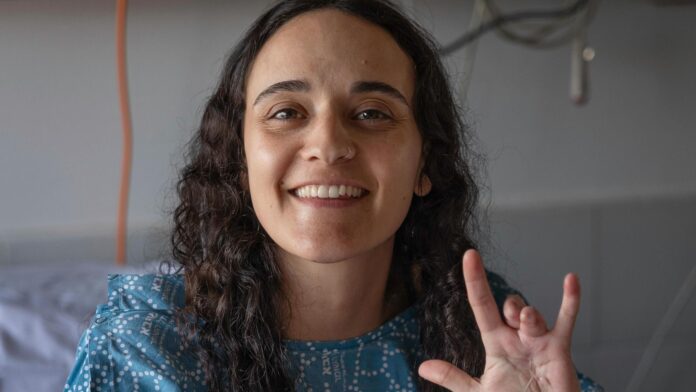
A remarkable account from former hostage Emily Damari has revealed that while she was being held captive by Hamas in Gaza, a radio suddenly began working inside the tunnels — allowing her to hear a live broadcast of Selichos from the Kosel.
The story was shared during an episode of “Me’Achorei Kosleinu,” a podcast produced by the Western Wall Heritage Foundation, featuring Yehuda Naftali, the chazzan who has led the main Selichos gatherings at the Kosel since 2015.
Naftali said that even after 11 years and dozens of nights leading Selichos each Elul, the experience has never become routine.
“Every night, there is no routine here,” he said. “You feel as though you are at the Kosel for the first time, saying Selichos for the first time.”
Naftali said the responsibility of standing before tens of thousands of people at the Kosel, along with millions more watching and listening around the world, continues to weigh heavily on him.
“You say: Wow, I am going to fulfill the obligation of Selichos for this entire crowd. There is nothing else like it.”
One of the moments that Naftali finds particularly powerful comes during Adon HaSelichos. Over the years, he said, the enormous crowd has become so familiar with the tefillah that he barely needs to lead them anymore.
“I just say ‘Adon HaSelichos,’ and that’s it. From that point on, it’s them. I used to have to lead them; today I don’t need to.”
Behind the enormous gatherings, however, are deeply emotional encounters that Naftali said have left a lasting impression on him.
He recalled meeting a bereaved father shortly before Selichos began one night. The father told Naftali about his son, who had been killed on Oct. 7.
“I went into the office, closed the door behind me and simply cried. The tears just kept falling.”
Naftali said encounters with survivors of Hamas captivity have also transformed the way he approaches the tefillos.
“When survivors of captivity are standing next to you… I feel as though I am their shliach tzibbur as well. I want something to come from this tefillah, for something to happen, for them to come home.”
During the conversation, the interviewer related an extraordinary account he had personally heard from Emily Damari, who survived Hamas captivity in Gaza.
According to Damari, while she was being held underground, a radio in the tunnels suddenly connected to a broadcast — and through it, she heard the sounds of Selichos being recited at the Kosel.
Naftali also spoke about the personal and family toll of his demanding schedule throughout Elul, when the nightly gatherings leave him with little opportunity to sleep.
“During Elul, I tell my wife: Goodbye, we’ll see each other after Yom Kippur,” he said with a smile, describing nights when he gets only three or four hours of sleep.
Naftali concluded by describing the thoughts that sometimes go through his mind as he stands before the ancient stones of the Kosel and looks out at the enormous crowds gathered there.
“What can a wall do to an entire nation… an old wall, an ancient wall, a holy wall that can bring the entire world to see this special place.”