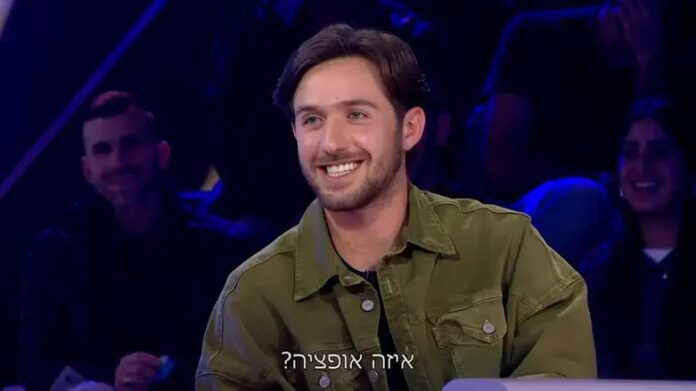
More than 18 months after returning from Hamas captivity, Omer Shem Tov is speaking about the inner struggle that accompanied his ordeal, describing how faith, humor and hope helped him survive the tunnels of Gaza and how he is now confronting the lasting trauma of what he endured.
In an interview with the Hebrew-language Arutz Sheva website, Shem Tov discussed his new book, “Meeting Myself in Hell,” which focuses less on documenting the brutality of captivity and more on the personal journey he underwent and his decision to choose life and hope after returning home. He said he initially resisted the idea of publishing his story.
“I didn’t want to publish yet another book by a hostage,” he admits. “I told myself there would soon be an entire shelf of hostage books, and I didn’t want to be just another one on that shelf. Eventually, I realized that I didn’t just want to tell people what happened to me. I wanted to talk about how you can rise from the darkness and find light within it.”
Among the most difficult subjects Shem Tov addresses is the guilt he continues to carry over Maya and Itay, two friends whom he persuaded to attend the Nova music festival, where they ultimately found themselves caught in the October 7 massacre.
“Maya was my best friend. I was the one who convinced her to come to the festival, and Itay decided to come because of her. Knowing that they ended up there, were wounded and kidnapped because of me was incredibly difficult. Neither of them ever blamed me, but deep down, it’s a feeling that is very hard to let go of.”
Those feelings have followed him beyond his immediate circle of friends. Shem Tov said encounters with wounded IDF soldiers and the families of troops who were killed while fighting during the war have left him grappling with the sacrifices made in the effort to rescue him and other hostages.
“There are people who went into hell to save me. Some were seriously wounded, and some never came back. When wounded soldiers tell me, ‘I would do it another thousand times,’ it shakes me. It’s hard to comprehend that someone was willing to pay such a price for you.”
One person whose actions remain deeply etched in Shem Tov’s memory is Ori Danino. Although the two had known each other for only a matter of hours before the October 7 attack, Shem Tov said Danino’s instinct to help others was immediately apparent.
“Ori was a light. He was always looking for a way to help. When the attack began, he had already managed to save four people. Then he called me and asked me to send him our location so he could go back and get us too. He knowingly returned into the inferno to save us. Later, he was kidnapped, and after months in captivity, he was murdered. It is a level of heroism that is almost impossible to describe.”
Even amid the terror of captivity, Shem Tov recalled discovering that humor could provide brief moments of relief and help the hostages preserve a sense of normalcy.
“We would quietly laugh into our pillows so they wouldn’t hear us. We even turned the IDF bombardments into a game, trying to figure out where each explosion was coming from. It may sound strange, but that was our way of remaining human.”
The sounds of Israeli military operations above ground brought their own complicated mixture of fear and reassurance. Every explosion carried the possibility of danger, but the sounds also reminded Shem Tov that Israel was still fighting to bring the hostages home.
“Hearing IDF tanks and aircraft gave me strength. I felt that I hadn’t been forgotten, that they were fighting for me. It gave me hope, even though every explosion was frightening.”
Shem Tov said he also attempted to develop a workable relationship with his Hamas captors as a survival strategy. He tried to make himself useful and establish some degree of rapport, even while the abuse continued.
“I cleaned for them, cooked for them, and tried to make them laugh. It didn’t make them human – they continued to beat me, humiliate me and spit on me – but it did slightly improve the way they treated me and helped me survive.”
The most transformative element of his captivity, Shem Tov said, was his renewed connection to faith. During his first days underground, confined in the darkness and barely able to move, he reached an emotional breaking point and decided to surrender his fate completely to G-d.
“During the first week, I simply went crazy. Then came a moment when I said to God: ‘Father, here I am. I’m in Your hands. Do whatever You want.’ From that moment on, I felt warmth, light within the darkness, as if someone was simply wrapping their arms around me. It’s a feeling I’ve been trying to return to ever since.”
Shem Tov also believes there was a profound connection between his own prayers underground and those being recited by his family at home.
“My mother would recite chapters of Psalms at home, and at that exact time I would be reciting the same chapters in the tunnel. I felt her prayers.”
Returning to Israel did not end the battle. Shem Tov said the psychological impact of captivity remains with him and requires constant effort as he tries to rebuild his life.
“I still feel that I have light to spread, but it’s a daily battle inside my head and my soul. Post-traumatic stress doesn’t simply disappear.”
Drawing from that experience, Shem Tov urged others struggling with the psychological wounds of war to speak openly about what they are experiencing. He also called on their families and friends to pay close attention to suffering that may not be readily visible.
“I want everyone dealing with PTSD to understand that it’s okay to talk, it’s okay to cry, and it’s okay to share. It doesn’t make you less of a man or less of a human being. And to those around them, I say: Open your eyes. Look at the people around you. Sometimes what you see from the outside is only a small part of what is happening inside.”
Shem Tov, however, does not want captivity to define the rest of his life. With his ordeal behind him, he is pursuing an ambition he held long before October 7: becoming a professional actor.
“I always dreamed of becoming an actor. I completed an acting course in New York, and my dream is to land a leading role in a major film. After that – an Oscar. I always dream big. After returning from captivity, I feel that anything is possible.”
{Matzav.com}