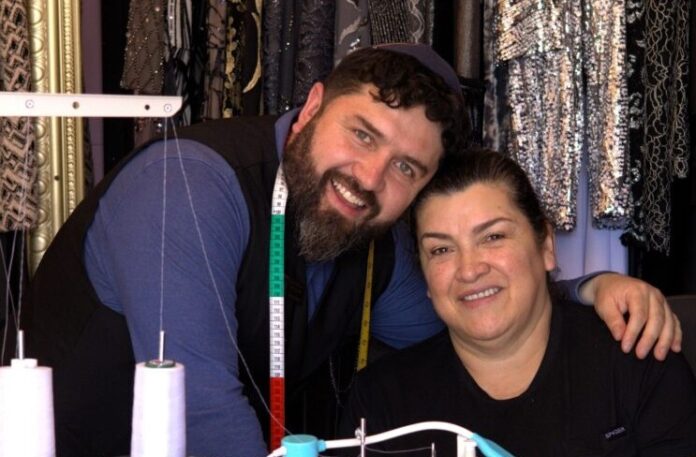
Teaneck fashion designer Ari Ladino, the owner of Luana Rose Modestly on West Englewood Avenue, and his mother, who worked alongside him at the store, have been detained by U.S. Immigration and Customs Enforcement, according to a report by the Jewish Link. Their sudden disappearance initially left customers desperately trying to retrieve gowns for upcoming weddings and simchos before it became clear that the two had been taken into immigration custody.
Elie Y. Katz, Ladino’s landlord, said he first realized something was wrong while attending a wedding, when he began receiving urgent calls from a woman whose daughter’s wedding gown was inside the locked store. With the wedding rapidly approaching and Ladino unreachable, Katz met the customer at the shop along with police. Packages had accumulated outside the storefront, further indicating that the business had unexpectedly stopped operating. They eventually entered the store and recovered the completed gown. The following day, Katz returned after another customer contacted him seeking a dress she also needed to retrieve.
The situation was particularly alarming because Ladino and his mother were ordinarily a constant presence at the business, where they routinely put in long hours. Ladino specializes in designing custom and semi-custom gowns for weddings, simchos and other special occasions, making their unexplained absence highly unusual.
Trying to determine what had happened, Katz contacted Ladino’s former business partner, who supplied several possible contacts. Among them was one of Ladino’s cousins, who asked to be allowed into the store, but Katz said he would not grant access without first receiving authorization from Ladino. Katz also asked police to check the address listed on Ladino’s driver’s license, but no one was found there. Ladino and his mother are originally from Colombia, although Katz said he had no knowledge of their immigration status.
The mystery was finally resolved the following day when Katz received a telephone call from a detention facility and found Ladino on the other end of the line. Given only a few minutes to speak, Ladino authorized Katz to allow his cousin into the shop and to provide access to customers who had gowns waiting for pickup. Ladino also told Katz that his mother had been transferred to a separate detention facility. When a woman traveled from Westchester to collect a dress for an upcoming simcha and Katz explained what had happened, she immediately offered to contribute toward Ladino’s expenses and left a check.
Ladino was also able to contact a woman who has been working with him as a business partner and instructed her to retrieve his phone from the store. The woman, who asked that her identity not be published, said Ladino directed her to organize a sale of the gowns remaining in the shop, with the proceeds intended to help finance his legal defense.
Michael Wildes, managing partner of immigration law firm Wildes & Weinberg, P.C. and a former federal prosecutor, said after learning about Ladino’s detention that the case illustrates what he described as the broader consequences that aggressive immigration enforcement can have on businesses and communities. “The president promised to rid us of hardened criminals, which no one would object to. We find now that the administration’s policies are intruding on some of the finest families and businesses throughout our nation. This is disappointing to hear and see firsthand from a businessman president.”
After being told that a sale of the store’s gowns could be held to help cover Ladino’s legal expenses, Wildes said the episode should serve as a warning to others who could face immigration-related legal problems. “It would be smart for your readership to make sure that they shore up any exposure that they, their family members, employees and co-workers may have with a competent attorney to preempt the harm that we see unfolding throughout the nation.”