Shlomi Ziv, who was kidnapped by Hamas terrorists on October 7 and rescued 246 days later in the daring Operation Arnon, has opened up about the horrors of his eight months in captivity, the dramatic moments of his rescue, and the renewed faith that he says emerged from the darkest period of his life.
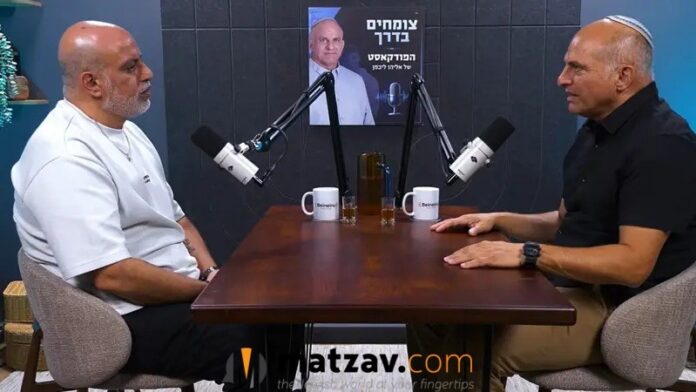
Speaking with Eliyahu Liebman on the “Growing Along the Way” podcast, Ziv described how his ordeal in Gaza transformed his relationship with Hashem and ultimately brought him back to putting on tefillin, something he had stopped doing years earlier.
Ziv and Liebman have known each other since a battle in Chevron 21 years ago. Ziv said that following that episode, his faith had been shaken and he eventually stopped putting on tefillin. His experience in Hamas captivity, however, sent him in the opposite direction.
“I’m not angry at Hashem,” Ziv said. “I simply say: Okay, I believe. I believe. There is just anger if this is the way… Show me that You are there.”
Every morning in captivity, Ziv said, he thanked Hashem simply for having survived another night.
“I thanked Hashem that I woke up and they hadn’t murdered me, or that some missile hadn’t fallen on us,” he recalled.
Along with that gratitude came one request that he repeated day after day.
“Give me the privilege of returning to put on tefillin. That is what I asked Him.”
Since his rescue, Ziv said, that request has been fulfilled.
“Every single morning, boruch Hashem, I have been given that privilege, and every morning I put on tefillin.”
Ziv also went back to the terrifying first moments of October 7, describing how he fled after terrorists opened fire toward the command post near Nahal Gerar. He ran into the area and hid inside a bush as gunfire continued around him.
“They were shooting anyone who ran… and then I told myself: Okay, stay here,” Ziv recalled.
Eventually, a terrorist spotted him.
“There was a point when I closed my eyes. I said: This is the moment. Either he shoots… You think that in another moment you are going to leave this world.”
When the terrorist ordered him out of hiding, Ziv pleaded in Arabic, “Don’t shoot.”
The terrorist responded, “I’m not going to kill you.”
Ziv was subsequently taken to a pickup truck together with Andrey Kozlov, who would remain alongside him in captivity and ultimately be rescued in the same operation.
At one point, Ziv considered trying to overpower or surprise the terrorist. But Kozlov, who had not yet realized that the armed man was a terrorist, spoke to him in English and asked for a weapon so that he could help.
“That’s when I realized there was no one to work with in that situation,” Ziv recalled.
Looking back, Ziv believes the misunderstanding may actually have saved their lives. Even if they had somehow managed to overpower their captor, he said, dozens of Gazans were waiting farther along their route.
Once in captivity, Ziv was subjected to searches, restraints and violent interrogations as his captors sought to determine whether he was an Israeli soldier.
“They tie you up, bind you, cover your eyes… They search to see whether you have a chip. During the first three days, there were interrogations accompanied by violence, because they wanted to know whether you were a soldier or not. If you’re a soldier, you’re worth more.”
The first two months were particularly devastating emotionally, Ziv said, and he found himself reduced to a state of near-total despair.
“There were two months of crisis… two months of being like a baby, crying, really the lowest of the low.”
Only afterward did something begin to change. Ziv described experiencing “an uplifting feeling of acceptance… trusting in Hashem, faith, hope.”
During conversations with his Hamas captors, Ziv said he sometimes tried to understand what future they envisioned and what they ultimately wanted from Israelis. Their responses, he said, left little room for ambiguity.
“Either you leave here and go back to where you came from, or you convert to Islam, or you die,” he recalled being told.
One captor went even further, warning him directly.
“On the next October 7, Shlomi, we’re going to reach the Galil… and next time we won’t kidnap you. Next time, you die.”
Then came the morning of June 8, 2024.
It initially appeared to be an ordinary Shabbos morning in captivity. Without warning, however, an explosion shook the area. Gunfire quickly followed from inside the building, and Ziv realized that something extraordinary was happening.
“It was a regular morning, a Shabbos morning, until suddenly there was an explosion. A moment later, there was already shooting inside the house, and then you understand that these are our security forces.”
Within moments, he heard something he had not heard in eight months: Hebrew.
“Hebrew! Hebrew! There! There!”
The battle inside the building continued for several tense minutes. During the rescue, Israeli officer Arnon Zamora was mortally wounded after leading the force into the building.
“That is where we lost a hero of Israel, our personal hero, Arnon Zamora, may Hashem avenge his blood, who fell as he was the first to break in,” Ziv said.
Ziv said he subsequently struggled with feelings of guilt over Zamora’s death, but Zamora’s family helped him understand that the officer would have acted exactly the same way regardless of which hostage was inside.
“You understand that it didn’t matter whether it was Shlomi Ziv or any other hostage — Arnon would not have hesitated for a moment.”
Even after Ziv and the other hostages were removed from the building, the rescue was far from over. Their vehicle became stuck after traveling only about 600 meters, leaving them exposed during what Ziv described as “15 minutes of fear.”
Then Israeli armored forces appeared around them.
“Armored personnel carriers, tanks surrounding us… and they rescued us from that stuck truck.”
Returning to Israel did not mean leaving Gaza entirely behind. Ziv said seemingly ordinary smells can suddenly transport him back to captivity. He asked his wife to throw away hand soap she had purchased because its scent reminded him of wipes his captors had distributed in Gaza. Even the smell of pita with olive oil and za’atar can trigger memories.
“There are flashbacks. There are smells,” he said.
But Ziv says he has chosen to move forward with a message he calls “Forward, Home” — words with a painful double meaning for him, having been used both when people were told to leave on October 7 and again during his rescue.
His experience has also left him with a message about Jewish identity that he now shares openly.
“Don’t be afraid to be Jewish,” Ziv said. “Don’t be afraid to be proud of where you came from and where you are going.”
{Matzav.com}