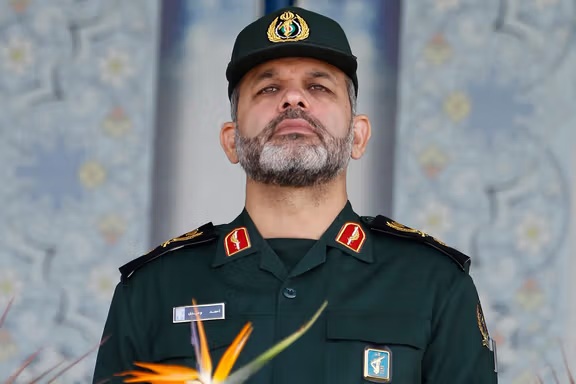
A senior Iranian military commander declared Saturday that Iran’s months-long conflict with the United States proved the strength of Islam, even as the Trump administration continues working to secure a long-term agreement despite America’s overwhelming military advantage.
Ahmad Vahidi, commander of Iran’s Islamic Revolutionary Guard Corps (IRGC), praised the country’s military and security forces, including the IRGC, the regular army, police, and Basij militia, claiming they had succeeded in confronting what he described as the world’s most powerful military.
Vahidi asserted that Iran’s campaign had shown that ”Islam can be made to rule the world” and had ”opened the gates of uprising for the oppressed of the world,” despite the fact that Iranian missile attacks have struck neighboring Muslim countries that host U.S. military forces.
His remarks stand in sharp contrast to the military realities of the conflict.
Throughout the war, the United States has maintained a dominant naval presence in and around the Strait of Hormuz while inflicting extensive damage on Iran’s naval fleet, missile capabilities, and other military assets. Iran has also faced severe economic hardship as a result of the fighting and intensified financial sanctions.
Nevertheless, Iran’s refusal to back down has highlighted Washington’s ongoing difficulty in turning military success into the comprehensive political settlement President Donald Trump has repeatedly predicted.
As early as May 23, Trump said an agreement with Iran had been ”largely negotiated” and would be announced ”shortly.”
On June 11, the President expressed confidence that a deal could be finalized within days, saying he believed Iran’s supreme leader had already approved it. That agreement, however, was never completed.
A temporary ceasefire later collapsed. In July, Trump declared the conflict ”OVER,” yet negotiations continued afterward, and the administration postponed additional U.S. military strikes in an effort to give diplomacy another opportunity.
By the end of July, Trump acknowledged that Tehran still was not prepared to reach an agreement, even while describing the negotiations as serious and holding out hope that progress remained possible.
The diplomatic deadlock has continued through August. Talks between the United States and Iran remain at an impasse, with Washington engaging additional countries in an effort to revive the negotiating process.
At the same time, Iranian officials have continued insisting on sanctions relief and compensation for wartime damage before agreeing to resolve the dispute surrounding the Strait of Hormuz.
Despite the stalled negotiations, Trump continued to project confidence on Friday, suggesting that once Iran is defeated, the United States could even declare the Strait of Hormuz to be American territory. Iranian officials quickly rejected the statement.
The situation has underscored the contrast between America’s battlefield dominance and the absence, thus far, of a final political agreement.
While U.S. forces have dealt substantial blows to Iran’s military infrastructure, Tehran has neither surrendered nor agreed to the broad settlement Washington has sought.
{Matzav.com}