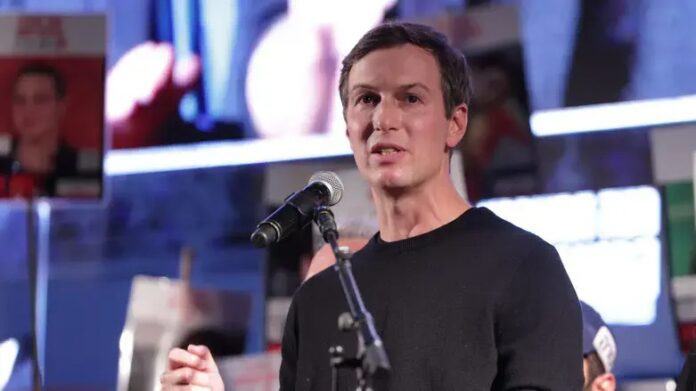
Jared Kushner, President Donald Trump’s envoy and son-in-law, said Monday that Hamas will be given roughly 60 to 90 days to surrender its weapons and dismantle its military infrastructure under the administration’s Gaza plan, while stressing that Israel will retain the right to act against immediate security threats.
Kushner outlined the timeline during an interview with Fox News following an almost four-hour meeting with Prime Minister Benjamin Netanyahu and his team in Israel. The talks focused extensively on implementing President Trump’s plan for Gaza and addressing Israeli concerns about the proposed framework.
Asked about Netanyahu’s objections to the Board of Peace roadmap and whether the Israeli leader was being pressured to alter his position, Kushner suggested that some of the disagreement stemmed from how the proposal had initially been understood.
“I think that was his perception of the plan as he got it,” Kushner said. “I think today we had a very, very good meeting.”
Kushner said the lengthy discussion allowed the American and Israeli teams to examine the proposal in detail and work through issues that had caused concern in Jerusalem.
“I think there were some valid concerns that they raised that we were able to address, and we were able to go through some of the misunderstandings and misinformation that’s been out about it as well,” he said.
After meeting with Israeli PM Netanyahu on Gaza, Special Envoy Kushner told Fox News:
"We could be seeing progress in as little 30 days, hopefully on starting to take some of the weapons out, and hopefully filling in some of the tunnels as well in the next 60 to 90 days." pic.twitter.com/RKTyLsUcO1
— Trey Yingst (@TreyYingst) August 17, 2026
One point on which Kushner said the administration would not compromise is the connection between rebuilding Gaza and eliminating the terrorist infrastructure there. Reconstruction, he said, will not proceed while Gaza remains militarized.
“We’re very committed to the fact that we have a plan to rebuild Gaza, but we will not allow Gaza to be rebuilt until the demilitarization occurs,” he said.
“Nobody wants to put more money into a place that’s gone on for so long only for it to be taken over by terrorists or blown up again.”
At the same time, Kushner emphasized that the agreement would not tie Israel’s hands if the country faces an immediate danger.
“We’re also not going to restrict Israel’s right to defend itself if there are any imminent threats,” Kushner said.
According to Kushner, the first concrete steps toward disarming Gaza could begin within approximately one month, followed by broader action against Hamas’s weapons and tunnel network.
“We could be seeing progress in as little as 30 days, hopefully on starting to take some of the weapons out and hopefully filling in some of the tunnels as well in the next 60 to 90 days,” he said.
Kushner acknowledged that carrying out the plan would depend on cooperation from both Israel and Hamas, but argued that successful implementation would provide Israel with an enormous security benefit and described the framework as a “win-win situation.”
“If Hamas actually gives over the weapons and the tunnels willingly over the next 60 to 90 days, that obviously would be the elimination of a huge security threat for Israel, almost an unthinkable achievement,” he said.
Sources said US Maj.-Gen. Jasper Jeffers, who heads the International Stabilization Force, will be responsible for overseeing the transfer of Hamas’s weapons.
Kushner also laid out what could happen if Hamas fails to honor its commitments. In that event, he said, the terrorist group would demonstrate to the international community that its professed interest in peace was not genuine.
If Hamas refuses to follow through, Kushner said, “everyone will see that they’re not genuine about peace,” while Israel would receive “a lot more support from the US and others to go and finish the job in the appropriate way.”
Kushner was also questioned about his own recent meeting with Hamas officials and whether anything he heard convinced him that the terrorist organization genuinely intends to pursue peace.
“They said all the right things, but obviously it’s very, very hard to trust a terrorist organization that committed these terrible atrocities,” he said.
While Kushner characterized the discussion with Hamas representatives as “very cordial,” he made clear that Washington would measure the organization by concrete behavior rather than assurances made during negotiations.
“We’re going to give them a chance to perform, but it’s going to have to be based on actions and steps, and I hope it will be true,” he said.
The Fox News interview also turned to the Trump administration’s negotiations with Iran. Kushner said the president remains focused on using economic pressure against Tehran and has not wavered from his determination to prevent the Islamic Republic from acquiring nuclear weapons.
"Right now, they're not showing any interest in doing something that makes sense for us." Special Envoy Jared Kushner told Fox News about Iran. "They have to be willing to make a real deal." pic.twitter.com/gjueF6ndA6
— Trey Yingst (@TreyYingst) August 17, 2026
“President Trump’s been very, very, very clear on why he took the actions he took, which is he believes that Iran cannot have a nuclear weapon,” Kushner said.
According to Kushner, Trump remains willing to strike an agreement if Tehran relinquishes its ability to develop a nuclear weapon. For now, however, he said the Iranian leadership is “not showing any interest in doing something that makes sense for us.”
Asked what is preventing the two countries from reaching an agreement, Kushner said the fundamental issue is whether Tehran is prepared to accept a substantive deal.
“They have to be willing to make a real deal.”
“President Trump wants to make a fair deal. That could be a win-win,” he continued, adding that Iran must accept “no nuclear weapons and no funding terror in the region.”
Kushner was additionally pressed about Trump’s disclosure that his administration maintains a back channel to senior officials in Iran’s Islamic Revolutionary Guard Corps.
Although he declined to discuss the specifics of those contacts, Kushner said communication between Washington and various elements of the Iranian government is taking place on an unusually extensive scale.
“The conversations between the US government and different areas of the Iranian government in all areas are probably more robust than it’s maybe ever been,” he said.
Kushner said maintaining those channels is particularly valuable because of the deep distrust between the United States and Iran, though he acknowledged that the ongoing discussions have yet to produce an agreement.
“President Trump’s going to be very patient,” he said. “He doesn’t want to rush to a deal. He’ll make the right deal when the right deal is ready. But we are having very positive and active conversations.”
{Matzav.com}