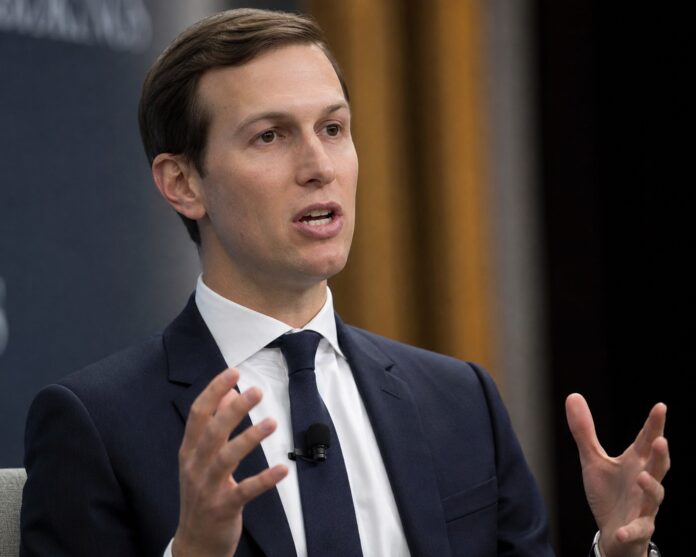
Jared Kushner marked the sixth anniversary of the Abraham Accords on Thursday with an expansive message touting the agreements’ achievements and suggesting that the Middle East may be on the verge of another potentially historic diplomatic breakthrough.
Kushner, President Donald Trump’s son-in-law and a key architect of the Abraham Accords, did not identify any specific country or disclose details of possible negotiations. But his repeated references to new “breakthrough opportunities,” an opportunity to create an “even broader movement” and the possibility of once again surprising the world immediately fueled speculation over what additional agreements could be under consideration.
“Six years ago, President Trump launched the Abraham Accords and opened a new chapter of peace, partnership, and prosperity in the Middle East,” Kushner wrote in a lengthy post on X Thursday morning.
“Many said it was impossible. But with courageous leadership, persistence, and a small group of people willing to challenge old assumptions, we proved that the impossible could be achieved.”
The Abraham Accords, brokered during Trump’s first term, dramatically altered the diplomatic landscape of the Middle East. The United Arab Emirates and Bahrain established formal relations with Israel in 2020, with Morocco subsequently normalizing relations with Israel and Sudan agreeing to move toward normalization.
In his anniversary message, Kushner argued that the agreements represented more than the establishment of diplomatic relations between Israel and several Arab countries. He portrayed them as a rejection of decades of Middle East diplomacy that he said had focused on containing conflicts instead of fundamentally changing the relationships that produced them.
“For too long, the region was trapped by old ideas and failed frameworks that managed conflict rather than solved it, and too often created incentives that perpetuated division and instability,” Kushner wrote.
He said the philosophy behind the Abraham Accords was instead to create practical relationships and mutual interests that would make peace beneficial to the countries and populations involved.
“The idea behind the Abraham Accords was simple: instead of reinforcing the things that divide people, build bonds that bring them together. Increase understanding. Expand trade and investment. Deepen security cooperation. Create tangible benefits that make people’s lives better and give everyone a stake in peace.”
Kushner pointed to the economic and diplomatic relationships that have developed since the accords were signed as evidence that the approach succeeded.
“What began as a bold vision has delivered billions in trade, joint innovation, new friendships and partnerships, and a powerful alternative to the failed approaches of the past,” he wrote.
But Kushner then shifted from looking back at the achievements of the past six years to discussing the current geopolitical landscape — and it was that portion of his message that raised the strongest possibility that additional diplomatic developments could be ahead.
“The Middle East is once again at an inflection point. There are breakthrough opportunities today that many will say are impossible,” Kushner wrote. “But we have seen what can happen when leaders reject conventional thinking, focus on common interests, and have the courage to pursue a better future.”
Kushner did not elaborate on what those “breakthrough opportunities” might entail. His use of the plural also left open the possibility that the Trump administration is looking beyond a single normalization agreement toward a broader restructuring of regional relationships.
“The Abraham Accords showed that a different path is possible,” Kushner continued. “Now we have an opportunity to build an even broader movement around cooperation, shared prosperity and security—and replace the failed ideas of the past with a new model that gives people across the region something better to believe in and build toward.”
The comments are particularly notable because of Kushner’s central role in the negotiations that produced the original Abraham Accords. Working alongside Trump administration officials during Trump’s first term, Kushner helped conduct the diplomatic effort that resulted in the normalization agreements.
Although Kushner’s post contained no explicit announcement that another country is preparing to establish relations with Israel, Saudi Arabia is certain to be at the center of speculation surrounding his remarks.
For years, normalization between Israel and Saudi Arabia has been viewed as the most consequential potential expansion of the Abraham Accords. An agreement involving Riyadh would carry significance far beyond bilateral relations because of Saudi Arabia’s political, economic and religious influence across the Arab and Muslim worlds.
Kushner, who developed close relationships with Saudi leaders during Trump’s first term, has also remained closely associated with efforts to reshape relations between Israel and the Arab world.
The prospect of Saudi normalization has repeatedly surfaced in diplomatic discussions in recent years, although negotiations have faced significant political and regional obstacles. The possibility has taken on renewed significance amid dramatic changes across the Middle East and the Trump administration’s efforts to capitalize on the new regional balance.
Kushner, however, carefully avoided naming Saudi Arabia or any other country Thursday, making it unclear whether his remarks were intended to signal a specific diplomatic initiative or to articulate a broader vision for the next phase of the Abraham Accords.
The language of his post nevertheless suggested that Kushner believes circumstances now exist for developments that could once again defy prevailing expectations.
His closing words were the clearest indication that he sees the original accords not as a completed diplomatic achievement, but as a model that could be expanded significantly.
“We surprised the world once. With the right leadership, focus, patience and courage, I believe we can do it again.”
The post offered no timetable for such a breakthrough and did not say whether negotiations with any additional countries have reached an advanced stage.
But coming from one of the principal architects of the original agreements, Kushner’s declaration that the region has reached another “inflection point” — coupled with his reference to multiple “breakthrough opportunities” — is likely to intensify attention on the Trump administration’s next moves in the Middle East and, in particular, whether the Abraham Accords may soon be poised for a major expansion.
{Matzav.com}