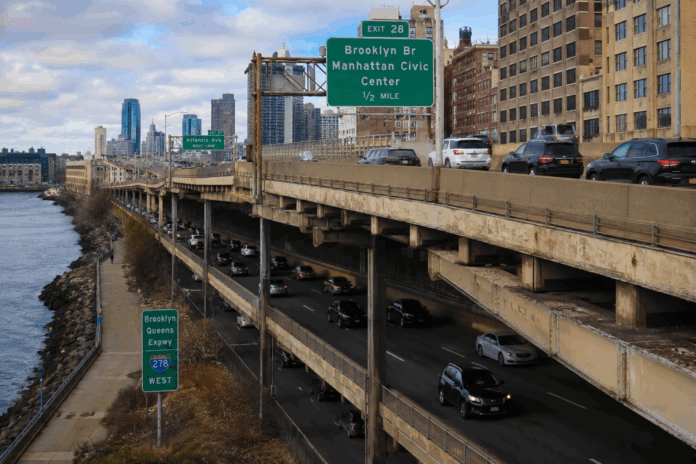
Mayor Zohran Mamdani on Monday unveiled a $4 billion proposal to rebuild the deteriorating Brooklyn-Queens Expressway, offering the latest attempt to solve a decades-old infrastructure crisis that has frustrated successive New York City administrations.
Under the plan, the badly deteriorated stacked section of the highway known as the triple-cantilever would be reconstructed rather than torn down entirely, an option that some residents and activists have advocated over the years. Construction is not expected to begin before 2030, and the entire project could take approximately a decade to complete.
To prevent tens of thousands of vehicles from being diverted onto neighborhood streets during the massive construction project, the city plans to erect a temporary highway alongside Brooklyn Bridge Park. Mamdani outlined the proposal Monday in a social-media video explaining how traffic would continue moving while the existing structure is rebuilt.
“This will extend the life of the BQE for another 40 years,” he said. “This plan allows us to safely fix the current problem, without slowing our city down and wasting decades more waiting while the BQE continues to get worse.”
The proposal follows years of unsuccessful efforts by previous City Hall administrations to determine what to do with the aging expressway.
Mayors Bill de Blasio and Eric Adams both considered various solutions for the deteriorating cantilever, which sits within a roughly 1.5-mile section of the BQE between Atlantic Avenue and Sands Street in Brooklyn that is controlled exclusively by New York City.
Those efforts repeatedly stalled. One of the most controversial came in 2018, when the de Blasio administration proposed temporarily routing highway traffic over the Brooklyn Heights Promenade while the BQE was repaired.
The prospect of losing access to the popular promenade for approximately six years triggered fierce opposition from Brooklyn Heights residents. The backlash helped derail the proposal, and de Blasio eventually retreated from it, announcing a different approach three years later centered on preserving the existing highway structure.
The Adams administration later sought federal assistance for a more comprehensive long-term reconstruction of the BQE but failed to secure the involvement it wanted.
At the same time, officials under Adams performed significant planning work that ultimately helped pave the way for the proposal Mamdani announced Monday, according to Councilwoman Joann Ariola (R-Queens), who accused the current administration of claiming credit for work begun before Mamdani took office.
“This is becoming standard operating procedure for this administration … The mayor and his team are taking all the credit for a project that started well before he was in office,” she said.
“It is insulting to everyone who worked on this before, but his propaganda machine is doing a great job of convincing the masses that Zohran Mamdani single-handedly is going to get the BQE repaired and save New York City.”
Whatever administration gets the credit, a major difference between Mamdani’s proposal and previous plans involves where motorists would be routed while the reconstruction is underway.
Instead of sending traffic across the Brooklyn Heights Promenade, the city would construct a temporary two-level highway over Furman Street, stretching from Atlantic Avenue to Columbia Heights and allowing vehicles to continue traveling beneath the promenade.
City officials said the temporary bypass would rise to approximately the same height as the existing Queens-bound portion of the expressway.
Plans also call for another temporary elevated highway beginning at Columbia Heights and extending above the Brooklyn Bridge approach toward the Manhattan Bridge, providing an additional route for traffic while crews work on the permanent highway.
The BQE, conceived under influential and controversial New York City planner Robert Moses, opened in 1957 and has since become one of the city’s most heavily traveled transportation arteries.
Speaking at an unrelated press conference in Queens on Monday, Mamdani said delaying a permanent solution carries an enormous financial cost. He estimated that maintaining the deteriorating BQE costs New York City approximately $160 million each year that the highway remains unrepaired.
“The plan does require a bypass, a four-lane bypass, at the level just below the promenade,” he said.
Mamdani argued that placing the temporary roadway below the promenade would avoid much of the disruption that doomed previous proposals while still allowing the massive reconstruction project to proceed.
“Previous proposals had put that bypass on the promenade, which would have been quite disruptive. We feel this proposal does lessen the community impacts of prior proposals.”
{Matzav.com}