

Dear Matzav Inbox,
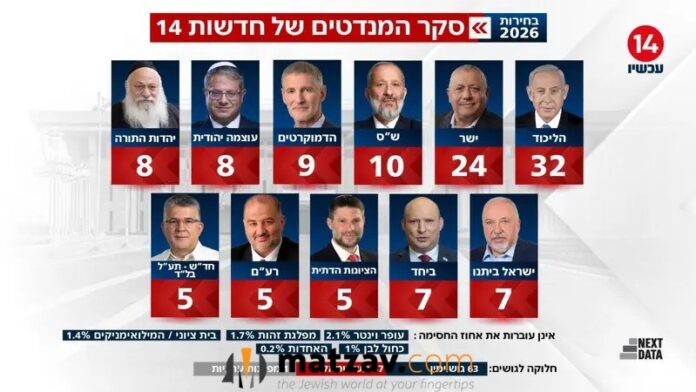
I saw a recent poll on Matzav with a line that I suspect most people simply read and moved past: “United Torah Judaism would receive eight seats.”
Am I the only one who sees that number and wonders how in the world that is possible?
I learned in Eretz Yisroel in 1988. That was nearly 40 years ago. In that year’s election, Agudas Yisrael received five seats and the newly formed Degel HaTorah received two. Between them, the Ashkenazic Chareidi parties had seven seats in the Knesset.
Now fast-forward almost four decades.
Look around.
How many Chareidi families existed then compared to today? How many children did those families have? And how many grandchildren? How many new neighborhoods have been built? How many new yeshivos, chadorim, Bais Yaakovs, kollelim and shuls have opened? How much has the Chareidi population of Yerushalayim, Bnei Brak, Beit Shemesh and other cities grown? Entire Chareidi communities have sprung up in places that barely registered on the map of Chareidi life in 1988.
And after all of that, we are talking about a projection of eight seats?
Eight?
Something is very wrong with this picture.
Are we supposed to believe that the Chareidi population has barely grown relative to the rest of the country over the past 38 years? That secular Israelis have somehow been having children and grandchildren at the same pace as Chareidi families?
Obviously not.
Anyone with eyes can see what has happened demographically.
So where are the votes?
That is the question I would like someone in Chareidi political leadership to answer.
Forget for a moment all the endless internal political discussions. Who gets which seat? Does Gur get this position? Does Belz get that one? Who represents Degel? Who represents Agudah? Which chassidus gets number five, and which faction gets number six?
Maybe before fighting over who gets seat number seven or eight, somebody should be asking why there isn’t a seat number nine, ten, eleven or twelve.
Where did everybody go?
How is it possible that a community blessed with extraordinary population growth over nearly four decades has barely translated that growth into additional political representation?
Perhaps there are explanations. Maybe a significant portion of the Chareidi population does not vote. Maybe too many people have become disillusioned with the parties. Maybe thousands upon thousands of Chareidi voters are casting ballots for Likud, Otzma Yehudit or other parties. Maybe the political leadership has failed to inspire younger voters to feel that casting a ballot for a Chareidi party matters. Maybe there are demographic or electoral factors that make the comparison more complicated than it appears.
Fine. Then tell us.
Because “eight seats” should not simply be another number at the bottom of an election poll.
It should set off alarm bells.
If a business had experienced explosive growth in its customer base for 40 years but its market share remained essentially unchanged, the owners would not pat themselves on the back. They would call an emergency meeting and demand to know what had gone wrong.
Why should politics be any different?
And there is another part of this that bothers me.
We constantly hear before elections how crucial every vote is. We are told that voting is an obligation, that enormous issues affecting the Olam HaTorah are at stake, and that Chareidi political strength depends upon every eligible voter going to the polls.
I don’t disagree.
But if that is true, then the leadership should be just as concerned about the other side of the equation: Why, after decades of breathtaking Chareidi population growth, has the political strength of the Ashkenazic Chareidi parties grown so little?
This isn’t about criticizing one politician or one faction. It isn’t about Gur versus Belz, Agudah versus Degel, or one chassidus versus another.
It is about simple arithmetic.
Nearly 40 years.
Families that had five children then now have dozens of grandchildren and great-grandchildren.
Neighborhoods became cities. Mosdos multiplied. The Olam HaTorah grew beyond anything people could have imagined in 1988.
Seven seats became…
Eight?
Someone needs to explain that.
Because if the Chareidi population has grown dramatically while its representation has barely moved, then either an enormous number of votes are going somewhere else—or an enormous number of votes aren’t being cast at all.
Either way, that should concern every person who cares about the political strength and future of the Chareidi community.
Instead of only asking who will occupy the eighth seat, perhaps it is time for Chareidi leadership to ask a much more uncomfortable question:
After nearly 40 years of unprecedented growth, why are we still talking about only eight?
T. Broide
Ramat Beit Shemesh
To submit a letter to appear on Matzav.com, email [email protected]
DON’T MISS OUT! Join the Matzav Status by CLICKING HERE. Join the Matzav WhatsApp Groups by CLICKING HERE.
The opinions expressed in letters on Matzav.com do not necessarily reflect the stance of the Matzav Media Network.




Shas didn’t exsist yet. They get some. The Peleg doesn’t vote you get som more. Gur & visnitz split. Only one faction has representation, that causes ill feelings. No bechiros pnimios, so small vhasidusen get nothing gur takes it all. Infact if they Gur they may get more seats.IMHO. then especially with what is going on now, many feel they are not being represented the number one should have been a chok giyus.