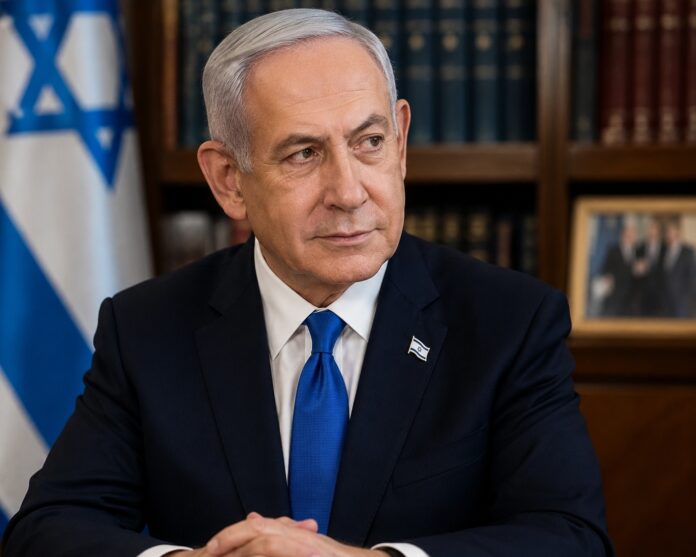
Israeli Prime Minister Bibi Netanyahu said today that Israel has already completed “80-90%” of the work necessary to eliminate the threat posed by Iran’s nuclear program, but warned that the campaign is not over and that Israel remains prepared to carry out additional military operations inside Iran.
Speaking in an interview with i24NEWS, Netanyahu portrayed the confrontation with Tehran as the culmination of Israel’s broader campaign against Iran and its network of proxies across the Middle East. He said Iran’s nuclear ambitions had posed an existential danger to Israel and that Israeli action had dramatically reduced that threat.
“We have done 80-90% of the work. We need to complete what remains,” Netanyahu said.
The prime minister said Israel retains the operational capability to return to Iranian territory if necessary, pointing to previous Israeli operations as evidence that the IDF can reach targets deep inside Iran.
Netanyahu said Israeli pilots “were there and can be there at any moment,” making clear that Israel considers additional strikes an option if Tehran attempts to rebuild capabilities that Israel has targeted.
His comments came as concerns remain over the status of Iran’s nuclear program following extensive Israeli and American strikes against Iranian nuclear facilities. The International Atomic Energy Agency has said it still lacks access to key bombed sites and information about Iran’s stockpile of uranium enriched to 60%, a level approaching weapons grade. Before the attacks, the IAEA estimated Iran possessed 440.9 kilograms of uranium enriched to that level.
Netanyahu said Israel’s strategy was deliberately designed to first weaken the forces surrounding the Jewish state before confronting Iran itself. He described Tehran as “the head of the octopus,” with its regional proxies serving as the tentacles Israel sought to sever before turning directly toward the Iranian regime.
In related remarks reported from the interview, Netanyahu said, “My intention was that ultimately we would confront Iran, the head of the octopus, and cut off its tentacles.”
The prime minister pointed to Israel’s military campaigns against Hamas in Gaza, Hezbollah in Lebanon and Iranian-linked forces elsewhere in the region as parts of that broader strategy. He maintained that weakening those groups helped create the conditions for Israel to confront Iran more directly.
Netanyahu has also made clear in recent days that Israel’s objectives extend beyond Iran’s nuclear infrastructure. In an earlier portion of his i24NEWS interview, he said Israeli agencies were working toward the collapse of the Iranian regime itself.
“We will defeat this regime. It will fall, we will bring it down. It is already standing on very shaky legs,” Netanyahu said.
Asked whether Mossad Director Roman Gofman was involved in efforts aimed at bringing down the Iranian government, Netanyahu replied, “All of our systems, under my direction, are working to bring down this regime and defeat it.”
The comments come amid renewed fighting between Iran and the United States and continued uncertainty over Tehran’s nuclear activities. The U.S., Britain, France and Germany are currently seeking an IAEA resolution that would report Iran to the U.N. Security Council over what they say is Tehran’s failure to meet its nuclear safeguards obligations and provide inspectors with required access and information.
Netanyahu indicated that Israel is closely watching for Iranian efforts to restore both its nuclear capabilities and the regional proxy network damaged during the fighting. He said Israel intends to act again if necessary rather than allow those capabilities to be rebuilt.
While Netanyahu’s assessment that Israel has completed as much as 90% of the campaign suggests that he believes the bulk of the immediate nuclear threat has been addressed, his comments also underscored that Yerushalayim does not regard the Iran campaign as finished.
{Matzav.com}