Israeli Prime Minister Binyomin Netanyahu has voiced strong support for President Donald Trump’s escalating economic campaign against Iran, while making clear that he remains deeply doubtful that Tehran’s current rulers are capable of reaching a meaningful diplomatic agreement.
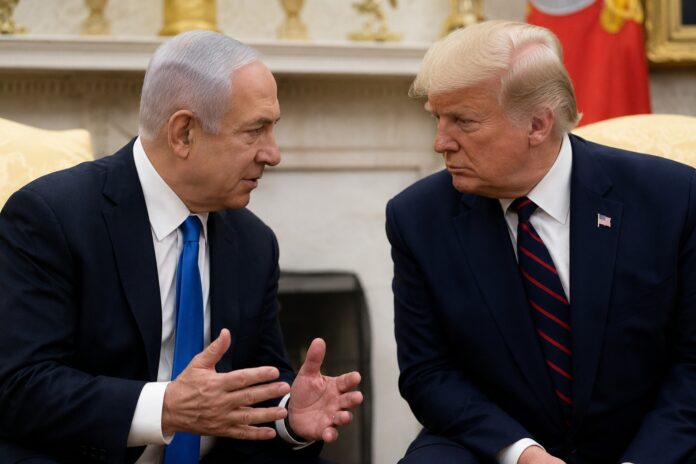
Netanyahu said the issue was discussed when he met with Trump at the White House on July 28, with the two leaders weighing the possible paths forward in confronting Iran. According to Netanyahu, he told the president during their conversation that he had little confidence that negotiations with the Iranian leadership could succeed.
Speaking at an event in Yerushalayim, Netanyahu recalled expressing that skepticism directly to Trump.
“I doubt, however, that an agreement can be reached with that group there, with those savages,” Netanyahu said.
“I tell you — an agreement cannot be reached,” he added.
Netanyahu made the comments at a gathering for Israeli residents of Yehudah and Shomron. His remarks were reported by AFP and were also independently reported by CBS News, Arab News and the Times of Israel.
According to Netanyahu, his White House discussion with Trump centered on three possible strategies for dealing with Tehran: attempting to negotiate an agreement, returning to military action, or dramatically increasing the economic pressure on the Iranian regime.
Netanyahu said he favored the economic option and applauded Trump for choosing to ratchet up the financial pressure on Tehran rather than immediately embarking on another large-scale military operation.
The prime minister said he had encouraged Trump to “tighten the siege” on Iran and praised the president for implementing that approach “in a very, very, very strong way,” according to the Times of Israel, which reviewed footage of Netanyahu’s comments.
Trump on Monday unveiled what he described as an “economic D-Day” targeting Iran, broadening the administration’s pressure campaign beyond Tehran itself to include foreign businesses and other entities that provide economic support to the Islamic Republic.
Netanyahu said the significance of Trump’s strategy lies in its focus on those helping keep the Iranian regime afloat, rather than restricting American pressure solely to Iran itself.
“Trump decided to tighten the siege on those who assist this regime, this terrible dictatorship,” Netanyahu said, according to AFP.
Netanyahu’s remarks amounted to a forceful endorsement of the Trump administration’s new economic offensive, even as Trump continues to keep diplomacy on the table as a possible path forward.
Trump has repeatedly indicated that he would prefer to resolve the confrontation with Iran through an agreement, while simultaneously warning that additional US military action remains possible if Tehran refuses to accept Washington’s demands.
Iran, for its part, has dismissed the administration’s intensified economic campaign.
Iranian President Masoud Pezeshkian said Wednesday that Washington would achieve nothing through its sanctions offensive, according to AFP reports cited by several news organizations.
Netanyahu has for years been a fierce critic of diplomatic arrangements that, in his view, would allow Iran to retain the ability to eventually restore its nuclear program or rebuild its military capabilities.
His latest comments come as the Trump administration attempts to use severe economic pressure to compel Tehran to make concessions, while stopping short, at least for now, of immediately resuming a broad military campaign.
The standoff also continues to center heavily on the Strait of Hormuz, where the conflict has caused major disruptions to commercial shipping.
Netanyahu’s remarks indicate that he currently views an intensified economic squeeze as the preferable strategy, even as he remains highly doubtful that Iran’s leadership can ultimately be brought into a durable diplomatic accord.
At the same time, Netanyahu’s description of his July 28 meeting with Trump shows that a negotiated solution was among the possibilities the two leaders considered, despite Netanyahu’s warning to the president that he does not believe the Iranian leadership can be trusted to make such an agreement.
{Matzav.com}