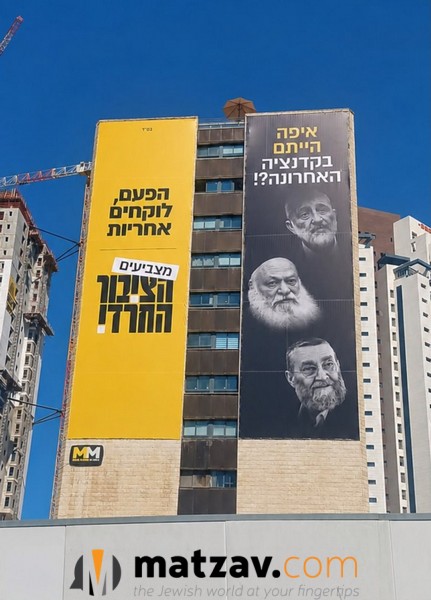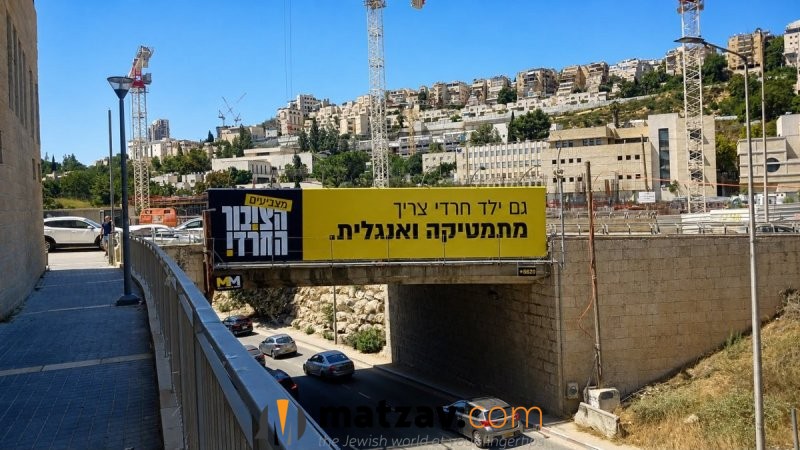
The newly formed HaTzibur HaChareidi party has launched a major election campaign across Chareidi cities and communities, days after announcing that it will run independently in the elections for Israel’s 26th Knesset.
The campaign, which carries the slogan “Where were you during the last Knesset term?” focuses on several issues that party leaders say have been inadequately addressed by the established Chareidi political parties, including the draft crisis and protection of the olam haTorah, mathematics and English education in Talmudei Torah, and employment.
Among the slogans being promoted by the party are: “Protect the olam haTorah — whoever is not learning should serve,” and “A Chareidi child also needs mathematics and English.”
HaTzibur HaChareidi officially announced its Knesset bid on Sunday during a launch event in Beit Shemesh. The party is seeking to establish itself as an alternative voice within Chareidi politics and is now bringing its message directly to voters in Chareidi population centers.
Party chairman Motti Leitner used the launch event to deliver sharp criticism of the existing Chareidi political leadership, arguing that decisions made in recent years have harmed the community and worsened its relationship with other sectors of Israeli society.
“The Chareidi community is facing an existential threat,” Leitner declared.
On the highly contentious issue of the military draft, Leitner said the party favors complete protection for those genuinely engaged in Torah learning, while calling for those who are not learning to serve.
“Whoever is learning will receive absolute and complete protection. Whoever is not learning — will serve,” he said.
The position represents an effort by the fledgling party to distinguish itself from the established Chareidi factions at a time when the draft crisis and the status of bnei yeshivos remain among the most explosive issues facing the community.
The party is also placing education prominently on its agenda, including its call for Chareidi children to receive instruction in mathematics and English. Its campaign materials specifically highlight the issue as part of a broader platform dealing with education, employment and poverty.
In the coming weeks, HaTzibur HaChareidi intends to expand its campaign around those issues and unveil a more detailed platform and policy proposals.
For now, party officials are seeking to inject themselves into the Chareidi political conversation and persuade voters dissatisfied with the established parties that there is room for a new alternative ahead of the elections for the 26th Knesset.