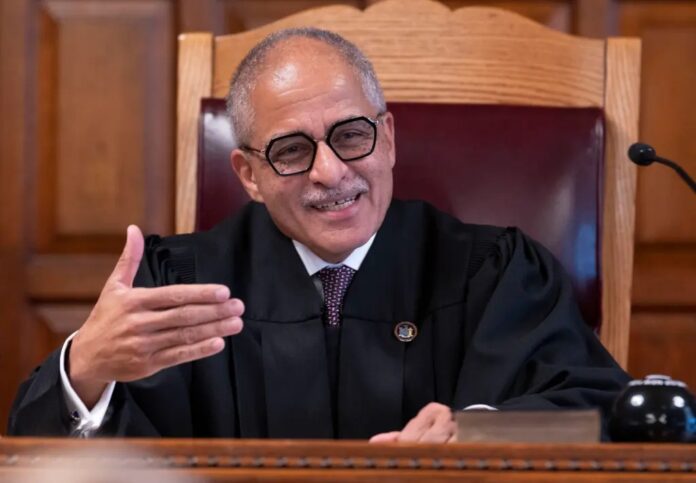
New York’s top judge has acknowledged that he crossed a line when he encouraged voters to remove judges who impose lengthy prison sentences, telling the state’s judicial watchdog that he should have chosen his words more carefully.
Chief Judge Rowan Wilson addressed the controversy while responding to an ethics complaint filed by Republican state lawmakers over remarks he made earlier this year at a CUNY Law School forum. During the event, Wilson criticized judges who hand down what he characterized as “stupid” long sentences and told attendees that voting such judges out of office was “something you can do for me.”
The New York State Commission on Judicial Conduct ultimately dismissed the complaint, but Wilson conceded in his response that his comments had been poorly framed.
“I wish I had been clearer,” Wilson wrote to the state Commission on Judicial Conduct, according to the commission’s dismissal letter.
Wilson explained that his remarks came after he heard about an unidentified judge who allegedly referred to a defendant as an “animal” and said the person should be “locked up” for the rest of his life before imposing sentence.
According to Wilson, his reaction was driven by his “extreme disgust of the comparison of human beings to caged animals.”
Wilson said that rather than personally encouraging the audience to vote against particular types of judges, he should have discussed more generally the authority voters possess to make those decisions.
“I should have said that the voters have that ability and should become informed and express their preferences through the electoral process,” Wilson wrote.
The controversy raised questions because judges are subject to stringent ethical restrictions concerning political activity and public political statements. Wilson’s comments about voting judges out of office formed part of the basis for the Republican lawmakers’ March complaint.
The Commission on Judicial Conduct, however, found no ethical problem with separate comments Wilson made at the same event advocating passage of the Second Look Act. The proposed legislation would allow certain convicted felons to seek a new sentencing hearing after serving 10 years.
“It is permissible for a Chief Judge, as leader of the Unified Court System, not only to advocate for but also to propose legislation concerning the law, the legal system and the administration of justice,” the CJC wrote.
Wilson has served as chief judge of the New York Court of Appeals, the state’s highest court, since 2022. His office did not respond Wednesday to a request for additional comment.
Republican lawmakers who brought the complaint said they welcomed Wilson’s acknowledgment, even though the judicial commission declined to impose discipline.
State Sen. Anthony Palumbo (R-Suffolk), a former prosecutor who serves as the ranking Republican on the Senate Judiciary Committee, said the episode should serve as a warning about the importance of the chief judge’s public statements.
“I’m glad to see that Judge Wilson’s conduct was addressed, and that he will choose his words more carefully in the future. It’s unfortunate that those comments were made in the first place,” Palumbo said.
Assemblyman Michael Tannousis (R-Staten Island), another lawmaker behind the complaint, maintained that Wilson’s original remarks were improper.
“The Chief Judge’s comments were wholly inappropriate, seeking to galvanize opposition against judges with whom he does not agree,” Tannousis wrote in a statement.
Tannousis also questioned whether Wilson received more lenient treatment from the commission than another judge expressing different views might have received.
“Although I appreciate the Commission’s investigation into the matter, I question whether a deferential standard was applied here that would not have been applied to judges with an alternative point of view,” he said.
The dispute is not Wilson’s first high-profile controversy stemming from his judicial philosophy. Before becoming chief judge, Wilson drew attention for a dissent in the closely watched legal battle involving Happy, an elephant housed at the Bronx Zoo.
An animal-rights organization sought to use habeas corpus — a legal mechanism traditionally employed to challenge unlawful human detention — to obtain Happy’s release. Wilson sided with the group in dissent when New York’s highest court rejected the effort.
“We should recognize Happy’s right to petition for her liberty not just because she is a wild animal who is not meant to be caged and displayed, but because the rights we confer on others define who we are as a society,” he wrote at the time.
Since taking over New York’s judiciary, Wilson has participated in several major and politically charged cases. Among the most prominent was the Court of Appeals’ 2024 decision overturning Harvey Weinstein’s Manhattan sex-crimes conviction, with the court concluding that the trial judge had improperly allowed testimony concerning allegations that were not part of the charges being tried.