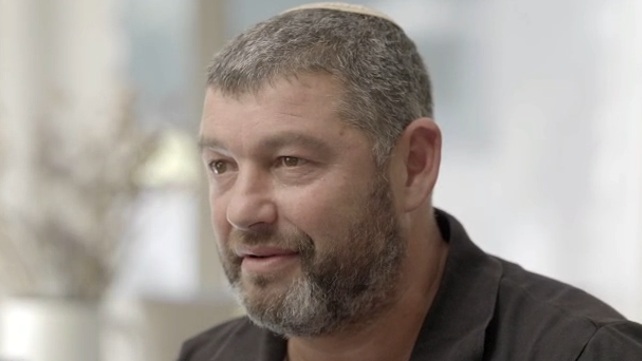
Ofer Winter, chairman of the newly established Amcha Yisrael party, unveiled a three-part proposal for bringing Chareidim into the IDF, arguing that Israel does not need a separate Chareidi draft law and instead should create a system tying state benefits to an individual’s formal status with the government.
Winter, a former senior IDF commander, outlined the proposal during an interview with Channel 12 on Thursday evening, one week after launching his new political party. In addition to the Chareidi draft controversy, Winter addressed the war in Gaza, his relationship with Prime Minister Benjamin Netanyahu, military discipline and refusal of orders, and calls from within the right-wing camp for him to abandon his political run.
Winter made clear at the outset that he has no intention of bowing to pressure to drop out of the race.
“I have truly experienced many combat situations. I am not in a hurry, and I do not give in so quickly. I understand that we are moving the cheese for a lot of people. The main consideration for me and for those who will join me here is how we bring something different to the Jewish people, how we bring hope to the Jewish people, and how we change things. Anyone who thinks that what was can remain exactly the same after three years of war, after the greatest failure that has happened to the Jewish people since the establishment of the state, in my view does not understand reality.”
At the center of Winter’s agenda is the deeply contentious question of Chareidi participation in the IDF. He said he has developed a comprehensive proposal built around three separate elements: legislation, changes within the IDF itself, and a new framework involving the Defense Ministry and Chareidi yeshivos.
“I want to explain what I said. I have a plan. We will present the plan in full, but I want to tell you its principles. The plan is built on three components. One component is legislation. I did not say a draft law. There is a draft law for everyone — there is no need for a draft law.”
Under the legislative portion of his proposal, Winter would establish a direct connection between an Israeli citizen’s status with the state and his eligibility to receive government benefits. At age 18, an individual would be required to formally resolve his status; those who do so would remain eligible for state benefits, while those who fail to do so would lose them. The system would also provide greater benefits to those who serve, with additional consideration for longer periods of service.
“The law solves several problems simultaneously. The law creates compensation for those who served and those who serve more. The idea of the law is this — you are a person in your country who has reached the age of 18. You arrange your status with the State of Israel, you receive rights from the state. You did not arrange your status, you do not receive rights from the state.”
The second component of Winter’s proposal would place responsibility on the IDF itself. He accused the military establishment of failing over many years to make the changes necessary to accommodate Chareidi soldiers, pointing to initiatives he undertook during his own military career.
“For 10 years in the army and two years outside the army, I have been working in the same direction. To do everything I can to integrate the Chareidi public into the IDF. When I was a brigade commander, I established a Chareidi company in Givati. When I was chief of staff, I established another Chareidi company in the Paratroopers. My plan was to establish companies throughout the army.”
Winter’s third component would involve the Defense Ministry and the Chareidi yeshiva world. Under his proposal, Chareidi yeshivos would formally arrange their status with the Defense Ministry and receive government funding through a framework he compared to arrangements currently used in the Religious Zionist community.
“The IDF is an essential component. It was also part of the problem for years. Under chiefs of staff who spoke one way publicly and felt differently privately, and did not do much to integrate the Chareidi public into the IDF. The final element is the Defense Ministry component. The Chareidi yeshivos will come and arrange their status with the Defense Ministry, exactly as happens in Religious Zionism, and they will receive funding. If you cheated the state, you will not receive funding.”
Winter stressed that his interest in the Chareidi draft issue did not begin with his entry into politics, saying that he has been involved in efforts to create frameworks for Chareidi military service for years.
Turning to the political pressure surrounding his new party, Winter insisted that Amcha Yisrael would operate independently and would not serve the interests of Netanyahu or any other political figure.
“I do not — neither I nor those with me — work for any person. We want to lead a change in the security outlook of the State of Israel and genuine integration of the Chareidi public into the IDF, to take care of those who serve and their family members — things that have not happened and are not happening for three years.”
Winter described himself as firmly on the political right and said he views Netanyahu as the leader of the right-wing camp. At the same time, he said he would prefer to see as broad a government as possible, including politicians who identify with the right but are currently outside Netanyahu’s coalition.
“We would be happy for the government to be as broad as possible, and for everyone who defines himself as right-wing to come back home. By the way, perhaps that way, this government will not rely on a majority of Goldknopf and Gafni, and finally it will be possible not to continue with the deadlock in which we find ourselves.”
Winter also laid out his position on the Gaza war, arguing that Hamas deliberately designed its strategy around fighting Israel from densely populated urban areas and exploiting humanitarian considerations to restrict the IDF’s freedom of action.
He said his preferred strategy would have been to move Gaza’s civilian population southward, separate civilians from Hamas terrorists and impose a siege over approximately two-thirds of the Gaza Strip. That, he argued, would have allowed the IDF to employ its military superiority more effectively rather than fighting according to the battlefield conditions Hamas had prepared.
“Therefore, I proposed, very simply, not to operate in the way Hamas planned to drag us into war, but to do the opposite to it, to push the entire population southward, to separate the population from Hamas, and to impose a siege on two-thirds of the Strip. That is how I thought it would be possible to bring the full power of the IDF to bear. In the end they would have surrendered; they did not plan, and they did not have enough energy for months.”
Winter went further in describing what he believes Israel’s long-term policy toward Gaza should be, saying the emphasis should shift away from rebuilding the enclave.
“I believe that Gaza must move from reconstruction mode to emigration mode. We are the ones rebuilding Gaza and giving them hope?”
Despite his criticism of the IDF leadership over its handling of Chareidi enlistment and the Gaza war, Winter took an unequivocal position against soldiers refusing military orders. He said the IDF’s effectiveness ultimately depends upon maintaining discipline throughout the ranks.
“My position throughout all my years as an IDF commander is that you do not refuse an order. That is how I acted during the expulsion from Gush Katif, when my family was evacuated from there. I said, ‘We will not refuse an order.’ That is what I said during every ceremony and episode of refusal. There are things you do not do; the strength of the IDF is discipline.”
Asked how he would handle soldiers who refused orders, Winter said disciplinary action should come first, followed by an examination of the circumstances that led to the incident. He added that military commanders should also exercise common sense and avoid unnecessarily creating conflicts, particularly as Israel seeks to encourage more Chareidim to serve.
“I would punish them for refusing an order, and afterward I would conduct an inquiry. A lot of things are a matter of common sense. We need to remember — we want male soldiers to be in the IDF and female soldiers to be in the IDF, and there is no need to forcibly stick a finger in someone’s eye, especially when we want to integrate Chareidim.”
Winter also weighed in on the continuing debate over what type of commission should investigate the failures surrounding the war. Rather than adopting either the conventional state commission of inquiry model or the alternative national commission proposed by some political figures, he suggested allowing the Knesset to select the commission’s leadership by secret ballot.
“I think there will not be a state commission of inquiry here and there will not be a national commission of inquiry. We will choose the head of the commission of inquiry and his deputy using the method by which the president of the State of Israel is chosen — in a secret ballot in the Knesset.”
Winter framed his new political movement as an attempt to overhaul several areas at once: Israel’s security doctrine, government treatment of soldiers and their families, the integration of Chareidim into the military, and the country’s long-term policy toward Gaza.
He concluded by predicting that the upcoming election will produce a significant protest vote from Israelis dissatisfied with the country’s political and security leadership following three years of war.
“I will say one more thing. I think that on October 27 there will be a protest vote here. Anyone who does not see that is trapped in the conception.”