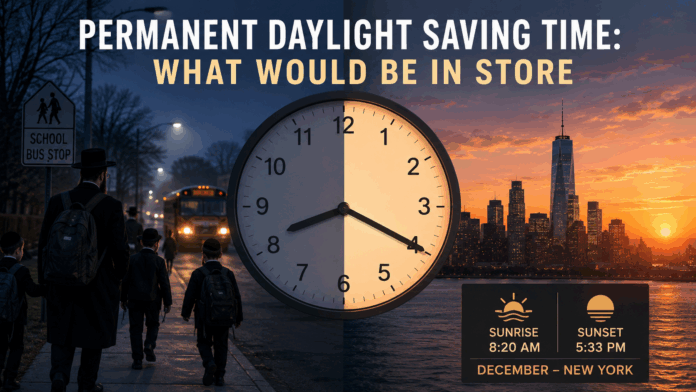
Americans could see dramatically later sunsets during the darkest months of the year if Congress approves permanent daylight saving time, but the extra evening daylight would come with a major trade-off: In many parts of the country, the sun would not rise until well after 8 a.m., and in some locations, darkness could linger past 9 a.m.
With the annual return to standard time approaching — and arriving as early on the calendar as possible this year — President Trump is continuing to press the Senate to approve legislation that would eliminate the twice-yearly clock change and establish daylight saving time throughout the year.
Such a change would noticeably alter winter mornings and evenings across much of the United States.
The Sunshine Protection Act would keep participating states on daylight saving time year-round. Hawaii and most of Arizona, which currently remain on standard time throughout the year, would continue to be exempt.
For most of the rest of the country, both sunrise and sunset would occur an hour later by the clock during the period between early November and March, when standard time is currently observed.
That would mean some particularly dark winter mornings. Large portions of the country would experience at least some days when sunrise does not occur until after 8 a.m., while certain areas would remain dark until after 9 a.m.
The benefit would come at the opposite end of the day, with Americans gaining an additional hour of evening daylight.
Many communities currently experience winter sunsets during the 4 p.m. or 5 p.m. hours. Without the November switch back to standard time, a 4:30 p.m. sunset would instead occur at 5:30 p.m., while a sunset shortly after 5 p.m. would move to shortly after 6 p.m.
Some locations could even experience winter sunsets after 7 p.m., something that does not occur under the current clock system.
Juneau, Alaska, for example, currently experiences 40 winter sunsets during the 3 p.m. hour. Under permanent daylight saving time, all of those sunsets would instead occur during the 4 p.m. hour.
Communities accustomed to months of particularly early darkness would experience an especially noticeable change. Green Bay, Wisconsin, and Burlington, Vermont, each currently have more than 90 winter days with sunsets before 5 p.m. Permanent daylight saving time would push those sunsets into the 5 p.m. hour.
Other cities would experience surprisingly late sunsets as winter nears its end. Juneau, Indianapolis, and Louisville, Kentucky, would see some of the latest, with sunsets occurring after 7:40 p.m. in early March.
But those same cities illustrate the central drawback of keeping daylight saving time permanently: extremely late winter sunrises.
Juneau’s latest winter sunrise would not occur until after 11 a.m. Indianapolis and Louisville would experience periods when the sun rises at or after 9 a.m., while Grand Rapids, Michigan, would have one of the latest winter sunrise times in the continental United States, at approximately 9:14 a.m.
Those dark mornings have helped derail previous attempts to establish permanent daylight saving time. Critics have also raised concerns about possible health effects, difficulties for religious observance, and complications for airline schedules, particularly during the transition to a new permanent system.
The debate has now returned to Congress. The House has already approved the Sunshine Protection Act of 2026, but the Senate remains in recess until September. It remains uncertain whether senators will bring the measure to the floor — or whether supporters have enough votes to send it to President Trump for his signature.
Lawmakers are considering several other approaches as well. Two House bills would allow individual states to choose permanent daylight saving time, while another proposal would establish a permanent half-hour shift between standard and daylight saving time.
Yet another bill takes the opposite approach, proposing to end seasonal clock changes by making standard time permanent, subject to certain exceptions.