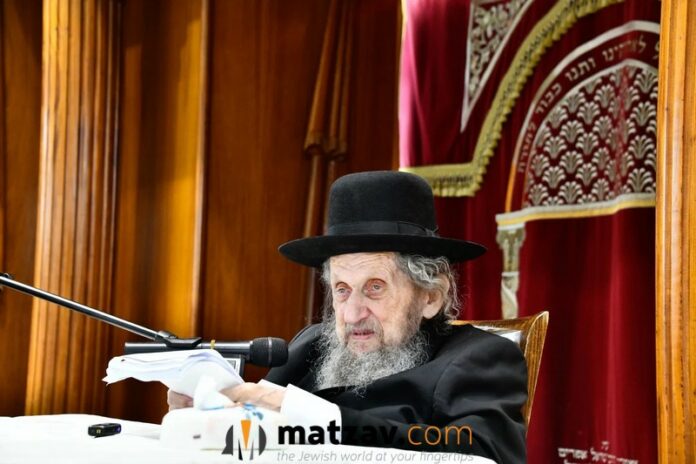
Rav Dov Landau, rosh yeshivas Slabodka, delivered a special shiur today at Yeshivas Zichron Yaakov, followed by words of chizuk to the bnei hayeshiva ahead of the Yomim Noraim, urging them to immerse themselves completely in Torah learning and emphasizing the importance of pursuing truth even when doing so requires admitting that one was wrong.
In his remarks, the rosh yeshiva focused on the obligation to approach Torah with genuine hasmadah and total absorption in learning. He stressed that this responsibility takes on particular significance during the difficult period currently facing those living in Eretz Yisroel.
“We need to learn, to be occupied with learning, to be immersed in learning — not to learn superficially, but to learn with immersion and diligence,” Rav Landau told the bochurim. “And with this difficult situation that we have here in Eretz Yisroel, certainly what we are obligated to do — with this and without this, it makes no difference — is to be immersed in learning, absorbed in learning. To get up in the morning — perhaps one cannot think in Torah learning; that is forbidden before Birchos HaTorah.”
Rav Landau went on to draw a distinction between genuine toil in understanding a sugya and merely searching for interesting insights or appealing vortlach.
“A good question, a good sevara of Rabbi Akiva Eiger — to be immersed in learning, not to search. Vortlach are a very beautiful thing, but that is not learning,” he said.
The rosh yeshiva emphasized that true Torah learning requires iyun, effort and a determined search to understand a sugya in its full depth, rather than being satisfied with attractive ideas and novel observations.
Rav Landau then spoke about the obligation to search for the truth in Torah, citing the Chazon Ish’s comments regarding the Kesef Mishneh.
“Hashem should help us that we should be able to learn, to search, as the Chazon Ish writes in the margin regarding the Kesef Mishneh: The Kesef Mishneh knew that there is truth in Torah, and he sought that truth — to seek the truth as much as we are able and capable of understanding, knowing and searching,” Rav Landau said.
He added that a genuine commitment to truth also requires a person to be willing to recognize when someone else has understood something correctly while he himself has not.
Rav Landau concluded with a pointed message about the importance of being able to acknowledge a mistake, explaining that being wrong is not a catastrophe; refusing to admit it is.
“Hashem should help us that we search for the truth. Included in that is that we acknowledge the one who says it. We did not merit to know, and the other person merited to know. It’s not terrible that the other person merited — it’s not a tragedy, nothing happened. If we made a mistake, no tragedy occurred. The tragedy is when we do not admit a mistake. Hashem should help us that we learn properly, that we are immersed in learning, absorbed in learning. And I wish everyone all the best, a kesivah vachasimah tovah, all the best.”