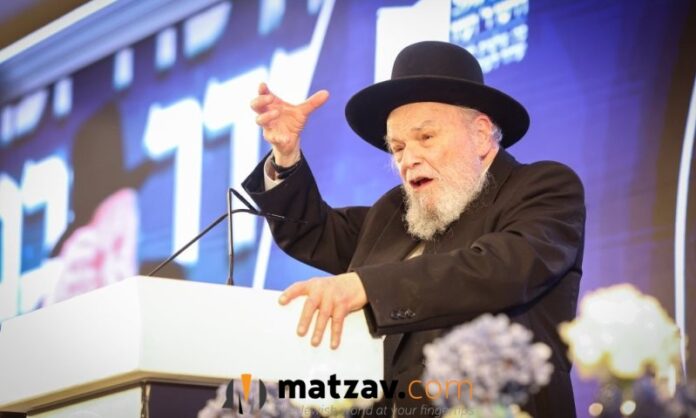
As the Elul zeman approaches, Slabodka Rosh Yeshivah Rav Moshe Hillel Hirsch delivered a stirring address to tens of thousands of bnei yeshivah gathered in Beit Shemesh for the siyum of the “V’Talmudo B’Yado” program organized by the Ichud Bnei Yeshivos. Calling on bnei Torah to prepare for Elul and Rosh Hashanah with renewed commitment, Rav Hirsch urged them to break free from mediocrity by accepting a concrete and demanding commitment to limud haTorah.
At the beginning of his remarks, the Rosh Yeshivah reflected on the decrees and hardships that the Olam HaTorah has endured over the past year. He said that as the Yom HaDin approaches, every individual must ask himself what genuine change he can make in order to merit a better year.
“We are just days away from Elul. We are returning to the yeshivos and approaching Rosh Hashanah,” he said. “We remember last Rosh Hashanah, and looking back we now understand what was written then. All of the decrees against us, all of the hardships, and all of the hatred directed against us—all of it was decreed by Hashem.”
The Rosh Yeshivah stressed that ordinary resolutions will not be enough given the current circumstances.
“We are approaching another Rosh Hashanah, when our fate will once again be written, and we must think about what we can do to change it. Certainly, if we want things to change, it requires something drastic. General chizuk alone is not enough. If there is not something drastic, there will be no change.”
Rav Hirsch then cited the Sforno on the posuk, “Re’eh Anochi Nosein Lifneichem Hayom Berachah U’Kelalah,” explaining that a person must avoid living an average, mediocre life and instead choose the path that leads to blessing and success.
“We must learn from this not to be mediocre,” Rav Moshe Hillel said. “We need to strive for outstanding success. That is what is demanded of us—to leave mediocrity behind and rise to higher levels.”
Continuing, he quoted the teachings of Rav Yisroel Salanter, explaining that true avodas Hashem cannot be limited to actions that come naturally through habit and routine.
“A person was created to toil, to wage the battle of serving Hashem, and is obligated to work hard in avodas Hashem. It is not enough merely to preserve what his natural tendencies already allow him to do on their own.”
The Rosh Yeshivah observed that many people—including bochurim—simply continue along the path of habit while neglecting areas that require genuine effort.
“They attended cheder, then yeshivah ketanah, then yeshivah gedolah, and later kollel, simply following their natural course. But whatever demands extra effort is often neglected. Rav Yisroel says that in such a case, a person is not serving Hashem at all—it is merely his nature carrying him along.”
Rav Hirsch emphasized that escaping mediocrity means fulfilling the will of the Creator even when it runs contrary to one’s personal inclinations.
“The foundation of serving Hashem is to observe and fulfill even those things that a person’s heart does not naturally desire. That is what it means not to be mediocre: to do what Hashem wants out of obligation and with the understanding that we simply must do it.”
The Rosh Yeshivah also quoted the teaching of his rebbi, Rav Aharon Kotler zt”l, explaining that many people hesitate to accept the ol Torah because of a mistaken assumption. A person fears the burden, when in reality accepting the ol brings with it “true wealth and genuine happiness.”
Rav Hirsch illustrated the point by referring to fasting on Yom Kippur. A person who is hungry and thirsty does not debate whether to eat because he knows with certainty that it is forbidden.
“It is difficult, but it is obvious that this is what we do. There is no argument,” he said.
He explained that the same attitude should apply to the obligation of limud haTorah.
“A person who accepts the ol Torah and realizes there is no alternative but to learn—that he cannot waste time and cannot limit himself only to what comes easily—is like someone on Yom Kippur regarding eating. Then he has no problem at all. On the contrary, he will actually feel that ‘Hashem’s Torah is perfect and restores the soul; Hashem’s commandments are upright and gladden the heart.’”
The Rosh Yeshivah then presented the assembled bnei yeshivah with a practical goal.
“Each person should accept upon himself the obligation of a fixed number of hours. Ten hours is the minimum—but it must be accepted. Some will say this is not for them, only for exceptional older bochurim. A bochur may think, ‘I’m an ordinary bochur. I’ve done all sorts of things. What does this have to do with me?’”
To answer that concern, Rav Hirsch quoted the Chofetz Chaim, who explained that the yetzer hara tries to prevent a person from taking on meaningful commitments by making him feel inadequate.
“When the yetzer hara sees that a person wants to undertake something great, it fills his heart with sadness and causes him to think that this mitzvah is not meant for him, but only for the great people of the generation and the outstanding masmidim. The Chofetz Chaim says that this is the yetzer hara.”
While urging dramatic personal growth, Rav Hirsch stressed that lasting change should be implemented gradually and in a practical manner.
“Each person should accept upon himself several hours each day during which there is absolutely no wasted time—only learning. He should establish those hours and recognize that they represent his ol. From there, he will be able to continue growing further and further.”
The Rosh Yeshivah concluded with a heartfelt tefillah that these practical commitments would arouse Heavenly mercy as the Yom HaDin approaches.
“Perhaps this practical commitment will arouse Heavenly mercy before the Yom HaDin. Then, b’siyata diShmaya, we will truly merit a Rosh Hashanah of being inscribed and sealed for a good year.”
{Matzav.com}