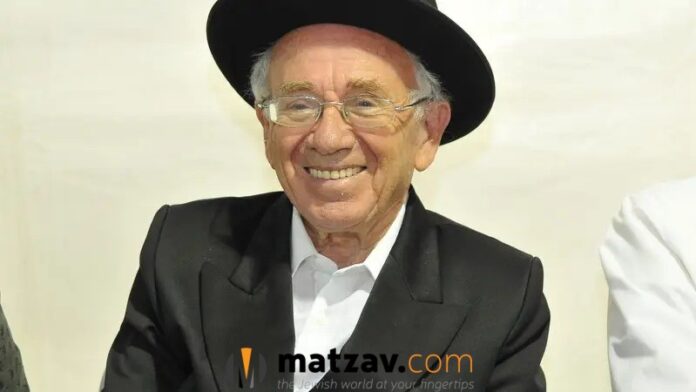
It is with great sadness that Matzav.com reports the petirah of Rabbi Dr. Yitzchak Alfasi z”l, the renowned historian and prolific author who devoted much of his life to documenting the history, personalities and dynasties of the Chassidic world. He was niftar at the age of 96.
Rabbi Alfasi, who authored more than 90 works over the course of his extraordinary literary career, was regarded as one of the veteran researchers of Chassidus in the generation. Among his best-known accomplishments was the monumental Encyclopedia of Chassidus, published by Mossad Harav Kook, which became an important reference work on the personalities and history of the Chassidic movement.
He was born on the night of Yom Kippur in 5690 in Tel Aviv, a son of Reb Yisroel Alfasi z”l, a prominent Gerer chossid who was among the early industrialists and builders of Tel Aviv.
From his youth, Rabbi Alfasi was deeply drawn to the world of Chassidus and developed a particularly close relationship with the Gerer dynasty. He was privileged to be close to the Bais Yisroel, the Lev Simcha and the Pnei Menachem, drawing from them a profound attachment to the world of Chassidim and Rebbes that would remain at the center of his life’s work.
Over many decades, Rabbi Alfasi devoted himself with remarkable persistence to researching the development of the Chassidic movement, its various courts, and the generations of Rebbes and tzaddikim who shaped them.
That lifelong effort produced more than 90 books, foremost among them his Encyclopedia of Chassidus, an enormous undertaking that established Rabbi Alfasi as a major chronicler of Chassidic history.
Chassidic historian Reb Yisroel Alter Grubais, who maintained a friendship with Rabbi Alfasi for many years, described the extraordinary diligence behind his accomplishments.
“Dr. Alfasi worked in the years before there were computers. He worked with unimaginable diligence. In a certain sense, despite several mistakes and errors he had here and there, the entire enterprise of Chassidic research in our time can be credited to Alfasi. He laid the foundation. And he did it out of a sense of mission and diligence. He almost never stopped writing. Every time you met him, the pencil was writing on the paper. May the merit of all the tzaddikim whose teachings he worked to clarify stand for him.”
Rabbi Alfasi’s writings covered an enormous range of Chassidic dynasties, personalities and historical periods.
Among the works that became particularly well known were his Chassidus From Generation to Generation series, his comprehensive History of Chassidus, Book of the Rebbes, and Chassidus and Eretz Yisroel.
He also produced detailed works devoted to individual Chassidic courts, including major volumes on Ger and Chabad, as well as extensive research into the tzaddikim of the Ruzhin dynasty and Breslov.
Remarkably, Rabbi Alfasi produced his vast body of work by hand, without relying on the technological tools that would later transform historical research and publishing. He painstakingly gathered sources, organized material and wrote his manuscripts with extraordinary consistency and attention to detail.
His research did not focus exclusively on famous Rebbes and celebrated personalities. Rabbi Alfasi documented hundreds and thousands of lesser-known tzaddikim and Chassidim whose names and stories might otherwise have disappeared with the passage of time.
His final published work was Encyclopedia of the House of Ruzhin — Malchus Shebemalchus, issued by Machon Shtefanesht.
Alongside his historical and Torah scholarship, Rabbi Alfasi served for many years as editor of the longstanding Shabbos B’Shabbato weekly parsha publication.
He also served as rov of the Goren—Komemiyus Avraham shul in Tel Aviv, where he taught Torah and developed warm relationships with numerous mispallelim and others who came into contact with him.
Rabbi Alfasi’s strength declined during his later years, but those close to him said he retained his Chassidic spirit and clarity of mind until the end of his life.
His passing is being mourned by his family, friends and the thousands who have learned from and consulted his works over the decades. His enormous literary legacy created a bridge between the living world of Chassidus that he personally knew and the painstaking historical documentation through which its personalities, dynasties and traditions will continue to be remembered.
Yehi zichro baruch.

{Matzav.com}