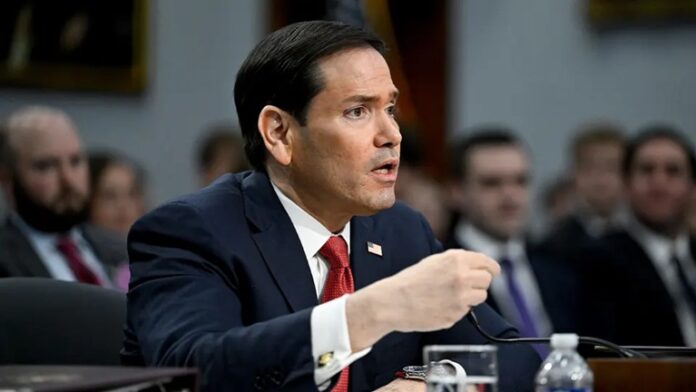
Secretary of State Marco Rubio declared Wednesday that the United States will not permit Iran to acquire a nuclear weapon and will continue using military force against Iranian threats to American troops and international shipping, even as Washington relies heavily on economic pressure to weaken Tehran and restrict its ability to finance terrorism.
In an interview with Fox News, Rubio said preventing a nuclear-armed Iran remains at the heart of the Trump administration’s policy toward the Islamic Republic.
“Well, first of all, I’ll remind everybody that, at the end, the core and central issue here is the following: Iran will never be allowed to possess a nuclear weapon, certainly not as long as President Trump is in office. So that’s first and foremost.”
Turning to the ongoing confrontation in the Strait of Hormuz, Rubio accused Iran of continuing to threaten commercial vessels and said the U.S. will strike Iranian assets that endanger American personnel or international maritime traffic.
“So we will continue to target those things that pose an imminent threat to our forces and to global shipping in the straits. The straits will remain open, and they will not be under Iranian control. And that’s what you’re seeing the President carrying out right now.”
Rubio said Washington has no intention of simply reverting to its previous relationship with Tehran. He argued that Iran’s already troubled economy will remain under intense pressure as long as the regime pursues nuclear weapons and directs its resources toward terrorist organizations and regional militias rather than its own population.
“So as far as the differences in their system, here’s the bottom line – their economy’s a disaster. It was a disaster before all of this, right, because they – if you think about it, Iran – every penny they get, be it through sanctions relief or whatever – every penny they get, they don’t spend it on the Iranian people. They don’t spend that money on their country. They use that money to fund Hezbollah and Hamas and terrorist organizations and militias in Iraq to threaten us and threaten the world. If they spent a fraction, just half the money that they’re spending on these militias – if they spent it on their own people, the Iranian people would be better off.”
According to Rubio, the administration’s economic campaign is designed both to increase pressure on the Iranian regime and to deny it the financial resources needed to support terrorism and advance its nuclear ambitions.
“So they’re going to continue to feel the squeeze, because understand that this is not just about punishing Iran, the Iranian regime. It’s about preventing them from having access to money that will then be used to sponsor terrorism, which is what they’ve always done. They want money for two things – to sponsor terrorism and ultimately to have a nuclear weapon. And we can’t allow that to happen.”
The secretary of state also put other countries on notice, warning that governments that assist Tehran in evading American sanctions or developing alternative methods of generating revenue could themselves face U.S. sanctions.
“I think what ultimately happens though is – and the President’s been very clear – is no country should be helping Iran evade sanctions. No country should be out there helping them create mechanisms by which they can generate revenue that they will then use to sponsor terrorism and try to build a nuclear weapon. And if countries decide to do that, then we’re going to have to sanction them too.”
Asked about Russian backing for Tehran, Rubio acknowledged that Moscow and Washington have sharply different positions on Iran but said foreign assistance to the Islamic Republic has not restricted America’s ability to take whatever action it considers necessary for its defense.
“Nothing that anyone is providing Iran is in any way impeding our ability to act as necessary to protect the United States.”
Rubio’s comments came days after the Treasury Department unveiled “Operation Economic Outcast,” a new initiative aimed at further isolating Iran and intensifying the financial pressure on the regime.
Economic measures, however, have not replaced the threat of military force. Secretary of War Pete Hegseth said last week that the Trump administration continues to consider military strikes in and around the Strait of Hormuz among its available options.
That threat was put into action Wednesday, when U.S. forces struck Iranian military equipment positioned near the Strait of Hormuz. Iran responded by firing ballistic missiles toward American military bases in Jordan.
President Trump said the U.S. operation was launched in retaliation for Iranian actions in the Strait of Hormuz and an earlier Iranian missile attack targeting a U.S. military base in Jordan. He also warned Tehran that any further retaliation could trigger even more powerful American strikes.