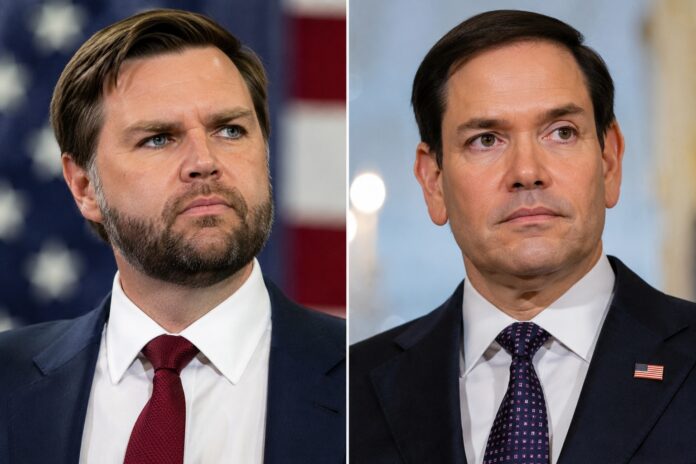
Secretary of State Marco Rubio performed slightly better than Vice President JD Vance across most of a series of hypothetical 2028 general-election contests, according to a new national poll testing the two leading Republicans against several potential Democrat presidential candidates.
The Emerson College Polling/The Hill survey examined how Rubio and Vance would fare against five possible Democrat nominees. Rubio posted stronger numbers than Vance in four of the five hypothetical races included in the poll.
The largest gap between the two Republicans emerged in a matchup with former Vice President Kamala Harris. Harris defeated Vance 49% to 45% in the hypothetical contest, while Rubio turned the result around and held a five-point lead over her.
Rubio also performed more strongly than Vance when paired against California Gov. Gavin Newsom and Sen. Jon Ossoff of Georgia, although both Democrats maintained leads in those matchups.
Newsom held a five-point advantage over Vance, but his lead dropped to two points when matched against Rubio. Ossoff likewise led Vance by five points, compared with a three-point advantage over Rubio.
Former Transportation Secretary Pete Buttigieg was the only potential Democrat candidate against whom Rubio did not improve upon Vance’s showing. Buttigieg led each Republican by five percentage points.
Rep. Alexandria Ocasio-Cortez of New York was the lone Democrat in the survey who lost hypothetical matchups against both Republican contenders.
Vance led Ocasio-Cortez by two points, while Rubio’s advantage over the progressive New York congresswoman stood at five points.
A significant number of voters remain uncommitted at this extremely early stage of the 2028 presidential cycle. At least 6% of respondents said they were undecided in every matchup tested, leaving substantial potential for the numbers to shift before the election.
The Emerson College Polling/The Hill survey questioned 1,000 likely voters from Aug. 16 through Aug. 17 and reported a credibility interval of plus or minus three percentage points.
Neither Rubio nor Vance has formally declared his candidacy for president in 2028.
Both men, however, have increasingly been viewed as leading potential contenders to eventually succeed President Donald Trump as the Republican Party’s presidential standard-bearer.
Previous Emerson polling has shown an extraordinarily close contest between them among Republican primary voters. A national survey conducted in July placed Vance at 39% and Rubio at 38%.
The same pattern appeared in an Emerson survey released in May, when Vance received 36% support among Republican primary voters and Rubio followed at 35%.
Rubio, who previously competed for the Republican presidential nomination in 2016, has indicated that he would step aside for Vance if the vice president ultimately decides to seek the presidency.
Vance, meanwhile, has said he intends to discuss the possibility of a 2028 campaign with his wife following the November midterm elections.
Trump has spoken favorably about both potential successors and has previously floated the possibility of the two eventually joining forces, saying a Vance-Rubio pairing would make “a great team.”
While the polling provides an early snapshot of Rubio and Vance’s prominent positions within the Republican Party, the large number of undecided voters and the more than two years remaining before the 2028 election leave both the GOP succession battle and the eventual general-election contest far from settled.