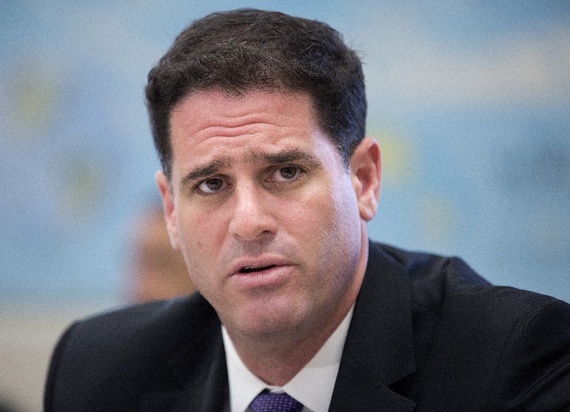
Behind-the-scenes negotiations between the homes of leading rabbanim had reportedly advanced toward a major overhaul of both Degel HaTorah and Agudas Yisrael’s electoral slates, but the plan ultimately collapsed — clearing the way for Yitzchok Goldknopf and other veteran United Torah Judaism lawmakers to remain in place for the upcoming election.
Details of the secret discussions were revealed Monday evening on Kol Chai’s main news program during a conversation between host Meny Schwartz and political commentators Avi Blum and Avi Ravina.
According to Blum, serious discussions had taken place between the rabbinic leadership of the two factions that make up United Torah Judaism, with the idea that both Degel HaTorah and Agudas Yisrael would simultaneously refresh their respective lists of candidates.
“There were contacts between the homes of the rabbanim, and it was agreed — there was really almost an agreement, I won’t say 100%, but there was an understanding that Degel HaTorah would replace its slate and then Agudas Yisrael would replace its slate as well,” Blum said.
The arrangement, he explained, was designed in part to ensure that removing any particular representative would not be viewed as a personal ouster — an issue that was particularly sensitive regarding Goldknopf.
As the election approached, however, Agudas Yisrael officials came to understand that Degel HaTorah was not planning to move forward with a comparable overhaul. According to Blum, that effectively guaranteed Goldknopf’s continued place on the Agudas Yisrael slate.
“The moment they understood that Degel HaTorah was not going to change the face of its slate, it was clear that no one would move Goldknopf either, who was loyal to the Gerer Rebbe,” Blum said.
Blum stressed that contrary to the impression that may have emerged, the sequence did not begin with an independent decision by Agudas Yisrael to retain Goldknopf. Rather, Degel HaTorah’s decision to leave its own lineup largely intact effectively brought the proposed broader reshuffling to an end.
Once it became clear that the entire slate would not be replaced, Blum said, the possibility of singling out Goldknopf for removal was essentially taken off the table. There had been an understanding from the outset that Goldknopf would not be personally targeted, particularly given his loyalty to the Gerer Rebbe.
“The moment the slate isn’t replaced, he stays. What was is what will be,” Blum said.
Blum also cautioned against placing responsibility for all of United Torah Judaism’s successes and failures during the outgoing Knesset term on a single representative.
Ravina offered a more critical assessment of Goldknopf’s expected continuation in office, arguing that it is difficult to ignore the aggressive political line the United Torah Judaism chairman pursued during the current term and the impact it had on the broader Chareidi community.
“From his perspective and in terms of his main activities, unequivocally for the benefit of the community, but in terms of the result, we didn’t always have the upper hand, certainly when it comes to the image of the Chareidi community,” Ravina said.
Ravina added that he, too, was surprised by the unequivocal indication that Goldknopf is now expected to receive another term as the Gerer representative.
Schwartz disagreed with that assessment, arguing that on the military draft issue in particular, Goldknopf succeeded in expressing sentiments held by significant portions of the Chareidi community. Those voters, he said, wanted their elected representatives to exert far greater pressure on Prime Minister Binyomin Netanyahu and even leave the government if no solution to the draft crisis could be reached.
Blum noted that Goldknopf and his senior adviser, Moti Babchik, had already concluded approximately two years ago that Netanyahu would not ultimately deliver the promised solution, while Degel HaTorah took a different approach.
“Now, two years later, we know… who was right and who was misled,” Blum said.
Ravina, however, argued that the more pressing issue extends beyond determining which faction correctly assessed the political battles of the outgoing term. The larger question, he said, is United Torah Judaism’s ability to retain and expand its electoral support.
According to Ravina, the challenge is not simply how the current representatives are viewed by the party’s most loyal voters, but whether United Torah Judaism can bring back voters on the edges of the Chareidi electorate who may now be considering other political options.
“At the end of the day, neither these nor those will bring the seventh seat,” Ravina said, referring to the debate between supporters of Degel HaTorah’s approach and those who backed Goldknopf’s political strategy.
Ravina warned specifically about Chareidi voters in what he described as electoral “border areas” — both Chassidish and Litvish voters who supported United Torah Judaism in previous elections because of their allegiance to the gedolei Yisrael, but who could now be targeted by competing parties.
He pointed to mixed neighborhoods in Yerushalayim and communities containing voters who are not necessarily part of United Torah Judaism’s hard-core electoral base. The concern, Ravina said, is that some of those voters may no longer automatically cast their ballots for the party.
That concern, Blum explained, was precisely one of the reasons the proposed overhaul had been considered in the first place.
“As part of the discussions that took place between the homes of the rabbanim, there was an understanding that the current slate… would cause voters to flee,” Blum said.
At the same time, Blum noted that as the Chareidi political establishment enters an especially complicated election period, there is also considerable value in retaining highly experienced representatives such as Moshe Gafni and other longtime lawmakers.
Ultimately, the proposed sweeping overhaul failed to materialize. As matters currently stand, United Torah Judaism appears poised to enter the upcoming election with a lineup that closely resembles the one that represented the party during the current Knesset term.