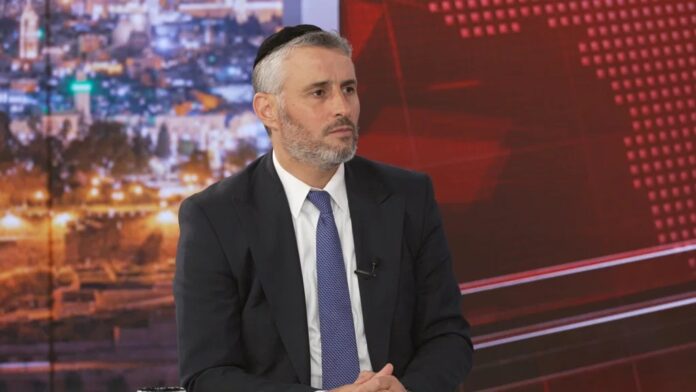
Shas CEO and MK Chaim Biton dismissed polls showing his party falling to seven seats, insisting that Shas has repeatedly outperformed surveys on Election Day, while declaring that the party remains committed to Prime Minister Benjamin Netanyahu but will demand legislation protecting the status of yeshiva bochurim before joining the next government.
In an extensive interview with Kikar HaShabbat’s Yishai Cohen, Biton also rejected claims that Shas’s performance during the outgoing Knesset term amounted to a failure. He blamed the judicial system and the war for blocking many of the party’s initiatives and defended Rishon LeTzion Rav Yitzchok Yosef amid the controversy over the cancellation of an event commemorating his father, Rav Ovadia Yosef.
Discussing the political landscape ahead of the elections, Biton made clear that Shas intends to remain aligned with Netanyahu and the right-wing bloc. At the same time, he laid down what he described as a critical condition for participation in the next coalition.
“We will not enter a government before there is a draft law that regulates the status of yeshiva students,” Biton said.
Biton was equally dismissive of recent surveys predicting that Shas will win only seven Knesset seats. He argued that similar polls have consistently underestimated the party, which ultimately won 11 seats in the last election. He also brushed aside recent criticism from Degel HaTorah MK Moshe Gafni, saying, “He’s having a difficult time in the internal Chareidi arena; he has to come out with some kind of showmanship.”
Turning to the controversy over the memorial event for Rav Ovadia Yosef, Biton said Shas is pursuing legal avenues to reverse the decision preventing the event from proceeding as planned.
“It is currently before an appeal to the attorney general and in preparation for a petition to the Central Elections Committee or the High Court, whatever is necessary to solve this problem. We cannot give up on this. Ultimately, there is the Maran Law, which was established by law, a law that passed unanimously.
“Usually, in his case, until now we were accustomed to unanimity across the Israeli consensus, because everyone knows — the million people at the levayah — Rav Ovadia is a consensus figure. Now there is something new: they dared, how should I put it, to dismantle the consensus on this issue, and to decide that the gathering that was established and funded under this law, which is essentially an event organized by the Religious Services Ministry and the Yerushalayim Municipality — and this is not the first year since the law was passed — cannot take place because they are turning it into something political.
“Even though I say unequivocally: I checked it. We are not involved in it, but I checked. There was no involvement and no connection at the event linking Rav Ovadia to Shas, despite the fact that it was his party.”
Asked whether Shas had agreed that its politicians would refrain from speaking at the memorial events so they could remain focused solely on Rav Ovadia’s Torah legacy, Biton said the rules governing such publicly funded events were already clear.
“First of all, it is not our agreement. It is obvious that there are very clear procedures for holding such an event, and even if there were additional procedures that they wanted to establish regarding this specific event. They simply disqualified it! They didn’t come and say, ‘We approve it if…’ Even though in the work plan prepared by the Religious Services Ministry and the municipality, it is clear from the outset.
“By the way, regardless of elections — when a government ministry and the Yerushalayim Municipality organize an event, there is no authorization to turn it into a political event. It is never a political event, and last time it was not a political event either. Let’s put it on the table: everything, everything the Chareidi sector wants… Yishai, do you know how many High Court petitions there are now and how many things? Everything, everything is being held up and stuck because anything connected to us gets stopped.”
Asked about the chances of successfully challenging the decision in court, Biton, who has a legal background, expressed limited confidence in the judicial process.
“Yishai, I happen to be a jurist, and I can tell you that when someone comes to me and consults with me about whether something will be approved or not, I can give my opinion. In this particular case, we are doing this because it is our obligation to do so. We hope that they will indeed come to their senses. But unfortunately, with everything recently, they always say: You know how you enter a courtroom; you don’t know how you will leave. Unfortunately, we already know how we will leave.”
Biton also defended Rav Yitzchok Yosef after the Movement for Quality Government called for a criminal investigation over his harsh comments concerning the attorney general.
“Come on, really. This is just a continuation of the idea that anything is legitimate for them, that they can do whatever they want. It is easy for them to do whatever they want. Everyone knows who Maran Rav Yitzchok Yosef is. This is his way of speaking; this is who he is. They are hurting his father! What do you expect? When someone attacks our Maran… To all of us, he is the father of us all, and to him, he is literally his father. What do they expect him to say: ‘Yes, give us some more blows and we’ll remain silent’? There are limits.”
The interview then turned to widespread frustration within the Chareidi community over the outgoing government’s record. During the term, the community has faced a succession of measures affecting daycare subsidies, yeshiva and kollel funding, housing programs and draft-related sanctions.
Biton acknowledged the difficulties but rejected the suggestion that Shas should be apologetic about its record.
“First of all, I have to say two things. One, there is some kind of situation where we are seemingly in a position of apologizing for this term. I am not saying this was the most successful term in the world. Certainly, there were complexities, and the entire legal situation was very complicated. We are not saying, ‘Come on, everything was smooth and everything was fine.’
“But there is one thing to say: first of all, because of the situation that existed, throughout this entire period, everything we put forward was blocked — Ofek Chadash, the draft law, everything. We saw what we were just talking about regarding the memorial event; it is proof happening right now. This simply happened throughout the entire term. They had one unequivocal objective: to dismantle this government, which, by the way, contrary to reality — survived until its final day.”
Biton said Shas had also failed to adequately publicize what its ministers and MKs accomplished and promised that the party would now begin highlighting those achievements.
“We also did not publicize the good things, and now we will. Get ready. A lot of material is about to come out — not because there are elections, but because we have no choice, we have to — and first of all, these things can no longer be disqualified because they were already accomplished. A great deal of material will now come out showing, first of all, what we did during this term. Six ministers in government ministries, many MKs who did amazing work. You will see it presented in such a way that you will no longer ask the question in this way.
“You will ask a question, and your question about the decrees is correct — yes, there were decrees, yes, the decrees were difficult, and yes, they harmed our community. But to your question, the clear answer is: So what? What do you want us to do?”
Asked directly whether the term should be considered a failure for Shas, Biton rejected that characterization.
“It is not a failure for Shas. It was… a complicated, difficult term, and we don’t only hope… You know, elections come around again every time, and I ask myself the question, because this is the question you really want to ask: ‘Wait, if you failed…’ I ask your question: So what is there to do there? If the thinking really is that this is it, then let’s leave politics for the rest of our lives.”
Biton was then pressed about voter frustration and surveys showing Shas at approximately seven seats. He said the party has seen the same phenomenon before, with polls significantly underestimating its eventual showing.
“If we are talking about polls, I ask you, Yishai: You have been around this arena for many years already. Let’s look for a moment. Open your phone, use GPT, whichever one you want. In election campaigns, two months beforehand, we were at seven seats. We were always at seven to nine, and we finished with 11. So mathematically, we are perfectly fine. If we are talking about the polls — fine. But let’s talk for a moment about the real question you are asking me: Is there some concern? First of all, it is not a matter of fear; it is a matter of concern, okay?”
Biton acknowledged that many Chareidi voters had expected considerably more from their elected representatives.
“The public expected more. We are also in an era when the public is very, very connected and knows everything — who knows that better than you? People want things, they hear things, they know things, and they also have the right to make demands. I agree that there is complexity. I am simply not afraid for one reason — you used the word fear: I believe in the public. I trust its intelligence and that it understands the situation. It understands that ultimately, in order to get what you want, you need to be part of a process. We are part of that process. You cannot look at one particular period of time.
“And take into account that we had a very difficult war during this period that completely diverted us. Our budgets as well, most of our budgets… Who knows better than you? Ofek Chadash had already begun on the ninth; a month before the war, they had already paid. The war stopped everything, they took the money, and petitions began. Obviously, if there had not been a war now, there would have been a different draft law, because everything changed.”
Biton also addressed the new HaTzibur HaChareidi party and speculation that left-wing interests may be financing its campaign. He stopped short of making a direct accusation but questioned where the party’s substantial campaign funding was coming from.
“All you need is for people to have intelligence. I ask you a question: Any reasonable person can look, understand how much a billboard costs and multiply that by a party that finds itself… I pay for these things; I am a party CEO. Do you know how much a campaign costs? Millions upon millions! I don’t know if… I am only raising the question. I have not determined anything; I have not said anything. Ask yourself. Let the public ask itself where so much money suddenly comes from.”
Asked whether HaTzibur HaChareidi could still damage Shas and United Torah Judaism by drawing 40,000 or 50,000 dissatisfied Chareidi votes even if it fails to cross the electoral threshold, Biton was skeptical.
“How many did you say? Forty thousand votes? Do you know what 40,000 votes are? I don’t want to give you examples. Many times, you know, there was never an election when there wasn’t someone — I don’t want to mention names right now, okay? People who broke away from Shas, various people throughout history — they always talked about enormous numbers, and in the end they didn’t even scrape together, you know, 5,000, 7,000, 8,000 votes.
“I’m not saying… In the end, disappointed people, you know, I’m not sure whether they will go to someone else or not vote; it’s the same thing. I repeat again: I don’t dismiss anyone. At the same time, everyone understands where home is, where there is a place with the ability and strength to change things. And when they see the list of what we changed, then, you know, things will calm down a little.”
Biton was also asked about the composition of Shas’s electorate and how many of its voters are strictly Chareidi compared with its traditional Sephardic constituency. He estimated that roughly two-thirds of the party’s support comes from one group and one-third from the other, although he acknowledged that the precise breakdown remains a matter of debate within Shas itself.
“Look, I’ll tell you: Studies are not… this isn’t polling. Research is in-depth research into what is happening among the public and an attempt to analyze the matter. It is clear that Shas is not entirely Chareidi. It is clear that there is a percentage… You know what, it is even an argument inside the room where we debate one this way, one that way. But we are talking roughly, let’s say, about a two-thirds, one-third situation, okay? Three or four seats, something like that.”
Asked how Shas manages the competing expectations of Chareidi voters and its broader traditional constituency, some of whom favor military service, Biton said that tension has always been part of the party’s identity.
“You have to understand that this is the only party in the State of Israel that is inside this conflict, and not only now. It stands out a little more now because there has seemingly been an escalation in society between the Chareidi public and the general public, an escalation that has separated and divided them somewhat. But we… I think this is my 14th or 15th election campaign in the movement. Every time again… But there was always the question of whether the sign displayed in Bnei Brak can be the same sign displayed in Tel Aviv. The real Shas truly has both. I came from a home where my father is Chareidi and all his brothers are secular. And that is almost the story of every family.”
Biton insisted that Shas’s declaration that it will support only Netanyahu is genuine and is not simply intended to reassure its more traditional right-wing voters.
“Genuine! You have to understand that as difficult as the last campaign was for us, the truth has to be said: It was difficult with the legal departments, it was difficult with the High Court petitions. Likud themselves were fine. Netanyahu did almost everything so that the law would pass. Obviously, he bears responsibility that the law did not pass.”
Asked whether Shas would refuse to enter a Netanyahu-led government even if the right-wing bloc secures 61 seats unless a draft law protecting yeshiva bochurim is first enacted, Biton said that is currently the party’s direction.
“I am careful with my general wording. It is currently on the table, that is the direction, and it seems to me that is where it will go. We will not allow it, because we have to finish this matter.”
Biton was also asked whether Shas might negotiate with another political bloc if Netanyahu fails to secure a 61-seat majority. He dismissed the scenario as hypothetical and predicted that the country’s right-wing majority would ultimately come together.
“It is hypothetical right now to discuss a situation in which Bibi will not be there. You have to understand one thing: The right-wing public is the majority of the country. Various divisions have been created and different population groups have separated, and suddenly Lieberman is no longer right-wing and suddenly this is no longer right-wing — but most of the public, numerically, even according to the harshest polls, is right-wing.
“Therefore, I believe that ultimately there will be a right-wing alliance, and that alliance will allow us to give our public what it wants. Our public also wants right-wing policies; that needs to be discussed. It wants right-wing policies, it wants to give this public what it has. And there is also an opportunity in the next term for us to make the changes that we want to make.”
Finally, Biton responded to a recent remark by Degel HaTorah’s Moshe Gafni, who said his party represents those who are “the most Chareidi,” while pointing to its rise in the polls. Biton suggested Gafni’s comments reflected pressures within Degel HaTorah’s own constituency.
“Look, Rabbi Gafni is an older and experienced man. I respect him; I have always respected him. By the way, I have to say that I worked with him a lot in my role as a minister in the Education Ministry, and we had a great deal of interaction. Every time he has… he has to come out with some kind of showmanship where he says something. Remember that last time he said seminaries would be opened. Every time he does something new. Fine, I’m not angry with him. It’s internal, it’s internal… Listen, it’s difficult for him, his internal Chareidi situation.”
{Matzav.com}