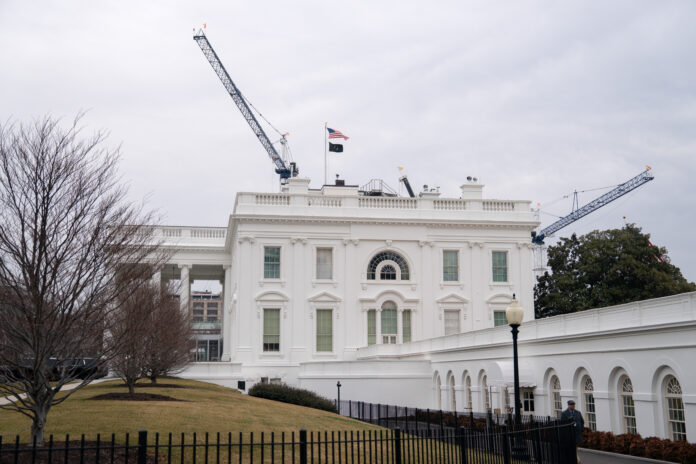
The Trump administration told the Supreme Court two weeks ago that construction of a new White House East Wing was “65% finished,” part of its argument that the work was too far along for the court to halt.
But by the White House’s own standard for measuring the project’s progress, established in a confidential agreement with contractor Clark Construction that was reviewed by The Washington Post, work on the controversial project was far less complete.
The agreement, finalized before Clark began demolition last October, stipulates that payments to the contractor be proportional to the amount of work completed, and that work cannot begin until the government approves spending for it. Based on that, if 65 percent of the work has been done, then the government should already have paid 65 percent of the total cost of the project.
Publicly available appropriations data shows that as of the end of July, the White House budget office had approved $144 million in spending from an account used to pay for the East Wing and other White House projects. Even if that entire amount were spent on the East Wing, it would come to only about 24 percent of the $600 million estimated construction cost that Clark provided the White House in March. The Post has previously reported that cost estimate.
In the same mid-August court filing in which the administration claimed 65 percent of the project was done, it said that it had already spent “around $200 million.”
If the government had spent $200 million on the East Wing project, the work would be just 33 percent complete, based on the $600 million budget estimate.
“You really want to understand why there’s such a big gap there,” said Carl Elefante, a retired D.C.-area architect and former president of the American Institute of Architects. In response to The Post’s findings, he called the government’s claim about the completion percentage “doubtful.”
The 65 percent claim was made in a sworn declaration by Joshua Fisher, the director for White House Management and Administration, who is overseeing the construction project. In the declaration, Fisher did not explain how the percentage was calculated but said, “Work has progressed too far to go back to the drawing board.”
His assertion came as the administration asked the Supreme Court to allow work on the ballroom to continue after lower courts ruled that the project was probably illegal without congressional approval and that construction must stop. The administration argued in part that stopping work while courts considered the merits of the case brought by the National Trust for Historic Preservation would cause “chaos in service of nothing” because the project had already progressed “beyond the point of judicial intervention.”
The White House did not answer The Post’s questions about the 65 percent figure and instead provided a statement from spokesman Davis Ingle. “President Trump continues to implement long-overdue and necessary renovations to beautify the People’s House as we approach our great Nation’s 250th anniversary of independence,” the statement said. “Thanks to the Builder-in-Chief, the White House will be properly glorified and remain in excellent condition for generations to come.”
The Justice Department, which represents the administration in court, did not immediately respond to a request for comment. Fisher did not respond to a request for comment. Clark referred questions to the White House.
Clark’s contract says the company will be paid monthly based on the percentage of total work that has been done. This is common in the industry, according to eight construction experts consulted by The Post who said that dollars spent is the standard method for measuring completion of large-scale construction projects.
Even if progress was measured according to Trump’s repeated claim that the ballroom will cost $400 million, paid for by private donors, it would be considered only halfway complete.
In public statements, the president has sometimes drawn a distinction between funding for the ballroom and security improvements tied to it, which the administration has acknowledged will be paid for by the Secret Service and the military. Clark’s March budget estimate indicated that half the total $600 million cost was to be paid for with tax dollars.
In its request to the Supreme Court to allow construction to proceed, the administration appeared to draw a similar distinction between the overall project, which includes a secure underground bunker, and the ballroom, writing: “The Project is on time and under budget, and the ballroom is funded with approximately $400 million in private donations … zero taxpayer dollars are needed or required.”
Measured by the expected duration of the work, the project is about 30 percent complete, according to the administration’s timeline.
Fisher said in his declaration that construction began in late October 2025 and is expected to be complete in August 2028. That puts the work 10 months into a 34-month construction schedule.
The president is still tinkering with the overall plans for the East Wing, according to three people who spoke on the condition of anonymity because they were not authorized to describe internal discussions.
Some of those changes involve the ballroom’s exterior. Renderings that the administration shared with the Supreme Court this month included the addition of a new feature that Trump picked out – golden seals on the exterior of the ballroom – and the restoration of another feature, a staircase, that had been included in prior plans before being abandoned.
One of the people with knowledge of the project said construction was not nearly 65 percent complete. “I’m not sure they’re 65 percent complete with designing the ballroom,” the person said, mocking the administration’s claims. “The ballroom continues to undergo significant changes to the base design, even while construction is ongoing.”
(c) 2026, The Washington Post · Sarah Blaskey, Jonathan O’Connell, Dan Diamond, Jarrett Ley