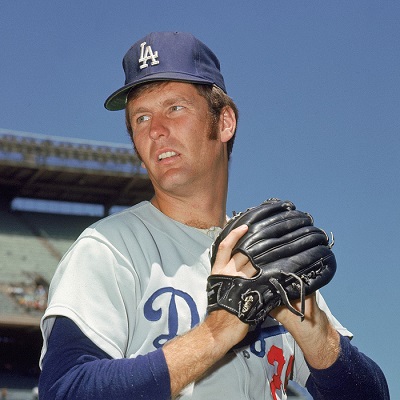
Tommy John, the longtime major league pitcher whose remarkable comeback from a revolutionary elbow operation forever linked his name to one of baseball’s most important surgical procedures, has died at the age of 83.
John had been receiving hospice care at his home in Bradenton, Florida, before his death.
The left-hander fashioned an extraordinary 26-season major league career, compiling 288 victories. Even more remarkably, 164 of those wins came after the elbow reconstruction that at the time was considered an unprecedented attempt to save his career.
Among pitchers from baseball’s Modern Era who are not enshrined in the Baseball Hall of Fame, only Roger Clemens, whose candidacy has been overshadowed by controversy, finished with more victories.
John was already an accomplished pitcher and had earned an All-Star selection with the Chicago White Sox before suffering the injury that would ultimately define his legacy. Pitching for the Los Angeles Dodgers in 1974, he tore the ulnar collateral ligament in his left elbow, an injury that ordinarily spelled the end of a pitcher’s career at the time.
Dodgers team physician Dr. Frank Jobe attempted something that had never before been done on a major league pitcher, reconstructing the damaged ligament in John’s throwing elbow.
John sat out the entire 1975 season while rehabilitating, then returned to the Dodgers in 1976 and proved that he could once again pitch successfully at the major league level.
His comeback became even more impressive the following season, when John emerged as one of the National League’s premier pitchers and finished second in voting for the 1977 Cy Young Award.
In a farewell letter published online on Aug. 8 in conjunction with Old-Timers’ Day at Yankee Stadium, John expressed his enduring gratitude to the doctor who had made his second baseball life possible. Jobe, John wrote, “saved my arm and made it possible for me to continue pitching. That surgery has since gone on to save the careers of countless pitchers, including many of the very best in the game today.”
John was born in Terre Haute, Indiana, on May 22, 1943, and attended Gerstmeyer High School. Although he received scholarship offers to play college basketball, he chose professional baseball instead, signing with Cleveland as an amateur free agent directly out of high school.
He reached the majors with the then-Cleveland Indians in 1963 at just 20 years old.
Ahead of the 1965 season, Cleveland dealt John to the White Sox. He developed into an established major league starter in Chicago and was selected as an American League All-Star in 1968.
After seven seasons with the White Sox, John was traded to the Dodgers in December 1971 in a deal that sent future Hall of Famer Dick Allen to Chicago.
“We are saddened to hear the news of Tommy John’s passing today,” Los Angeles Dodgers President and CEO Stan Kasten said. “Tommy was an exceptional pitcher throughout his career in Major League Baseball, and his courageous role in becoming the first to have surgery that would go on to bear his name can’t be overstated. His impact both on and off the field has been felt by ballplayers of all ages and will be for generations to come.”
John faced the Yankees three times as a starting pitcher in the World Series, once with the Dodgers in 1977 and twice more in 1978. He then crossed over to the other side of the rivalry, signing with the Yankees as a free agent before the 1979 season.
His arrival in The Bronx immediately paid dividends. John won more than 20 games in each of his first two seasons with the Yankees, finishing second in the American League Cy Young voting in 1979 and fourth in 1980.
Former Yankees teammate Ron Guidry remembered John as both a gifted pitcher and an invaluable resource for those around him.
“It was great having him on the team,’’ Guidry said at Old-Timers’ Day. “He was so knowledgeable. When we were together, we were pretty much 1-2 on the staff and having him around gave me great comfort. He could talk and it was nice to have him around because he would answer any question you had and he did so much in the game.”
The Yankees traded John to the California Angels in August 1982. He remained with the Angels until being released during the 1985 season, after which he joined the Oakland Athletics.
John’s remarkable career eventually brought him back to New York. He rejoined the Yankees in 1986 and remained in The Bronx through the end of his playing days. His final major league start came in May 1989, shortly after he turned 46.
By that point, John was the oldest active player in Major League Baseball. His 26 seasons also tied Deacon McGuire’s record for the most seasons played, a mark Nolan Ryan later surpassed by playing 27 seasons.
John’s longevity produced staggering career totals. He made 700 starts, eighth-most in major league history, and threw 4,710 1/3 innings, ranking 19th on the all-time list.
Yet for all those accomplishments, his most enduring impact on baseball can be traced to one pitch on July 17, 1974.
John, then 31, was starting for the Dodgers against the Montreal Expos when he threw a pitch to Hal Breeden and immediately knew something had gone terribly wrong.
He later described feeling the “strangest sensation I had ever known…Right at the point where I put force on the pitch, the point where my arm is back and bent, something happened. It felt as if I had left my arm someplace else. It was as if my body continued to go forward and my left arm had just flown out to right field, independent of the rest of me.”
John attempted one additional pitch before Dodgers manager Walt Alston removed him from the game.
When rest and conventional treatment failed to heal the damaged elbow, Jobe approached John with the radical idea of reconstructing the ligament surgically.
Similar operations had previously been performed on hands and wrists, but never on the elbow of a pitcher whose livelihood depended upon the extraordinary stress placed on his throwing arm. In September 1974, Jobe replaced the torn ligament with a tendon taken from John’s right forearm.
John later explained that, from his perspective, there was little reason not to take the chance.
“I couldn’t pitch anymore,’’ John told The Post in 2019. “And I wanted to pitch and make a living playing baseball. If I didn’t have the surgery, I wouldn’t have been able to continue playing the game.”
The operation succeeded beyond virtually anyone’s expectations. It not only allowed John to resume pitching but eventually became a standard procedure that has prolonged or rescued the careers of generations of professional and amateur pitchers.
John nevertheless expressed concern over the years about how commonplace the surgery had become, particularly among increasingly young pitchers.
Yankees ace Gerrit Cole, who underwent the procedure in 2025, credited John’s willingness to undergo the experimental operation with blazing a trail for the countless pitchers who followed.
“It’s weird to think about the surgery saving us, but the player had to step up to the table and do it. He had tremendous success afterwards. He was really writing the book for all of us. There’s a lot of gratitude towards him.”
When John finally returned to a major league mound at the beginning of the 1976 season, his extraordinary recovery earned him the nickname “The Bionic Man.”
His postseason career continued after he joined the Yankees. John appeared in one playoff game in 1980 and played a significant role in helping New York return to the World Series the following year. During the 1981 World Series against his old Dodgers club, he surrendered just one run across 13 innings in three appearances, although Los Angeles ultimately won the championship.
John also enjoyed notable success in shutouts during different stages of his lengthy career. He led his league in that category with the White Sox in both 1966 and 1967 and did so again with the Yankees in 1980.
Despite his 288 victories, four All-Star selections, remarkable longevity and historic impact on the sport, John never came particularly close to receiving enough votes for induction into the Baseball Hall of Fame.
His years with the Yankees also included a terrifying ordeal away from the field. John’s 2-year-old son, Travis, was critically injured after falling from a third-story window, but survived.
The family endured another devastating tragedy decades later. John’s son Taylor died by suicide in 2010. John subsequently became involved with the American Foundation for Suicide Prevention.
John remained connected to baseball after his pitching career ended. Among his post-playing roles, he worked as a broadcaster for the Yankees and Minnesota Twins and managed in the minor leagues, including a stint managing the Staten Island Yankees in 2004.
In his later years, John was diagnosed with bladder cancer. As his health declined, the baseball lifer prepared a goodbye message from hospice, reflecting on the extraordinary career and life that had followed a decision in 1974 to take a chance on an operation no major league pitcher had ever undergone before.
The surgery would carry his name for generations, but John’s own comeback remained its original success story: a pitcher who appeared to have reached the end of his career at 31 and instead returned to the mound, pitched until he was 46 and won another 164 major league games.
{Matzav.com}