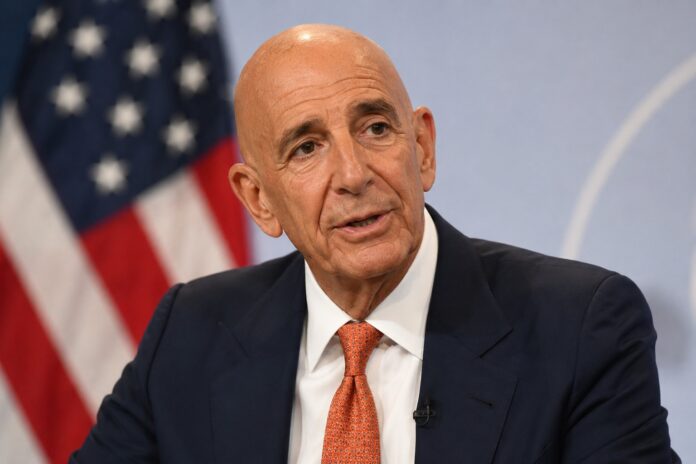
U.S. Special Envoy to Syria and Ambassador to Turkey Tom Barrack moved Sunday to clarify controversial comments in which he referred to Israel as “still” occupying the Golan Heights, insisting that President Donald Trump’s recognition of Israeli sovereignty over the strategic territory remains unchanged U.S. policy.
Barrack’s clarification followed remarks he made Friday during an interview with Lebanese-Australian entrepreneur Mario Nawfal. His characterization of the Golan appeared to clash with the policy established by Trump in 2019, when the United States formally recognized Israeli sovereignty over the territory.
Israel captured the Golan Heights from Syria during the 1967 Six Day War and extended Israeli sovereignty over the territory in 1981. While the United Nations and much of the international community continue to classify the area as occupied Syrian territory, the Trump administration broke with that position in 2019 by formally recognizing the Golan as part of Israel.
Speaking to The Associated Press on Sunday, Barrack maintained that his use of the term “occupation” was intended as a historical reference rather than a statement of current American policy.
“United States policy on the Golan was set by President Trump in 2019 and is unchanged,” he said.
Barrack said his original comments came in the context of a discussion about Lebanon and why he does not anticipate Israel annexing Lebanese territory. Israeli forces remain deployed in portions of southern Lebanon following the latest fighting with Hezbollah.
According to Barrack, his broader point was that agreements reached through negotiations are generally more durable than territorial arrangements that remain contested over long periods. He pointed to the Golan Heights as an example of territory that has remained the subject of international dispute for decades.
During the same interview, Barrack also took aim at Israeli airstrikes carried out last week against an airbase in northern Syria. Israeli officials said those strikes were aimed at preventing Turkey from establishing a military foothold at the facility.
The envoy was also forced to clarify a separate remark concerning U.S.-backed negotiations involving an Israeli withdrawal from Lebanon and efforts to disarm Hezbollah.
Discussing the challenges surrounding those talks, Barrack had said “there are two people missing from that (negotiating) table – Hezbollah and Iran.” The comment prompted speculation that he was advocating bringing Iran and Hezbollah directly into the negotiations.
Barrack rejected that interpretation on Sunday, saying he had been describing the obstacles facing negotiators rather than suggesting that either Hezbollah or Tehran should be invited to participate.
“I was describing the difficulty of the problem, not proposing a new table,” Barrack told AP. “Hezbollah is a designated foreign terrorist organization. We do not negotiate with it, and nothing I said suggests otherwise.”
Barrack said Iran nevertheless remains central to the underlying problem because of its longstanding financial and military backing of Hezbollah, noting that “the weapons in question are supplied and financed by Iran,” which complicates efforts to reach a resolution.
Israeli Defense Minister Yisroel Katz had publicly criticized Barrack’s initial comments about the Golan, saying they were “full of inaccuracies and contradict President Trump’s clear position,” while arguing that American officials cannot simply disregard the administration’s established recognition of Israeli sovereignty over the territory.
{Matzav.com}