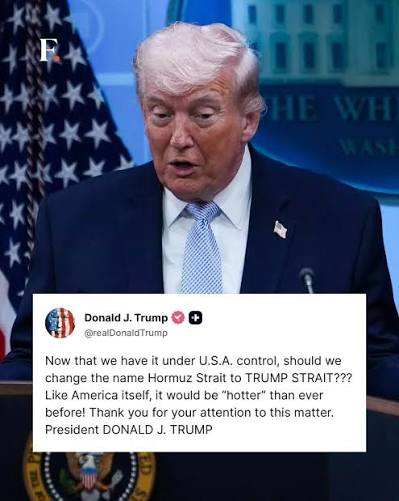
President Donald Trump suggested Wednesday that the Strait of Hormuz be renamed the “Trump Strait,” pointing to what he described as American control of the strategic waterway as renewed fighting between the United States and Iran intensifies across the region.
“Now that we have it under U.S.A. control, should we change the name Hormuz Strait to Trump Strait? Like America itself, it would be ‘hotter’ than ever before!” the President said Wednesday.
Trump raised the possibility one day after US Central Command launched another series of strikes against Iranian military targets.
According to the US military, the operation hit sites connected to Iran’s Islamic Revolutionary Guard Corps, including air-defense positions, radar installations, maritime assets and facilities, mine-laying capabilities and communications sites.
Iran’s Foreign Ministry responded Wednesday by accusing the United States of striking civilian locations and service infrastructure in Khuzestan, Sistan and Baluchestan, Hormozgan and Kerman provinces. Tehran also claimed that a wedding in Kuhestak, in Sirik County, was struck, causing deaths and injuries.
CENTCOM disputed Iran’s characterization of the strikes. Navy Captain Tim Hawkins, a CENTCOM spokesman, told TIME: “We are aware of reports, which originated from Iranian state media. The U.S. military never targets civilians, unlike the IRGC.”
The IRGC, meanwhile, said it carried out retaliatory attacks overnight Tuesday against US bases in Jordan, Kuwait and Bahrain, as well as another American facility in Iraq.
The latest exchange follows roughly a month in which active fighting between Washington and Tehran had largely subsided. On Sunday, the US military struck two Iranian launchers on Larak Island that it said were being prepared to fire rockets carrying naval mines into the Strait of Hormuz.
Trump’s proposed name change comes as control of the Strait has emerged as a major point of confrontation between the United States and Iran. Before the war, roughly one-fifth of the world’s oil supply passed through the narrow waterway.
The president has recently ordered other prominent geographic name changes. Most recently, amid an escalating trade dispute between Washington and Ottawa, Trump directed that Lake Ontario be designated “Lake America” in the United States.
Trump has asserted that the United States now exercises near-total control over the Strait of Hormuz. However, the struggle surrounding the waterway has continued after Washington and Tehran adopted competing interpretations of a Memorandum of Understanding reached between the two sides.
With no apparent diplomatic resolution in sight, the Trump administration has continued threatening what it calls an “economic D-Day” against Tehran, tightening sanctions while simultaneously applying military pressure.
Commercial shipping through the Strait has again fallen sharply as instability in the area increases.
Data provided to TIME by commodities data and analytics company Kpler showed that just six vessels crossed the Strait on Tuesday, compared with 19 ships the previous Friday.
The decline is particularly dramatic compared with traffic before the Iran war began on Feb. 28, when approximately 138 vessels typically traveled through the crucial shipping route during a 24-hour period.
The danger to commercial shipping was underscored Wednesday when UK Maritime Trade Operations reported an attack against a tanker traveling through the Strait, saying the incident resulted in two casualties.
Saudi Arabia’s Foreign Ministry said Iran had targeted a Saudi tanker in the waterway. UKMTO subsequently reported that two members of the vessel’s crew were killed.
Iran’s retaliatory attacks also drew condemnation from its Gulf neighbors, with the Gulf Cooperation Council describing the strikes on US bases in the region as a “heinous” act.
GCC Secretary General Jasem Mohamed AlBudaiwi said “these Iranian attacks represent a blatant violation of state sovereignty and a direct threat to their security and stability.”
AlBudaiwi said the GCC stands “firmly alongside” the affected countries “in all measures and actions taken to preserve their sovereignty, protect their security and stability, and ensure the safety of their peoples and residents.”
The GCC consists of six countries on the Arabian Peninsula: Bahrain, Kuwait, Oman, Qatar, Saudi Arabia and the United Arab Emirates.
The UAE, which suspended trade with Iran in August amid missile attacks, separately condemned Tehran’s latest strikes throughout the Gulf region.
“These hostile attacks constitute a flagrant violation of the sovereignty of the brotherly nations and a threat to their security and stability,” said the UAE’S Ministry of Foreign Affairs on Wednesday.
{Matzav.com}