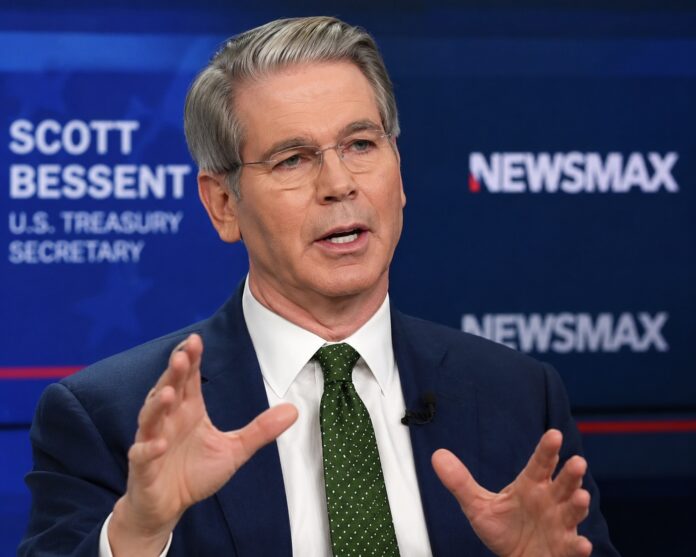
Treasury Secretary Scott Bessent warned Tuesday that the Trump administration intends to economically “asphyxiate” Iran, threatening to cut banks, companies and other entities dealing with Tehran or the Islamic Revolutionary Guard Corps out of the U.S.-dominated financial system while seizing regime-linked assets around the world.
Speaking with FOX Business host Larry Kudlow during a fireside discussion at the G20 Finance Ministerial in Asheville, North Carolina, Bessent said U.S. authorities have already located offshore financial accounts tied to the IRGC as well as extraordinarily valuable real estate holdings connected to the regime.
Kudlow asked Bessent whether countries or institutions that violate the U.S. embargo and naval blockade against Iranian ports would face sweeping secondary sanctions.
“Countries that go against this embargo, you’ll cut them off,” Kudlow prefaced, referencing the U.S. naval blockade of Iranian ports. “Secondary sanctions, you take them out of the U.S. dollar system, you’d take them out of the U.S. banking system, you take them out of the Federal Reserve wire, take them out of the SWIFT ledger?”
Bessent responded by pointing to action already taken against a bank in Dubai, warning that the same treatment could be applied to a broad range of businesses and financial entities with ties to the IRGC.
“That’s what happened to this bank in Dubai, and it could be entities, it could be airline leasing companies, which we’ll be looking at. It could be anyone who does business with the IRGC, we are tracking down the IRGC’s assets, and I will say it on worldwide TV, just so you know,” Bessent warned, “we know where in the British Virgin Islands your accounts are at these trust companies, we know the $100 million houses you have around the world, and we are going to freeze those.”
The Treasury secretary said Washington will work with allied governments to shut down those financial networks and pursue assets that U.S. officials believe were improperly accumulated by Iranian regime figures. He said confiscated assets could ultimately benefit ordinary Iranians or victims of terrorism.
“We are going to our partners, we are going to close all of that down. So we are going to go after the regime’s illegitimate assets that they have stolen from the Iranian people, and those can go back to the Iranian people, or they can go to the victims of terror, like the families of the soldiers who are on the USS Cole,” Bessent continued.
Bessent first publicly outlined the strategy on Aug. 24, when he said the United States was preparing an economic offensive against the Islamic Republic comparable in scope to the military campaign used to defeat Nazi Germany.
The intensified financial campaign follows President Donald Trump’s pledge to unleash an “economic D-Day” against Tehran. The administration’s strategy is aimed at tightening pressure on an Iranian economy already facing severe difficulties, with potential repercussions for the country’s population of more than 90 million.
Bessent said the administration intends to deprive Tehran of the financial resources needed to pursue nuclear weapons, maintain its stockpile of highly enriched uranium and support its network of terrorist proxies across the Middle East.
“We will stop this regime’s ability to have a nuclear weapon, to have their current highly-enriched uranium to project terrorist power through their proxy networks and to terrorize the Gulf,” Bessent said. “And we are telling people, either you are with us or against us.”
Bessent also addressed the potentially crucial role of China, arguing that despite Washington’s broader disagreements with Beijing, the two countries share significant interests when it comes to Iran, particularly preventing Tehran from acquiring a nuclear weapon and maintaining freedom of navigation through the Strait of Hormuz.
“And everyone says to me, ‘Well, what about China? I said, we have more in common with the Chinese on Iran than we disagree with [them] on. The Chinese agree — Iran cannot have a nuclear weapon. The Chinese agree that there should be freedom of navigation in the Strait of Hormuz. So we have had private discussions with them in terms of achieving those goals.”