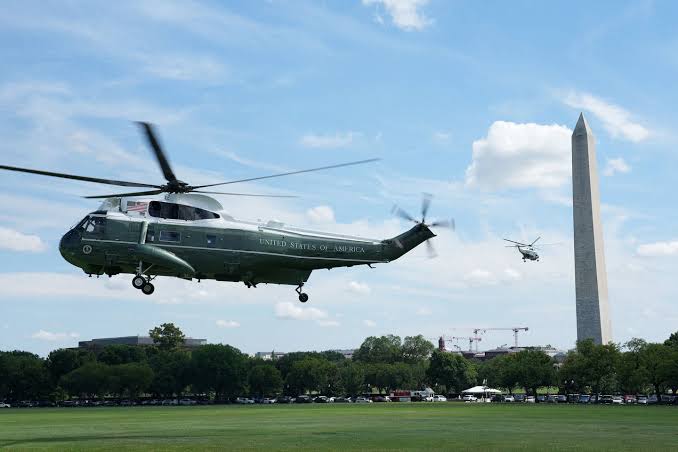
WASHINGTON — Construction at the White House forced President Donald Trump’s Marine One helicopter to use a temporary departure point with inadequate radio coverage, contributing to a communications breakdown before the presidential helicopter came too close to a commercial passenger jet earlier this month, federal investigators revealed Thursday.
A preliminary National Transportation Safety Board report released Thursday provides the clearest account yet of the Aug. 4 incident, when Marine One departed from the Ellipse, just south of the White House, as an Envoy Air passenger jet was taking off from nearby Ronald Reagan Washington National Airport.
The NTSB found that ongoing construction at the White House had temporarily shifted Marine One operations away from the usual South Lawn location to the Ellipse. FAA technicians subsequently determined that the temporary site lacked adequate line-of-sight coverage to the radio equipment used for communications with Reagan National’s control tower.
The finding links the incident to the extensive construction taking place on the White House grounds, including work on a new permanent granite helipad designed to accommodate the newer generation of presidential helicopters.
The communications failure meant controllers apparently did not know Marine One was about to depart and therefore did not stop commercial aircraft operations at Reagan National as required.
Under longstanding procedures between the Pentagon and FAA, Marine One is supposed to give Reagan National controllers three minutes’ notice before lifting off. That warning allows controllers to clear potentially conflicting air traffic from the helicopter’s route toward Joint Base Andrews.
The requirement has taken on even greater importance since the Jan. 29, 2025, collision between an American Airlines regional jet and an Army Black Hawk helicopter near Reagan National that killed 67 people. Following that disaster, the FAA established procedures requiring takeoffs and landings to be stopped when helicopters are traveling along conflicting routes near the airport.
On Aug. 4, however, Marine One’s warning never successfully reached the tower.
Investigators said the helicopter crew’s first radio call was not received at all. A second transmission reached the tower but was “broken and completely unreadable.”
Marine One’s pilots then attempted to use a backup procedure, asking personnel at the helicopter facility at Joint Base Anacostia-Bolling to relay the three-minute warning to Reagan National.
That effort failed as well.
Without receiving the warning, controllers allowed Envoy Air Flight 3742, an Embraer E-170 bound for Pensacola, Florida, to depart from Runway 1 just as Trump’s helicopter was leaving the Ellipse.
The aircraft subsequently experienced what the FAA described as a “momentary loss of separation.”
Preliminary calculations indicate Marine One and the passenger jet came within approximately 0.82 nautical miles of one another horizontally and 700 feet vertically. Investigators are continuing to analyze surveillance data to determine the precise minimum separation.
The Envoy pilots told investigators that their aircraft’s traffic collision avoidance system issued a “Traffic, Traffic” warning shortly after takeoff. They could see the helicopter on their cockpit display but never visually spotted Marine One outside the aircraft. The system did not issue the more serious resolution advisory that would have instructed the pilots to climb or descend to avoid a collision.
Marine One’s pilots, meanwhile, were eventually warned about the departing jet and reported that they had the aircraft in sight.
“We’ll be doing a momentary delay,” the Marine One pilot said after seeing the traffic.
The passenger jet climbed above the helicopter, and the two aircraft continued moving away from one another.
Neither aircraft was damaged, no injuries were reported, and both continued their flights normally.
The White House has maintained that Trump was never in danger.
“Marine One flights are piloted by some of the best aviators in the world, and at no point was the President in harm’s way,” White House spokesman Kush Desai said after the incident.
Perhaps most troubling, Thursday’s report revealed that officials were already aware of communications problems before the incident occurred.
On July 30, just days before the close call, personnel from Marine Helicopter Squadron One, or HMX-1, met with Reagan National air traffic controllers specifically to discuss problems communicating with Marine One.
The helicopter crews acknowledged that radio communications had been “spotty,” while controllers raised concerns that they had not always been receiving the required three-minute departure notifications.
The two sides agreed that if direct radio contact failed, Marine One crews would use alternative means of relaying the warning.
That backup system was precisely what the Marine One crew attempted to use on Aug. 4 — but the message still failed to reach the tower.
The NTSB’s investigation then uncovered a physical explanation for at least part of the communications problem.
FAA technicians examined the radio system and concluded that “there was not adequate line-of-sight” between the radio transmitter and receiver site and the Ellipse, where Marine One had temporarily been operating because of the White House construction.
The FAA subsequently relocated the radios used for Reagan National’s helicopter-control frequency from a nearby neighborhood to the top of the airport’s control tower.
Tests conducted afterward with HMX-1 helicopters near the Ellipse found no further deficiencies with the communications system.
Transportation Secretary Sean Duffy had previously acknowledged that investigators were examining communications problems involving the presidential helicopter operation.
“We’ve found at a staff level, between the Marine One team and the FAA, there had been some telecom issues,” Duffy said earlier this month. “We are resolving that, and our teams are working very well together.”
The incident occurred as the White House South Lawn was undergoing significant construction related to Trump’s new permanent helipad.
Trump has said the granite landing pad is necessary because the newer VH-92A presidential helicopters are substantially more powerful than the older aircraft and risk scorching or damaging the South Lawn with their exhaust. The project has been estimated at roughly $5 million to $6 million, with Sikorsky parent company Lockheed Martin contributing toward its cost.
The NTSB has not issued a final determination of probable cause, and its investigation remains ongoing.
Thursday’s preliminary findings, however, reveal an extraordinary chain of events: construction moved the president’s helicopter to a temporary site, that location suffered from inadequate radio coverage, repeated attempts to warn air traffic controllers of Marine One’s departure failed, and a commercial passenger jet was then permitted to take off as the president’s helicopter entered nearby airspace.
The incident is likely to draw additional scrutiny because it occurred in the same highly congested Washington airspace where the deadly 2025 collision between an Army Black Hawk and an American Airlines regional jet led to sweeping new restrictions on helicopter operations.
The NTSB investigation remains active, while the FAA has already taken steps to improve radio coverage and coordination between Reagan National controllers and the presidential helicopter unit.
{Matzav.com}