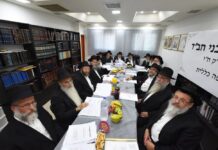
The dramatic removal of veteran MKs Moshe Gafni and Uri Maklev from Degel HaTorah’s Knesset slate represents the first major imprint of Rav Dov Landau and Rav Moshe Hillel Hirsch on the party’s parliamentary lineup, but the shakeup is not expected to fundamentally alter Degel HaTorah’s approach toward Prime Minister Bibi Netanyahu and the right-wing bloc.
Over the years, an almost unwritten rule has developed within Degel HaTorah: Each new generation of the party’s Torah leadership eventually places its own representative in the Knesset.
Rav Elazar Menachem Man Shach selected Moshe Gafni; Rav Yosef Shalom Elyashiv chose Uri Maklev; Rav Aharon Leib Shteinman brought in Yaakov Asher; and Rav Chaim Kanievsky selected Yitzchok Pindrus. Now, the time has come for Rav Landau and Rav Hirsch to put their own stamp on the party’s Knesset representation.
The notable exception was Rav Gershon Edelstein, who did not make such a change during the period in which he led the party. Some attribute that to the relatively brief period before his petirah, while others point to the dynamics surrounding his leadership. An initiative to replace some of Degel HaTorah’s MKs was already raised during his lifetime, but ultimately did not move forward.
Rav Landau and Rav Hirsch have now overseen what amounts to a political earthquake within Degel HaTorah: the removal of Gafni and Maklev, two of the party’s longest-serving and most recognizable Knesset members.
The biggest beneficiary of the upheaval is Yaakov Asher. The veteran MK is expected to move into the top leadership role and serve as chairman of both Degel HaTorah and United Torah Judaism. His elevation will also make him the party’s most visible political face, including in polling and television coverage.
The personnel changes, however, should not necessarily be interpreted as signaling a significant change in Degel HaTorah’s relationship with Netanyahu or the broader right-wing bloc.
There is no major ideological gulf between Gafni and Asher in their approach to Netanyahu. Both have maintained a strong relationship with the prime minister, as have many Chareidi politicians, while at the same time expressing frustration over commitments they believe Netanyahu has failed to fulfill.
Ultimately, the defining issue for Degel HaTorah in the next Knesset is expected to remain the military draft law. The party’s political support will hinge heavily on which political bloc can assemble a majority for legislation addressing the status of bnei yeshivos in a manner acceptable to the Chareidi parties.
For Netanyahu, the present political landscape leaves him without an obvious rival capable of offering the Chareidi parties such an alternative. The changes within Degel HaTorah may therefore dramatically reshape the faces representing the party in the Knesset, while leaving its central political calculation largely unchanged.
{Matzav.com}