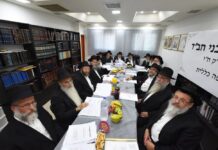
Thousands of Vizhnitzer chassidim gathered at midnight on Motzoei Shabbos for the first Selichos, as Rav Chaim Meir Hager, the eldest son of the Vizhnitzer Rebbe, delivered an emotional address about his father’s ongoing medical treatments and urged the tzibbur to intensify their Torah and tefillos for the Rebbe’s recovery.
Just minutes before the Vizhnitzer Rebbe entered the main bais medrash for Selichos, Rav Chaim Meir Hager, Av Bais Din of Vizhnitz, addressed the massive gathering, speaking about the atmosphere within the Vizhnitzer court as the Rebbe continues to undergo difficult medical treatments.
In an impassioned address, Rav Chaim Meir spoke openly about the treatments his father has been undergoing and called upon the chassidim to continue storming the heavens on behalf of the Rebbe, Rav Yisroel ben Leah Esther.
“Dear Jews,” the Vizhnitzer Av Bais Din began, “aside from all the avodah incumbent upon every Jew during these days of mercy and Selichos, we, Vizhnitzer chassidim, also have an obligation to utilize these days of mercy for our father, our shepherd, the Rebbe shlita. The tzibbur is being called upon tomorrow to recite the entire Sefer Tehillim together, as is customary, and also to add to the power of Torah by learning together for at least two hours, with a large gathering. Tefillah is one of the things in which everyone requires chizuk.”
Rav Chaim Meir then outlined three points that he said should guide the chassidim at this time.
“The first point, which everyone knows, is that we need tefillos for our crown and our shepherd, who has already been dealing for two years with an ‘unexpected guest.’ My father shlita has undergone, and still needs to continue undergoing, treatments that are not at all easy. They weaken him and take a toll on his strength, as the tzibbur can see with its own eyes. We need to daven so that the proper influence will quickly come in its entirety, as my brother (Rav Yaakov Mordechai, Av Bais Din of Elad) already urged the tzibbur this past week in a telephone message.”
“Second, from this we need to know that, baruch Hashem, we have what to daven for. In Hashem’s great kindness, we can tangibly see the words that we will soon say in Selichos, ‘Hashem guards all those who love Him.’ We see special hashgachah from Above with our father, that there is a direction in which things are going. Although tefillah is always appropriate, and Chazal say, ‘Even if a sharp sword rests upon a person’s neck, he should not despair of mercy,’ baruch Hashem, we are not in such a situation. With us, chalilah, the language of ‘despairing of mercy’ is not relevant at all.
“We can see it tangibly, even during these very last weeks, when our father was extremely weak and the doctors were considering and deliberating about how to proceed. From Shomayim, it was shown that new gates are opening, literally a reality of ‘Who causes salvations to flourish and creates cures,’ and the medical hishtadlus is continuing to advance. Therefore, as we said, we must daven, and baruch Hashem, we have what to daven for.”
Rav Chaim Meir said his third point was the most important of all: the chassidim have repeatedly witnessed the effect of the tefillos being recited for the Rebbe.
“Third, and this is the most important: all the time, literally all the time, we see tangibly that the tefillos of Yisroel help, the tefillos of Yisroel make an impact, the power of tefillah is above everything. We see tangibly that when people daven, there is a great awakening and it makes things easier for our father. That itself should be an enormous chizuk for every one of us regarding what the power of tefillah means. When we look at him, at these two years alone, we receive tremendous strength regarding what tefillah means. Therefore, from all three of these points emerges one great practical point: Dear Jews, tefillos!”
With great emotion, the Av Bais Din then described his father’s emunah and complete submission to the will of Hashem throughout the difficult medical ordeal, saying that the Rebbe has never sought to know whether a treatment had succeeded.
“I can say, and we all know this, that throughout this entire two-year period, my father shlita did not even once ask or request after a treatment whether it had succeeded — not after the major surgery and not regarding other things, not even once! My father follows a clear path: What the doctors say must be done as hishtadlus, but beyond that — nothing. For him, there is no difference whatsoever whether, according to their understanding, it succeeded or whether it did not. He did his part, and he left the rest to HaKadosh Baruch Hu. Therefore, we too — and not only us — every chossid is deeply concerned for our father, checking and asking what is happening and what the situation is. But what is incumbent upon us? Tefillos! That is our obligation, and that is what truly helps.”
Rav Chaim Meir then related a story about the author of the Yosher Divrei Emes, who was once traveling during a harsh winter when he fell into deep mud as heavy rain poured down and found himself unable to escape.
“The Yosher Divrei Emes once traveled on the road during a harsh winter and fell into mud. It was deep mud and the rain was pouring heavily, and he had no way to extricate himself. He raised his hands and cried out: ‘Ribbono Shel Olam! I know what You want from me. You want me to do teshuvah. It is true, I really need to do a great deal of teshuvah, but I ask You, Ribbono Shel Olam, in such a situation can I do teshuvah? Can I accomplish anything while I am in the mud? I ask You, take me out of here, and I truly will accept upon myself a new awakening!’”
Rav Chaim Meir then applied the story directly to the Rebbe’s condition and the spiritual responsibilities of the Vizhnitzer chassidim as the Yomim Noraim approach.
“Dear Jews! My father is going through so much, not for himself, but for us! What is wanted from him is that we should do teshuvah! We are going to say Selichos; it is a time for cheshbon hanefesh, and the heart knows the bitterness of its own soul. But we need to raise our hands to Shomayim and plead: It is true, an awakening is indeed required, but when we look at our Rebbe like this, is it possible to attain the proper awakening of closeness to Hashem when we do not hear from my father the Torah of preparation for Rosh Hashanah? When we do not sufficiently have the fire of the tish? When the Pesukei Dezimrah is missing? How can we properly correct what needs to be corrected?”
He continued with an emotional plea for the Rebbe to regain his strength and return fully to leading his chassidim.
“Therefore, let us ask HaKadosh Baruch Hu: Give us back our father, our Rebbe, our leader, with healthy strength! With strong strength! And he will lead us day after day, and then we will be able to serve HaKadosh Baruch Hu with all our strength!
“We are now going to ask ‘to listen to the song and to the prayer.’ The Tiferes Shlomo writes that ‘the song’ means the song of Torah. The power of Torah together with the power of tefillah — these two great powers together, with Hashem’s help, will shake the worlds! HaKadosh Baruch Hu should help that we openly and soon see the complete yeshuah, and that there should be a kesivah vachasimah tovah for my father and for all Jews, that we should receive tidings of redemption and salvation and merit to accomplish all that is good!”
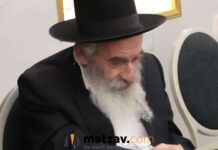
At the conclusion of the address, the Vizhnitzer Rebbe entered the main bais medrash wrapped in the inherited tallis of his grandfather, the Imrei Chaim of Vizhnitz zy”a. The Rebbe then went to the amud and led the entire Selichos in the traditional Vizhnitzer nusach.
Following Selichos, the thousands of chassidim broke into the traditional niggunim of the Yomim Noraim, as the Rebbe vigorously encouraged the singing.