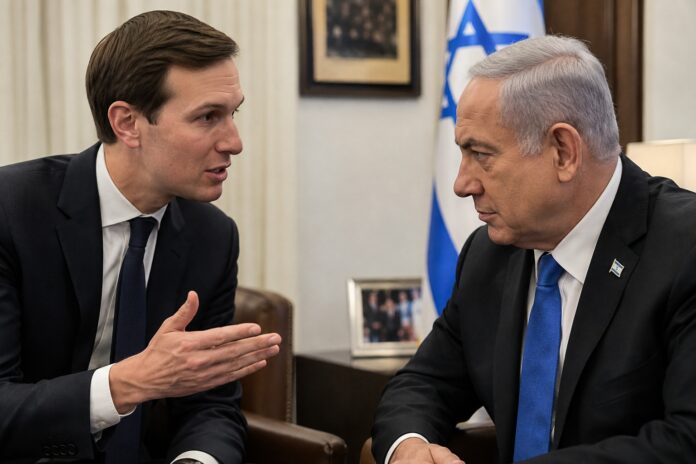
A series of tense private conversations reportedly took place in recent days between Israeli Prime Minister Binyamin Netanyahu and Jared Kushner, President Donald Trump’s son-in-law and senior envoy, as disagreements deepened over the Peace Council’s proposed 15-point framework for the future of Gaza.
According to a report by Israel’s Channel 14, the discussions became increasingly strained after Netanyahu rejected the Peace Council’s 15-point document. The report said the prime minister’s decision was influenced both by pressure from within his coalition and by concerns that the proposal could ultimately pave the way for the creation of a Palestinian state.
During one of the conversations, Kushner reportedly accused Netanyahu of undermining an initiative the prime minister himself had originally supported.
“You’re throwing obstacles in the way of an idea that you wanted. You didn’t want Israel to rule the Gaza Strip, you didn’t want Hamas—and with that goal we established the Peace Council. Now you’re throwing obstacles in the way when it’s time to put the plan into action,” Kushner reportedly told Netanyahu, according to sources familiar with the discussion.
Netanyahu responded by insisting that Israel’s security conditions are non-negotiable and that any political process must come only after Hamas has been fully dismantled.
“That’s true—we wanted something different in Gaza that would not pose a threat, but only after the Strip is completely demilitarized and Hamas is disarmed, not before. Bringing an agreement under which the Strip will be governed under Palestinian law is, in effect, a Palestinian state,” the prime minister replied.
Kushner is considered one of the key architects of the Peace Council initiative and has played a central role in shaping the Trump administration’s proposed roadmap for Gaza’s future. According to the report, the difficult exchanges with Netanyahu, together with mounting pressure from coalition partners, contributed to the prime minister’s public declaration yesterday that Israel rejects the council’s 15-point document.
According to the report, the dispute now extends beyond the wording of the proposal itself and centers on a fundamental question regarding Gaza’s future: whether political negotiations can move forward alongside the process of demilitarization, or whether any diplomatic arrangement must wait until Hamas has been completely disarmed.
The Prime Minister’s Office declined to comment on the report. However, sources familiar with the discussions said significant differences between the two sides remain unresolved.