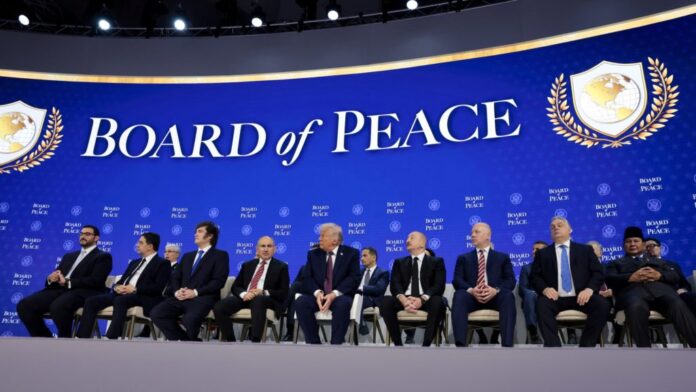
The Board of Peace on Wednesday forcefully denied reports that it had struck a financial arrangement with Hamas, rejecting claims that a proposed $400 million fund would be used to pay off the terror group’s debts as part of a disarmament agreement.
In a Hebrew-language statement posted on X, Board of Peace envoy Nickolay Mladenov said the money described in the organization’s 15-point Gaza roadmap is intended solely for approved contractors and severance payments for Gaza civil servants—not for Hamas.
Calling the reports inaccurate, Mladenov said allegations of a financial agreement with Hamas are “false,” emphasizing that no such proposal had ever been discussed, negotiated, or considered. He also stressed that Hamas “will have no role” in governing Gaza and no access to Board of Peace funds.
The controversy focuses on Clause 5 of the proposed roadmap, which directs the future Palestinian technocratic governing body, known as the National Committee for the Administration of Gaza (NCAG), to evaluate legitimate financial obligations owed to suppliers, contractors, and other entities, with payments capped at $400 million.
Kan interpreted that provision as effectively providing debt relief for Hamas. Board of Peace officials, however, insist that interpretation is completely incorrect.
According to an Arab diplomat from one of the mediating countries who spoke with The Times of Israel, the NCAG would conduct a comprehensive audit of Hamas’ financial records after assuming responsibility for governing Gaza.
The diplomat said money from the proposed fund would be paid only to contractors whose claims are verified as legitimate, with extensive background checks ensuring that no payments are made to anyone connected to terrorist activity.
Another portion of the fund would be designated for severance packages for Hamas-employed civil servants who are not retained by the incoming administration. The diplomat described those payments as both a legal obligation and a means of preventing even greater poverty in the war-ravaged Gaza Strip.
Mladenov added that every proposed payment would undergo a review and approval process before funds are distributed, with all financial records remaining subject to audits by donor nations.
The disagreement comes at a critical moment for the 15-point roadmap, which is designed to implement the Gaza peace framework approved under U.N. Security Council Resolution 2803 and is facing significant political resistance.
Prime Minister Binyomin Netanyahu rejected the proposal on Sunday, declaring that Israeli forces would remain in Gaza until Hamas is “genuinely disarmed.”
A Board of Peace official told Reuters the following day that discussions with Israel were still ongoing despite Netanyahu’s public objections.
Mladenov appealed to Israel to back the initiative, arguing that the alternatives—allowing Hamas to rebuild its military capabilities or requiring Israel to reoccupy Gaza—would impose “an enormous human, military and economic cost.”
He said the proposal calls for Hamas’ complete disarmament, the establishment of civilian rule, and deployment of an international security force operating under American leadership.
According to officials familiar with the planning who spoke with The Times of Israel, the International Stabilization Force is expected to receive its first troops from Morocco, while Albania, Kazakhstan, and Kosovo have also pledged personnel. The plan envisions creating an initial humanitarian zone in Rafah, where Israeli forces would withdraw and ISF troops would take over, allowing screened Gazan civilians to relocate from areas controlled by Hamas.
Mladenov also announced that a monitoring system to oversee ceasefire violations is already operational.
The current ceasefire began last October under President Donald Trump’s broader Gaza initiative, which outlined a phased Israeli withdrawal, the surrender of weapons, and the transfer of governing authority to the technocratic committee.
Although Prime Minister Netanyahu has publicly opposed the roadmap, IDF soldiers told Channel 12 this week that their rules of engagement inside Gaza have become considerably more restrictive since the disarmament plan was unveiled, raising the possibility that some level of coordination with the Board of Peace is already taking place even as political disagreements continue.
{Matzav.com}