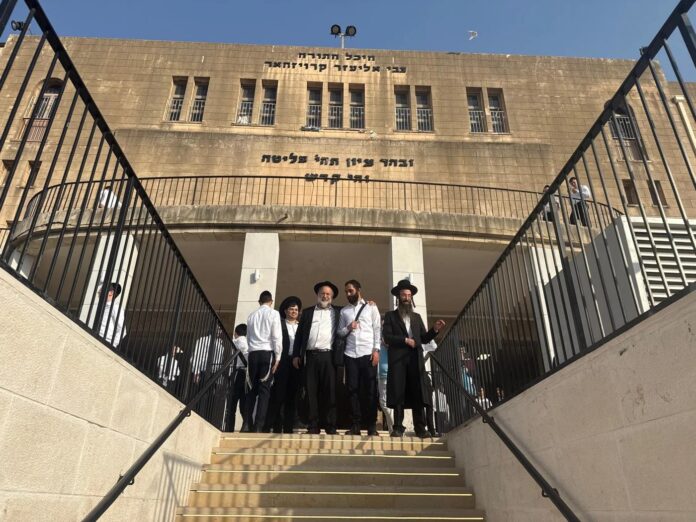
The Tel Aviv District Court on Sunday upheld an arbitration ruling in the decades-long battle over control of Ponevezh Yeshiva, ordering the faction led by Rav Shmuel Markowitz to vacate the yeshiva’s property by the end of September.
Judge Yehudit Shevach, deputy president of the District Court, rejected a petition filed by the Mesores HaTorah organization, Rav Markowitz and Rebbetzin Tzipora Markowitz seeking to overturn the arbitration decision issued by retired judge David Cheshin. The Markowitz faction says it now intends to appeal the ruling to Israel’s Supreme Court, a move that could potentially delay the eviction if the court agrees to intervene.
The 19-page ruling requires Rav Markowitz’s talmidim to leave the Ponevezh campus by September 30, 2026, corresponding to 19 Tishrei, during Chol Hamoed Sukkos.
Cheshin had originally ordered the faction to leave by July 30. However, Shevach noted that the deadline had already passed and that the parties were now “at the threshold of the Yamim Noraim,” leading her to extend the deadline. She expressed hope that the evacuation would be “carried out without further escalation.”
Beyond requiring the faction to leave the campus, the arbitration ruling upheld by the court prohibits the Markowitz group from using the yeshiva’s trademarks, including the name “Ponevezh Yeshiva” and its logo.
Rav Markowitz is also barred from presenting himself under the title “Rosh Yeshivas Ponevezh.” His faction was further ordered to pay NIS 75,000 in legal expenses to Ponevezh Yeshiva and its president, Rav Eliezer Kahaneman.
In her ruling, Shevach issued unusually harsh criticism of the conduct surrounding the dispute over the years, rejecting the Markowitz faction’s argument that the historic “2000 ruling” granted Rav Markowitz permanent and irrevocable rights as part of the yeshiva’s spiritual leadership.
According to Shevach, whatever rights had originally been granted were forfeited after Rav Markowitz “undermined the ruling and its purpose, through a chain of actions that continued consistently over the course of years.”
She relied on Cheshin’s factual findings that what amounted to a “yeshiva within a yeshiva” had been established on the campus, dividing the talmidim into competing camps.
The judge was particularly severe in describing the violence and vandalism that have accompanied the bitter dispute.
She characterized the campus as a “battlefield characterized by the use of physical force, riots, violence, vandalism,” and described incidents there as “despicable and disgraceful acts of violence and vandalism… amounting to a chillul Hashem.”
Addressing the claim that Rav Markowitz possessed an eternal right to his position, Shevach wrote that the argument should “blush” when compared with what she described as the long history of actions undertaken by Rav Markowitz, or by others acting in his name or with his authorization.
She added, in particularly pointed language, that those actions were conducted “as is the practice, with apologies, of the last of the criminals.”
The battle over Ponevezh Yeshiva stretches back to the 1990s and intensified significantly toward the end of that decade as Rav Elazar Menachem Man Shach’s health declined. The dispute ultimately developed into one of the most bitter and enduring conflicts in the yeshiva world, dividing communities and families and drawing repeated attempts at intervention by leading gedolim over the ensuing decades.
Approximately four years ago, retired judge David Cheshin was appointed as arbitrator in the dispute. His eventual decision ordered Rav Markowitz’s faction to leave the yeshiva campus and imposed financial penalties.
With the District Court now affirming Cheshin’s ruling, the lengthy legal battle has moved significantly closer to a conclusion.
Toward the end of her decision, Shevach wrote that reconciliation between the rival camps on the Ponevezh campus is not presently realistic and warned that allowing the conflict to continue could, chalilah, bring destruction upon the institution.
She said the outcome “reflects the painful reality, which requires separation through the removal of the rebellious camp.”
Rav Markowitz’s faction, however, says the legal fight is not over and intends to seek relief from the Supreme Court.
In its earlier petition to overturn the arbitration decision, the faction argued that Cheshin had dramatically exceeded his authority by effectively nullifying the historic “2000 ruling,” which it maintains established Rav Markowitz’s status as a permanent and unconditional rosh yeshiva.
Attorneys representing the petitioners argued that the arbitrator invented an implied condition to conclude that Rav Markowitz’s rights had retroactively expired in 2007.
“A determination born out of nothing,” the petition stated. “The arbitrator turned the bowl on its head; he created a new legal reality that retroactively negates 20 years of rights and communal reliance.”
The District Court rejected those arguments and upheld the arbitration ruling in full.
The remaining question is whether the Supreme Court will agree to hear the planned appeal and potentially intervene, or whether Shevach’s ruling will remain intact and Rav Markowitz’s faction will be required to leave the Ponevezh campus by the end of September.
{Matzav.com}