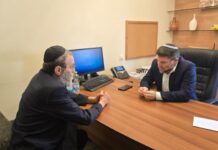
Gilad Erdan, chairman of the new Unity Party, says Israel should grant military-service deferments to exceptional Torah scholars chosen by leading rabbonim and roshei yeshiva, arguing that Torah study deserves at least the same recognition the state gives outstanding athletes and artists.
In a wide-ranging interview with Yishai Cohen in the Kikar HaShabbat studio, the former Likud minister laid out his new political platform, explained why he left Likud, addressed his party’s weak showing in current polls and spoke extensively about Chareidi military service and education.
Erdan rejected accusations that he has become anti-Chareidi and said he opposes mass arrests of yeshiva bochurim or proposals to strip draft evaders of voting rights. At the same time, he insisted that every Israeli citizen should ultimately contribute through military, national or civilian service and called on Chareidi leaders to actively encourage enlistment.
He also advocated a gradual transition toward state-run Chareidi education with core curriculum studies, while stressing that such changes should not be imposed overnight.
On the broader political front, Erdan ruled out joining a narrow right-wing or left-wing government. He said he would be prepared to send Israel back to elections rather than abandon his commitment to forming a broad unity government.
The interview began with Erdan discussing the Likud primaries and his decision to leave the party.
“Some of those elected are friends of mine, and I congratulate them. But in Likud it doesn’t really matter, and that is also why I left Likud and departed from Likud. Because in Likud, it doesn’t really matter where you are on the list or whether you were elected to a high or low position.
“I was elected five times in the top three — the ability to influence what happens to the people through your position on the list is simply zero. Because in the end, the prime minister wants to survive as prime minister, and the result is that he gives instructions to all the elected officials and they have to fall in line on the issues that are most significant today to the citizens of the country, and I’m sure we’ll discuss them further — such as the draft law.”
Erdan was then asked about his assertion that he had been offered a reserved slot on the Likud slate but turned it down, a claim that Likud officials have denied.
“What can I tell you? I think that for decades I have had zero zigzags and have never deviated from the things I told the public, and I believe that most of the public believes me that I don’t want a reserved slot in Likud and that I embarked on a new path.”
“You know,” Erdan continued, “they were searching high and low for new figures who are representative and statesmanlike. There are those who would say that I meet the criteria, fine, but that’s not the point. I’m not interested in reserved slots; I’m interested in leading a path of unity.”
Erdan said the current Likud bears little resemblance to the party of earlier generations.
“That is exactly what shows that today’s Likud is not the original Likud of the past. Today, as a ruling party for many years already, many special-interest elements have penetrated and entered this party whose goal is not the path of Jabotinsky or Begin. Their goal is to influence political decisions.”
He added: “There are always phenomena like this in a ruling party, with special-interest groups that want to exert influence, but I think it has now reached an all-time high. And that is one of the reasons I want to exert influence through my own independent path of unity.”
Asked about polls showing his Unity Party failing to cross the electoral threshold, and whether his relatively late entry into the race had hurt his chances, Erdan said he believes voters remain open to hearing his message.
“I feel that the public is more open than ever to being persuaded and listening, and wants to understand deeply in these elections how things will affect its future. It could be that if we had started a little earlier, the beginning would have been easier. It doesn’t matter. We charged ahead. All day, I and every member of our slate are at parlor meetings and meetings with the public.”
Asked why that activity has yet to translate into stronger poll numbers, Erdan said his party has not yet achieved sufficient public awareness.
“We still don’t have enough public awareness. In the coming days, we will increase our exposure through our campaign, including billboards and additional means. And once the public internalizes the existence of the Unity Party, the values we represent and who our team is — you will see that, with Hashem’s help, it will gain momentum.”
Cohen asked whether the so-called third bloc could ultimately unite, mentioning Chili Tropper and Benny Gantz as potential partners.
“There is a dramatic difference. First of all, you are right, and the public is right to expect the parties in the bloc known as the ‘unity bloc’ — and I call it ‘unity and solutions’ — and there are currently three parties in this bloc, and it is a legitimate demand that we find a solution for how to work together.
“But when Chili Tropper, who comes from the left, while I am clearly a man of the right, says that he is prepared to give Gadi Eisenkot the votes for a narrow government that will ultimately be controlled by the extreme left-wing positions of Yair Golan or, rachmana litzlan, the Arab parties — then I cannot go together with him, unless he changes that position and makes clear, as we do, that we will not join any narrow government.”
Asked whether that meant he was moving toward a merger with Benny Gantz, Erdan said no agreement could yet be assumed.
“No, it still can’t be assessed, because ultimately it also depends on the conditions. What can be assumed is that every effort will be made to create one party that will lead this. I believe that it will be the Unity Party under my leadership. The people are moving to the right. Whoever is supposed to lead such a bloc needs to be a right-wing person whom the public feels comfortable with.”
Asked directly whether he would insist on leading any such united party, Erdan responded:
“With Hashem’s help, I will try to convince them that this is the right thing. Because if today 70%-80% of the Jewish public defines itself as right-wing or center-right, then whoever needs to lead such a bloc should be a right-wing person whom the public trusts to fight, in any government that is formed, for it to be a government that represents right-wing positions.”
The interview then turned to Chareidi issues. Cohen told Erdan that a Chareidi MK had asked what had happened to a politician who had once been considered a close friend and political partner of the Chareidi parties.
“Whoever calls me anti-Chareidi is a liar or has an agenda. And I come from Religious Zionism and studied at Yeshivat Netiv Meir not far from here, and who better than I understands the importance of keeping mitzvos and, first and foremost, Torah study.
“But together with those values, we live here together in the State of Israel, the state of the Jewish people. And when I look — and this is my obligation as an elected official or as someone who now wants to return to the public arena — my obligation is to look at the long term: How will the State of Israel, with Hashem’s help, continue to exist? And it will only be able to continue to exist if all the citizens of the country… And this is not only connected to Chareidim; it also relates to secular people who don’t serve in the military or national service.”
Cohen asked Erdan to spell out his plan for Chareidi enlistment and whether he would accept Eisenkot’s proposal to exempt 3% of the overall draft-age cohort.
“First of all, I don’t think Gadi Eisenkot will really stand by anything he is saying right now, and the same applies to the other side, because what is important to them is getting to the prime minister’s chair — something that I have currently put aside. I think there must be a basic principle that every citizen in the State of Israel serves the state in some way: national service, civilian service, and combat service. The most urgent thing today is combat soldiers, in order to guarantee Israel’s security with all the fronts surrounding us.
“And therefore, anyone who can be a combat soldier should do it. And I say: The obligation to serve, the obligation to serve, will apply to everyone. I am against mass arrests. I don’t believe that we will turn someone into a combat soldier by sending him to prison. I don’t think, chas v’shalom, that voting rights should be revoked, as in the positions of Lieberman and Hendel.”
Erdan stressed that withholding fundamental democratic rights was a line he would not cross.
“I don’t think, chas v’shalom, that voting rights should be revoked — those are populist positions. In a democratic country, you don’t violate a person’s basic civil rights, not because he or his grandfather was more or less loyal to the state, right? There are basic things, okay? Children deserve to receive what they deserve to receive.”
Asked whether there would be exemptions for Torah learners, Erdan answered unequivocally.
“Absolutely yes. It’s not a matter of exemptions but rather deferment of service. I think Torah study is a more important value than outstanding athletes or artists, okay? And if the State of Israel today knows how to accommodate and prioritize outstanding athletes or outstanding artists in order to exempt them from military service — then certainly, all the more so, and all the more so again, Torah prodigies as well, with the geonim, the roshei yeshiva and the leading rabbonim of the generation deciding whom they want.”
Erdan said, however, that the willingness to accommodate elite Torah scholars must be accompanied by a constructive approach from Chareidi leadership toward military service.
“It also depends on willingness. If the leaders of the Chareidi public do not fight against enlistment but instead come with a constructive approach and say: ‘Listen, in order for us to speak to our public and encourage it to enlist — first of all, we need to see not one Chashmonaim Brigade, but infrastructure ready for ten Chashmonaim Brigades, with the required kashrus, with gender separation.’ I have no problem with any of those things! Because we want to make sure that someone who enters the military as a Chareidi can also leave his military service as a Chareidi.”
Cohen then asked whether Erdan accepted the framework advanced by his political ally Yuli Edelstein before Israel’s strike on Iran, which spoke of eventually reaching enlistment levels of roughly 50% of the Chareidi draft cohort.
“No, don’t call it the ‘Edelstein framework.’ With all due respect, Yuli was the committee chairman. He received it from the government, from the prime minister. And given the overall situation and the existential anxiety that existed in the country at the time, the desire to reach compromises — it still exists. I still understand that we need to try to reach compromises — but there are certain moral principles that I am not interested in compromising on, and I see no reason to compromise on them.”
Erdan argued that the conversation over Chareidi enlistment needs to be reversed, with Chareidi leaders approaching the broader Israeli leadership with their own proposal.
“The approach is that the leadership of the majority of the Israeli public needs to come to the political leadership of the Chareidi public and say, ‘Oh, we’ll give you this-and-this percentage; will you agree to encourage enlistment?’ No! Let the leaders of the Chareidi public come and tell the leadership of the entire country in Israel: ‘Look, if you agree to such-and-such a percentage of exceptional Torah learners receiving an exemption or deferment, then we will encourage the children of the Chareidi public to be part of the country, to get under the stretcher.’ Then we can begin talking! To come and tell the majority of the public, ‘Give us a number and we’ll start from there’?”
The conversation then moved to core curriculum requirements in Chareidi schools. Cohen asked whether Erdan supported Naftali Bennett’s position that institutions failing to teach the full core curriculum should receive no government funding, with education ultimately becoming state-run.
“I think there needs to be a gradual process here, at the end of which the state-Chareidi schools will be an official educational stream, okay? We will legislate it as an official stream, and of course there will be the necessary accommodations for the children of the Chareidi public. I don’t think that overnight we should punish the children, but a gradual framework must be established.”
Asked whether that meant all institutions would eventually become state-run, Erdan said:
“It sounds as though that is some kind of dirty word. Yes, I think that ultimately every sane country that wants to live and wants to survive — its children need to receive an education that connects them to Zionism, that connects them to the state, that brings them to what I believe is the correct conclusion, for which there is no alternative: that they need to be part of the state in every sphere. And that is how I view the education of children in the Chareidi public.”
Cohen asked whether Erdan would rule out sitting in a government with Aryeh Deri, Moshe Gafni or Yitzchok Goldknopf.
“If they accept the principles — I don’t rule anyone out. You know what they say: A baal teshuvah…”
Asked why he does categorically rule out the Arab parties, Erdan replied:
“Correct. It doesn’t matter what the Arab parties say; I don’t believe them. If in the most difficult hours for the people of Israel after October 7 they are incapable of identifying with us, condemning Hamas, saying that it is a terrorist organization — then everything they say is within the framework of what Muhammad taught his believers, right? To lie and one day slaughter Jews when possible. I don’t accept that in any legitimate government.”
Erdan then returned to the possibility of governing alongside the Chareidi parties.
“Now,” he said, “Aryeh Deri, Moshe Gafni, everyone whom we have known for decades — if they accept these principles, then of course we can argue about how much time the processes should take. I’m not naive. I’m a politician and public figure of decades. Obviously, there are processes.”
Cohen presented Erdan with a post-election scenario: If his party crosses the electoral threshold and neither Netanyahu nor Eisenkot agrees to form a unity government, would he support one of them in reaching 61 seats or force another election?
“First of all, we’ll see whom the people gave greater legitimacy to form a government. I will demand that he make a very generous offer to the other side, and therefore, if the side that did not receive the legitimacy refuses, then we will point to that side as the one refusing unity. And with no alternative, I will not violate my commitments to the public: We said that we would bring unity, I am genuinely right-wing, and we will also pass the law requiring service for everyone. Therefore, if one side refuses unity — we will go back to the people, at least once, for at least one additional election. We will point to that side as the one that caused another election because it refused.”
Cohen pressed him on whether that meant he was genuinely prepared to accept another election rather than join either a narrow right-wing government or a narrow center-left coalition.
“A narrow government would be a major disaster for Israel. And I’ll say it in language that may be extreme, yes: Unity or we die! Not that all of us will, chas v’shalom, die. The value today of unity — of sitting together and solving problems, and reaching a broad judicial reform by consensus, and how we fight together against the unions to lower the cost of living, and how we find a solution for service by all citizens of the country that also protects the lifestyle of the Chareidi public, and also Arabs who need to perform national service…”
{Matzav.com}