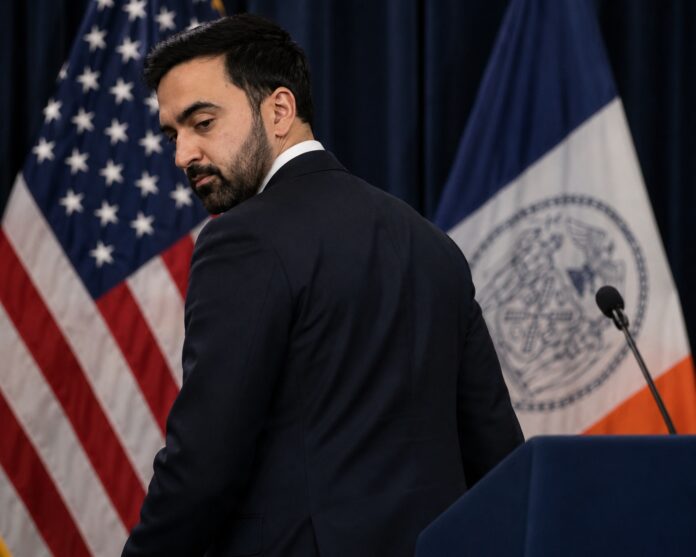
A coalition representing immigrant-owned grocery stores and bodegas sued New York City Mayor Zohran Mamdani on Monday in an effort to stop his planned network of taxpayer-funded supermarkets, arguing that the city-run stores would unfairly compete with private businesses and could inflict the same kind of damage officials have long warned Walmart would cause if it entered the city.
The Multicultural Business Coalition, an alliance of 50 chambers of commerce representing businesses from a wide range of ethnic communities, filed two lawsuits in New York state court. One is a seven-page class-action complaint brought on behalf of “hundreds” of store owners who are “members of groups historically discriminated against.”
According to the class-action filing, allowing the municipal supermarkets to begin operating would violate the civil rights of those business owners.
A second lawsuit, a 13-page action filed in New York state Supreme Court, argues that Mamdani’s government-run supermarkets would create many of the same competitive concerns that have surrounded Walmart’s repeated attempts to establish a presence in New York City.
The Arkansas-based retail giant has tried unsuccessfully for years to gain a foothold in the city, facing intense resistance from elected officials and organized labor. Opponents have repeatedly argued that Walmart’s deep discounts and enormous purchasing power would devastate neighborhood stores and other small businesses.
Mamdani’s municipal supermarkets “have pledged to sell food items 30% below the market-rate, a rate that rivals or exceeds Walmart discounts,” according to the second filing.
The lawsuit compared the city’s proposal to “allowing Walmart to operate deep discount business, while bringing ‘affordability’” and argued that such a policy “would eliminate an untold amount of opportunity for minority businesses and small business at large.”
The coalition also alleges that Mamdani and his administration unveiled the supermarket initiative without conducting a “proper review” of its potential consequences. The suit contends that the city should have undertaken a land-use and economic analysis examining how taxpayer-supported grocery stores would affect existing neighborhood businesses before selecting locations.
“There is no extant evidence that the respondents have undertaken any studies and or serious analysis before its current arbitrary site selection,” according to the second filing.
“It is beyond debate that the municipal grocery stores openly compete with the grocery stores at large,” MBC alleges.
The coalition further maintains that City Hall “failed to study the discriminatory effects” the government supermarkets could have on family-operated bodegas and grocery stores owned by Hispanic, Arab and Asian entrepreneurs. The lawsuit is asking a judge to require the city to conduct an economic-impact analysis before moving forward.
Mamdani, questioned about the litigation during an unrelated press conference in Queens on Monday, defended the supermarket initiative and predicted it would survive the court challenge.
“I’m confident both in the legality of this, that it will stand up in court and the importance of delivering it”
The Multicultural Business Coalition was organized earlier this year specifically to fight Mamdani’s supermarket proposal. The initiative is expected to cost taxpayers $70 million to establish five city-owned stores, which are slated to offer basic groceries such as produce, meat, milk, cheese and bread at prices roughly 30% below prevailing levels. City Hall estimates that customers could save about $90 per month, or approximately $1,000 annually.
The first announced location is at La Marqueta, the food marketplace in East Harlem.
“My grandfather opened up one of the first bodegas in the late 1960s when East Harlem was burning and the A&Ps and Waldbaums were leaving,” said MBC Chairman Frank Garcia.
“He established the first Latino Grocery Association to protect the rights of immigrant store owners. I am proud to be following up in his tradition because what Mayor Mamdani is doing is disgracing his memory.”
MBC President Ken Roldan accused Mamdani of pursuing a policy that directly threatens the very minority and working-class entrepreneurs the mayor has portrayed himself as seeking to help.
“Make no mistake about this plan,” MBC’s president Ken Roldan said in a statement. “It is a direct assault on minority business by a mayor who claims to be a champion of disenfranchised poor and working-class New Yorkers.”
Neither lawsuit currently names the individual businesses that claim they will be harmed by the first two city-run supermarkets. One is planned for La Marqueta in East Harlem, while another is slated for Hunts Point in the Bronx at the site of the former Spofford Juvenile Detention Center. Locations for the proposed Brooklyn, Queens and Staten Island supermarkets have not yet been made public.
Roldan told The Post that the coalition expects to announce the first named plaintiffs at a press conference later this week. The court filings will then be amended to formally add those businesses to the litigation.
Some small-store owners have also expressed fears that publicly challenging City Hall could expose them to retaliation, according to Roldan. He said owners are concerned that the administration could scrutinize their permits and licenses and use regulatory violations to impose fines or otherwise pressure them.
“We will spotlight it if they are picked on,” Roldan said.
Jairo Guzman, president of the NY State Mexican Chamber of Commerce, said immigrant communities have spent generations building the neighborhood food businesses that have become a defining part of New York City.
“The Puerto Ricans were the bodega pioneers and they were followed by the Dominicans, the Arabs, the Koreans, the Chinese and finally my Mexican business members,” said Jairo Guzman, president of the NY State Mexican Chamber of Commerce in a statement.
“Food retailing–from bodegas to supermarkets- is New York City’s great mosaic. Mayor Mamdani needs to withdraw his disastrous plan and work with us to find different ways to bolster and sustain what so many (New York City) immigrants have created.”
{Matzav.com}