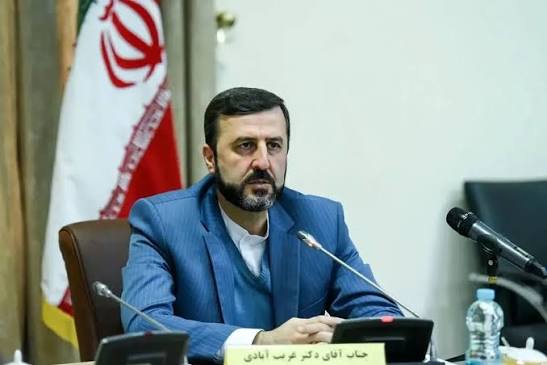
Iran declared Tuesday that it remains in a state of war and will refuse to reopen the Strait of Hormuz until a series of sweeping demands are satisfied, while a senior Iranian official warned that Tehran could launch preemptive military action rather than wait for another American attack.
Iranian Deputy Foreign Minister Kazem Gharibabadi said that any reopening of the critical international shipping route would be contingent on an end to hostilities across the region, the removal of the blockade and a resolution of the conflict in Yemen.
“We are still in a state of war, and the Strait of Hormuz will remain closed,” Gharibabadi said, according to Iranian media.
“The reopening of the Strait of Hormuz will only happen in exchange for ending the war on all fronts, lifting the blockade, and resolving the situation in Yemen.”
Gharibabadi also said Iran is demanding that Washington honor commitments Tehran says were included in a memorandum of understanding reached between the sides in June.
“We told Pakistan’s Army Chief that reopening the Strait of Hormuz depends on America fulfilling its commitments under the memorandum of understanding.”
The Iranian official then issued a more explicit military warning, suggesting Tehran does not necessarily intend to wait for the United States to initiate another attack before responding.
“Why should we always wait for America to attack? We can take preemptive action.”
Gharibabadi’s remarks came hours after President Donald Trump announced that the U.S. Navy had successfully removed all mines from international waters in the Strait of Hormuz and warned Iran against attempting to mine the crucial waterway again.
“I have just been informed by the United States Navy that all mines have been removed and/or detonated from within the International Waters of the Strait of Hormuz. Iran has been notified that any ship or boat placing new mines will be immediately and systematically destroyed,” Trump wrote on Truth Social.
He added, “Through Space Force, we are watching every square inch of the Strait, as we are, also, with Pickaxe Mountain and the already destroyed three other Nuclear sites. There is a Zero Tolerance policy on mine placement in full force and effect.”
As tensions remained high, Pakistan said its diplomatic efforts to mediate between Iran, the United States and Israel had produced movement toward a possible resolution.
Pakistani Interior Minister Mohsin Naqvi said Tuesday that “significant progress” had been made during talks with Iranian officials regarding the ongoing conflict and potential steps toward an agreement.
Naqvi traveled to Tehran together with Pakistan’s army chief, Field Marshal Syed Asim Munir, with both officials holding discussions with the Iranian president.
“Field Marshal Syed Asim Munir and I had a very positive and productive meeting with the President of Iran,” Naqvi said afterward.
According to Naqvi, the meeting covered the Iran-U.S. conflict, broader instability throughout the region and possible avenues for ending the confrontation, including measures needed to restore the Islamabad Memorandum of Understanding.
“The Iranian President candidly shared his Government’s perspective and concerns, and we had a very constructive exchange on the issues involved,” Naqvi stated.
“Significant progress was made, and the meeting concluded on a highly positive note. We remain hopeful that this momentum will help pave the way for further progress and lasting peace in the region,” he added.
Pakistan’s military said the discussions additionally focused on preventing further escalation, reopening the Strait of Hormuz, bringing the war to an end more quickly and exploring the possibility of a negotiated settlement.
At the same time, the Trump administration is sharply increasing financial pressure on Tehran. Washington has launched “Operation Economic Outcast,” an expansive campaign intended to further isolate Iran economically and deprive the regime of sources of revenue.
U.S. Treasury Secretary Scott Bessent unveiled the initiative Monday, saying Washington would pursue Iranian economic connections across the globe. The campaign encompasses a broad range of sectors, including oil, transportation, banking, shipping, aviation, digital assets, technology and gold.
Bessent also put foreign governments, banks and other entities on notice that those continuing to facilitate Iranian economic activity could face American penalties, including secondary sanctions and being shut out of the U.S. dollar system.
Iranian Economy Minister Ali Madanizadeh responded by saying Tehran had expected the economic offensive and had already developed a two-year strategy to withstand the pressure. Gharibabadi, for his part, claimed the Trump administration’s move toward intensified economic measures demonstrated that Washington had been unable to achieve its goals militarily.
{Matzav.com}