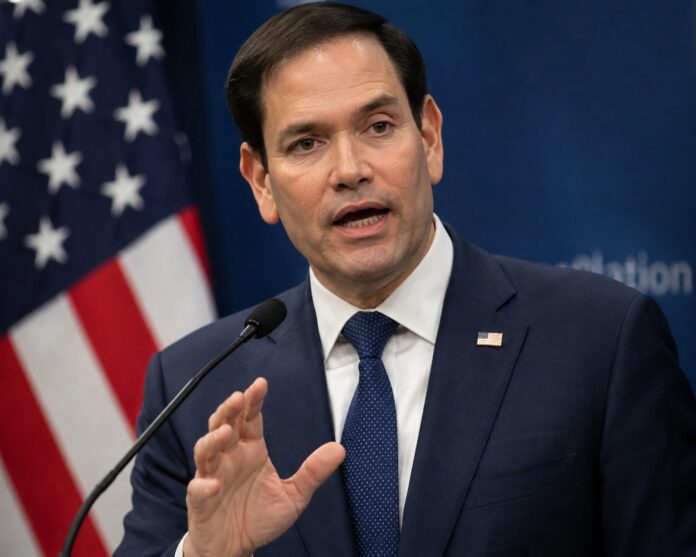
The Trump administration is not currently planning another round of military strikes against Iran and is instead focusing on tightening economic pressure on Tehran, Secretary of State Marco Rubio has told foreign allies, according to a report Tuesday by Axios.
Rubio informed several allied foreign ministers that “for the time being,” Washington intends to emphasize other means of pressuring Iran, including the sweeping new sanctions campaign unveiled this week, two sources familiar with the conversations told Axios.
The shift comes as U.S. officials increasingly believe that the American naval blockade is inflicting significant pressure on Tehran, while U.S.-led efforts have allowed greater volumes of oil to move through the Strait of Hormuz.
One U.S. official told Axios that Rubio stressed that the administration has no present intention of returning to large-scale combat operations. However, the secretary of state did not exclude the possibility of renewed military action if Iran attacks first.
A second U.S. official pointed to the U.S. Navy’s clearing of mines from the Strait of Hormuz as a pivotal development in the conflict, arguing that the operation has deprived Tehran of one of its most important sources of strategic leverage.
During his conversations with foreign ministers, Rubio reportedly laid out several components of the Trump administration’s strategy: refrain from additional military action against Iran for now, increase financial pressure through the naval blockade and the Treasury Department’s new sanctions campaign, and facilitate the movement of as much Iranian oil as possible through the Strait of Hormuz and onto world markets.
Another U.S. official told Axios that the strategy is likely to remain in effect at least until the midterm elections. After that point, officials could potentially revisit the possibility of another military campaign.
American officials believe Iran’s ability to exert influence over global energy markets has been dramatically diminished by the removal of mines from most of the Strait of Hormuz and the growing number of oil tankers traveling through the waterway’s southern lane.
“The Iranians have lost control over the strait. Now the U.S. controls it,” one U.S. official told Axios.
Washington’s blockade is also reportedly taking a growing toll on Iran’s oil income. U.S. officials say virtually no tankers have been observed at Kharg Island, Iran’s principal oil-export terminal, over the past two weeks.
“The Iranian economy is in free fall and the regime’s military has been decimated,” State Department spokesman Tommy Pigott told Axios, “and we are cutting off every financial lifeline the regime has remaining.”
He added, “The President has been clear that Iran cannot have a nuclear weapon, and that he will use the tools necessary to ensure that objective is accomplished.”
Despite the administration’s current preference for economic pressure, U.S. Secretary of War Pete Hegseth emphasized Monday that military force remains an option even after Washington’s announcement of additional sanctions against Tehran.
“By no means are we foreclosing using kinetic strikes anywhere in the Strait of Hormuz or around Iran,” Hegseth told reporters.
Hegseth also said that the Iranian regime is incapable of withstanding the level of economic pressure now being imposed by the United States.
{Matzav.com}