Senior U.S. military commanders have warned Secretary of War Pete Hegseth that the six-month conflict with Iran is placing an unsustainable strain on American forces and potentially weakening defenses elsewhere, according to a report by The Washington Post.
The concerns were detailed in the Aug. 14 edition of the Secretary of War Orders Book by the leaders of the Army, Navy and Air Force, as well as four-star commanders responsible for American military operations in Europe, Asia and Latin America.
The classified document, produced twice each month, provides an accounting of the worldwide availability of U.S. military personnel, warships, aircraft and weapons systems, according to individuals familiar with the assessment who spoke to the Post on condition of anonymity.
One source summarized the broader message from military leaders as “too much for too long.”
The commanders of U.S. European Command, U.S. Pacific Command and U.S. Southern Command, together with Chief of Naval Operations Adm. Daryl Caudle, registered a formal “non-concur” with the document. The designation indicates that they oppose the deployment extensions even though they will carry out the orders.
Army and Air Force officials approved the extensions while simultaneously warning of substantial risks associated with them.
President Donald Trump has maintained more than 50,000 U.S. Central Command troops on alert for months while seeking to pressure Tehran into reopening the Strait of Hormuz and agreeing to American terms for bringing the war to an end. The conflict began Feb. 28 with U.S. and Israeli airstrikes against Iran.
The United States reinstated its naval blockade of Iranian ports in early August after Iranian attacks against commercial shipping caused a June memorandum of understanding to collapse, according to a Congressional Research Service report released this month.
Under the Aug. 14 orders, some American forces deployed to the Middle East are expected to remain there through September, while others could stay in the region into 2027.
Adm. Samuel Paparo, commander of U.S. Pacific Command, objected to the continuing requirement that his command provide an aircraft carrier strike group and destroyers for operations against Iran. Leaders of European Command and Southern Command similarly warned Hegseth that transferring ships and surveillance aircraft to CENTCOM has diminished their ability to carry out homeland-defense missions.
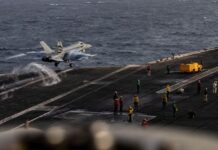
Caudle warned Hegseth that the Navy cannot maintain its current operational tempo indefinitely without a clear end date. He also reported that only about one-quarter of the Navy’s destroyer fleet is currently ready for deployment, representing a steep decline from readiness levels before the war.
Speaking recently at an event in Norfolk, Virginia, Caudle publicly described the deployment extensions as “very challenging for our sailors,” adding that he pushes back hard on them, “but the enemy gets a vote.”
The Army’s 82nd Airborne Division, which mobilized 2,000 soldiers in March and would be expected to play a central role in any U.S. ground invasion of Iran, is anticipated to remain in the region through at least September, with additional extensions considered likely.
Army Patriot air-defense units are also expected to have their deployments extended. Supplies of Patriot interceptors have been reduced by their extensive use during the Iran conflict as well as earlier transfers to Ukraine.
Pentagon spokesman Sean Parnell told the Post that decisions about where and how long U.S. forces are deployed are based on current threat assessments, President Trump’s priorities and recommendations from the chairman of the Joint Chiefs of Staff and combatant commanders.
Parnell added that the Department of War “does not discuss internal operational processes,” including the orders book or “specific concurrences, non-concurrences, or risk assessments.”
The Trump administration, meanwhile, has disputed reports that the U.S. military is facing shortages of munitions.
{Matzav.com}