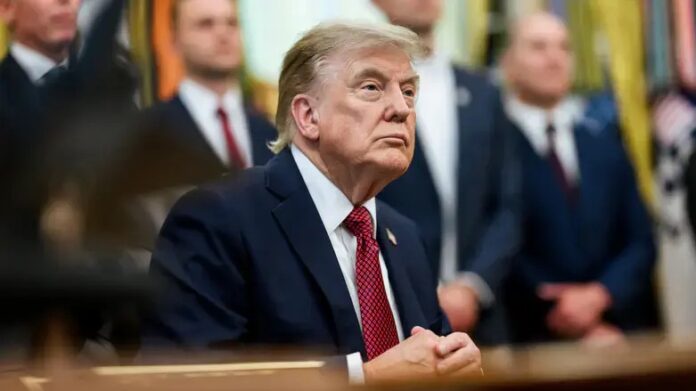
President Donald Trump is expected to welcome a high-level delegation of American rebbes and a rosh yeshiva to the Oval Office on Thursday for a pre-Rosh Hashanah meeting focused on religious liberty, the independence of yeshivos, antisemitism and other issues affecting Orthodox Jewish communities, sources involved in arranging the visit told Matzav.com.
The meeting is expected to take place around midday Thursday, Sept. 3, placing some of the most prominent rabbinic leaders in the country directly inside the Oval Office for a personal audience with the president.
The delegation is expected to include the Vizhnitzer Rebbe of Monsey, who has now confirmed that he will personally make the trip to Washington; the Bobover Rebbe; the Satmar Rebbe, Rav Aharon Teitelbaum of Kiryas Yoel; and Rav Aryeh Malkiel Kotler, Rosh Yeshiva of Beth Medrash Govoha in Lakewood. Rav Aharon Mendel Twersky, a son of the Skverer Rebbe, is expected to attend as his father’s representative.
The precise makeup of the delegation has shifted during the planning process, and published reports have offered differing accounts of which leaders were initially invited and which ultimately intend to attend. One report said that both Satmar Rebbes had received invitations, while earlier plans also called for the Skverer Rebbe himself to participate. The Skverer Rebbe is now expected to be represented by his son.
The Vizhnitzer Rebbe of Monsey, who had been traveling in Eretz Yisroel, has decided to travel to Washington and personally participate in the meeting, according to sources.
The gathering is being arranged as a pre-Rosh Hashanah visit and an opportunity for the rabbinic leaders to personally express their appreciation to Trump for policies they view as supportive of religious Americans and the Orthodox community in particular.
Sources involved in the planning say that the rabbonim are looking forward to extending their brachos to Trump ahead of Rosh Hashanah and thanking him for his administration’s approach toward religious liberty.
The delegation is also expected to use the rare Oval Office access to raise substantive communal concerns, chief among them the continuing battle over government interference in yeshiva education.
The leaders are expected to ask Trump to help protect the independence and integrity of yeshivos in New York and elsewhere, amid longstanding battles over attempts by state and local authorities to regulate curricula and impose secular-education requirements on private religious schools.
That issue has emerged in multiple reports as perhaps the principal domestic policy matter likely to be discussed. One source reported that people familiar with the planning described preserving the autonomy of chareidi education from New York State intervention as the central substantive concern behind the meeting.
The delegation is also expected to discuss the danger posed by antisemitism and ask the administration to continue using federal authority to protect Jewish communities and institutions from antisemitic violence.
The meeting has ostensibly been in development for months rather than being hastily arranged. White House Jewish liaison Martin Marks has been working on the gathering for several months and personally contacted invitees.
The format itself has undergone considerable discussion. Initial plans reportedly contemplated very brief individual encounters between Trump and each rabbinic leader, potentially lasting only a few minutes, while organizers have also been working on arranging a roundtable that would provide more time for a substantive conversation.
The White House has not yet publicly announced the gathering, and reports indicate that some logistical details remain subject to change.
The upcoming visit also comes amid intense attention surrounding the participation of the Satmar Rebbe, Rav Aharon Teitelbaum, who has publicly indicated that he intends to raise the plight of yeshiva bochurim in Eretz Yisroel facing the military draft.
According to sources, the Satmar Rebbe said over the weekend that he initially considered declining the White House invitation because of the timing in Elul, but decided that the opportunity to advocate on behalf of Jews facing difficulties warranted making the trip.
People familiar with the broader planning, however, have pushed back against portrayals of the Israeli draft controversy as the central purpose of the meeting. One source said that the official purpose is a Rosh Hashanah greeting and that other matters could arise during the conversation, while another account said the main domestic concern is protecting frum schools from government interference.
The visit also reflects a relationship between Trump and the American frum community that predates the current meeting.
In April, Trump hosted frum communal representatives at the White House for a Pesach gathering. Among those participating were representatives of Satmar and Skver, Agudath Israel of America executive vice president Rabbi Chaim Dovid Zwiebel, US Special Envoy to Monitor and Combat Antisemitism Yehuda Kaploun and Tzedek Association founder Reb Moshe Margaretten. New Square Mayor Yisroel Meir Spitzer attended and conveyed greetings to Trump from the Skverer Rebbe.
Trump also sent a personal letter to the Skverer Rebbe in August 2025 in honor of the wedding of one of the rebbe’s great-grandchildren. The letter was delivered by Spitzer and other frum activists with ties to the administration.
The relationship stretches back further. In 2020, an array of leading American rebbes and roshei yeshiva signed a letter thanking Trump for his efforts on behalf of religious liberty. The signatories included both Satmar Rebbes, the Skverer Rebbe, the Bobover Rebbe and the Vizhnitzer Rebbe of Monsey.
Thursday’s gathering would bring that relationship into the Oval Office at a particularly significant moment, just days before Rosh Hashanah and as American Orthodox communities confront concerns ranging from the future of independent religious education to the continuing threat of antisemitism.
For the participants, sources say, the objective will be twofold: to convey their appreciation and brachos directly to the president and to use the extraordinary access to the nation’s highest office to advocate for the ability of American Jews to educate their children according to their religious traditions and to live openly and safely as Jews.