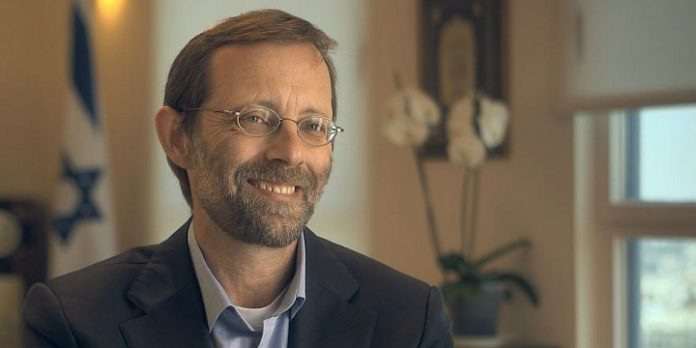
Israeli political activist and former Knesset member Moshe Feiglin offered an unusually personal account of his life in a wide-ranging interview, speaking about everything from his childhood and political battles with Prime Minister Bibi Netanyahu to the death of his grandson Yair in Gaza — a loss Feiglin says he connects painfully to his unsuccessful campaign against the Oslo Accords.
Speaking with Eli Gotthelf on the Kikar FM podcast, Feiglin traced the experiences that shaped his worldview, including his parents’ divorce, his military service, the creation of the Zo Artzeinu protest movement, his years in politics, and two devastating tragedies that struck his family.
The interview began with an unusual distinction Feiglin has held for roughly two decades: He is barred from entering Britain.
“I have perhaps already been banned for 20 years from entering the United Kingdom, which has become the Islamic Kingdom,” Feiglin said.
Feiglin recalled receiving an official brown envelope at his home from the British government informing him that he would not be permitted to enter the country. He said the decision stemmed from a statement he had written asserting that the Arab was not the son of the desert, but the father of the desert.
According to Feiglin, the line itself originated with Lord Jarvis, a British official who served in the Sinai during the 1930s.
“For quoting an official British figure, they ban me from entering England,” he said.
Asked whether he took satisfaction in the ban, Feiglin said his initial reaction was mainly disbelief, and that he first suspected the letter was some sort of prank.
The conversation then turned back decades to Feiglin’s childhood in Rechovot, where he described himself as an unusually independent and inventive boy. While still in first grade, he once took a canteen and decided to walk all the way to Ashdod, navigating by reading road signs along the way.
The journey lasted between six and seven hours before a woman spotted the young boy alone and contacted police. His mother eventually had to travel by bus to retrieve him.
Known as Moishik at the time, Feiglin said he was constantly trying to invent technological solutions to everyday problems. One childhood idea involved a refrigerator storage system with a movable arm that would allow shelves to rotate and be repositioned.
Another concept involved rapidly heating shower water. He also devised a military idea involving rifle rounds that could function like batteries and trigger ammunition explosions inside enemy tanks. As a child, he drew a design for a tank shell and mailed it directly to the IDF.
To his surprise, the military took the proposal seriously enough that he received a written response from a lieutenant colonel. Feiglin also recalled devouring the books in Rechovot’s municipal library, saying his intense reading helped develop the language and rhetorical abilities that would later become central to his public career.
The interview grew more personal when Gotthelf raised Feiglin’s parents’ divorce, which occurred when he was seven, around the time of the Six-Day War.
Feiglin admitted that he had hoped the subject would not come up. His father came from a secular pioneering family that participated in the establishment of Mishmar HaYarden, while his mother came from a deeply religious Chassidic family in Australia.
The ideological gulf between his parents ultimately proved too wide to bridge, and Feiglin described their separation as a deeply destabilizing experience for a young child.
“I suggest to every couple today, understand that there is nothing harder you can do to a child than break up his family,” he said.
Feiglin said the divorce left him yearning for elements of both his parents’ worlds — religious and secular — and that he eventually came to see that tension as part of the path through which Hashem led him toward his own mission.
“This inner need within me to connect the worlds led me, among other things, ultimately to this philosophy,” he explained.
As a child, Feiglin was attracted to his father’s secular lifestyle and wanted to walk around without a yarmulke. Despite the divorce, however, his father remained closely involved with the family. Feiglin characterized his parents’ separation as relatively amicable, without the bitter court battles he said frequently accompany divorce today.
A defining religious moment came after the Six-Day War, when his family traveled to Yerushalayim and Feiglin saw the Kosel emerging amid the ruins of the recently demolished Mughrabi Quarter. Overwhelmed by the sight, he immediately pulled a yarmulke from his pocket and placed it on his head.
Today, however, Feiglin said he generally avoids davening at the Kosel because of his views concerning Har Habayis.
“The Kosel has become a barrier to the real thing, Har Habayis,” he said.
Feiglin later attended a military boarding school before entering the IDF. He said he rejected the Hesder track in favor of full military service because he wanted to connect more completely with the broader Israeli public.
Serving as an officer in combat engineering, Feiglin worked extensively with mines and explosives. During one particularly dangerous incident, his unit mistakenly returned to an area containing explosive devices they themselves had planted.
Feiglin ordered his soldiers to dig into the sand, take cover and place their hands over their heads. Lying on the ground with them, he carefully counted all 10 explosions before allowing the soldiers to get back up.
During the First Lebanon War, tragedy struck when an armored personnel carrier carrying soldiers from the unit Feiglin had trained was hit by a missile fired from a Syrian helicopter. Feiglin said half of the soldiers he had commanded, along with the officer who replaced him, were killed.
Years later, during the First Intifada, another officer who had replaced him was burned to death when a jeep was set ablaze in Shechem.
Asked what went through his mind after repeatedly witnessing people around him die, Feiglin said the experiences left him feeling that Hashem was protecting him and that his survival carried an obligation.
“As long as I am here, it means I have not finished my role,” he said.
Feiglin also recalled how he responded to rock-throwing attacks in Yehuda and Shomron during reserve duty. While others added protective nets and helmets, he mounted a large Israeli flag on his vehicle and drove with it prominently displayed.
His wife, Tzipi, adopted the flag as her own trademark when she traveled through Shechem to bring cookies to soldiers.
Feiglin said the idea later grew into a nationwide initiative. After finding an importer capable of supplying flags designed for vehicle windows, he began distributing them as a symbol of Israelis traveling without fear. He credits that effort with helping launch the now-familiar practice of displaying Israeli flags on cars around Independence Day.
Following his military service, Feiglin traveled to the United States, returned with rappelling equipment, and launched what he described as Israel’s first rappelling-based window-cleaning company.
The business grew to about a dozen employees and serviced major buildings, including those belonging to the Diamond Exchange and Elbit.
Feiglin subsequently joined a partner in establishing a high-tech venture. Their concept involved a computerized system designed to reduce by roughly 60% the time required for security screening of rappelling workers entering the Diamond Exchange.
At the time, Feiglin said, his ambition was straightforward: Make enough money to retire early and enjoy life.
The Oslo Accords changed those plans entirely.
Convinced that conventional demonstrations would accomplish little, Feiglin developed a strategy of nonviolent civil disobedience through the Zo Artzeinu movement. Activists would establish outposts in Yehuda and Shomron while simultaneously blocking roads across Israel.
Feiglin recalled traveling from community to community trying to recruit participants, despite previously barely knowing his own neighbors.
“I brought the concept of nonviolent civil disobedience. We went down to the roads with handcuffs on our hands; we said, take us to prison,” he recalled.
The campaign succeeded in disrupting traffic nationwide and putting substantial pressure on the government.
During one road blockade, Feiglin received a phone call from Tzipi informing him that the plan was succeeding throughout the country. He described the realization that his idea had become a nationwide reality as one of the happiest moments of his life.
His business career effectively ended there, as Feiglin chose to devote himself to public activism instead.
Authorities eventually indicted him on serious charges that included sedition and unlawful assembly. When he appeared in court, Feiglin refused to plead for leniency, maintaining that he was proud of what he had done and prepared to accept the consequences. He later hung a copy of the indictment in his living room as a reminder of his commitment to his principles.
The discussion then moved to Feiglin’s political career and his long-running ideological disagreement with Netanyahu.
When Gotthelf challenged him over the gap between his ambitious rhetoric and his limited governmental accomplishments, Feiglin responded by questioning what Netanyahu himself had accomplished before becoming prime minister aside from serving as Israel’s ambassador to the United Nations.
For Feiglin, political effectiveness without a clearly defined national destination is ultimately meaningless.
“Netanyahu is the last Mohican of the Zionism of existence. There is no destination toward which he is leading the country other than survival,” Feiglin said.
Feiglin argued that Israel now requires what he describes as a “Zionism of destiny,” rooted in the country’s Jewish identity rather than merely in ensuring its continued existence.
Gotthelf also raised Feiglin’s attempt to transform Likud from within through his Manhigut Yehudit movement.
Feiglin said he recruited 22,000 people into Likud and eventually built a political force representing approximately one-quarter of the party’s Central Committee. The strategy ultimately failed, he said, because those members would not consistently vote as a unified ideological bloc and instead supported individual politicians who offered tactical political promises.
The host also confronted Feiglin with accusations of megalomania that critics have leveled against him.
Feiglin rejected that characterization, insisting that he has little personal desire to occupy a Knesset seat.
“If there were another Feiglin, I would donate to him and go back to riding bicycles. My problem is that I don’t have enough ego,” he said.
He acknowledged that his lack of conventional political ego can make it difficult to generate the relentless drive required to survive in politics. What repeatedly brings him back after political setbacks, he said, is a sense of mission rather than personal ambition.
Feiglin said he now believes his podcasts have helped create a genuine and stable electoral base around his ideas. He described that following as consisting of both Chareidi and secular Israelis who identify with his effort to reconnect Israeli nationalism with Jewish identity.
The final portion of the interview turned to the most painful chapters of Feiglin’s family life.
His son David was critically injured in a bicycle accident. Feiglin recalled receiving the news while riding a tandem bicycle with Tzipi in Yarkon Park.
Tzipi remained beside David’s bed at Beilinson Hospital for an entire year, refusing to leave him. During that period, Feiglin wrote an essay titled “The Doors Open for Me,” reflecting on Israeli identity through what he witnessed inside the hospital.
Feiglin said the extraordinary support his family received from Israelis of vastly different backgrounds gave him a powerful glimpse of the underlying bonds connecting Israeli society.
Years later came another devastating blow: His grandson Yair was killed while fighting in Rafah in the Gaza Strip.
Feiglin recalled receiving a telephone call from his daughter Nechama shortly before he was scheduled to deliver a lecture. He immediately packed up his equipment and informed those gathered that his grandson had been killed and that he had to leave.
When Gotthelf asked when the enormity of the loss finally overwhelmed him, Feiglin said it happened when he found himself alone on the morning of the levayah and broke down crying.
He also revealed a painful sense of personal responsibility that continues to accompany his grief. Feiglin believes there is a direct historical line between his failure to stop the Oslo process and the war in which his grandson ultimately lost his life.
During the shivah, Feiglin learned from Yair’s comrades in his elite unit just how deeply his grandson had been influenced by conversations with him.
For Feiglin, that loss has intensified the sense that his political and ideological struggle is about preventing another national catastrophe.
“October 7 was only an opening. Our country continues to be led by the same people, the same ideas,” he warned.
As the deeply personal conversation drew to a close, Feiglin turned his attention to his family and asked listeners to daven for his wife, Tzipora Penina bas Rachel Chaya, whom he described as the greatest gift he has received. Gotthelf concluded the interview by thanking Feiglin for the unusually candid discussion.
{Matzav.com}