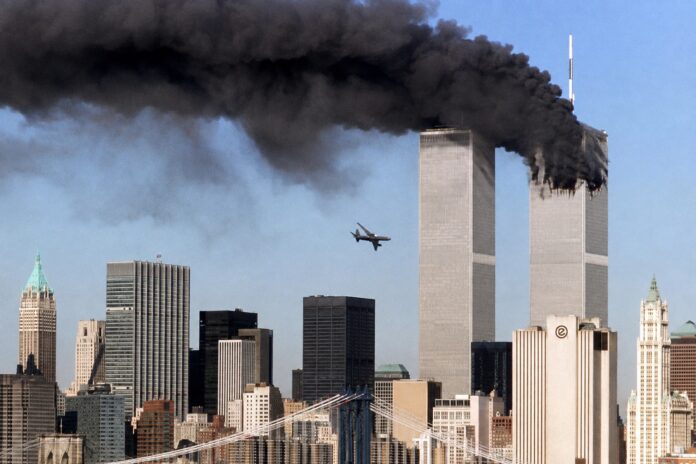
A victim of the September 11, 2001 terrorist attacks has been formally identified through forensic investigative genetic genealogy, marking the first time New York City has successfully used the emerging technique to identify someone killed at the World Trade Center.
A quarter-century after the attacks claimed nearly 3,000 lives, New York City authorities continue the painstaking effort to identify remains recovered from the World Trade Center site.
The latest identification was made by the New York City Office of the Chief Medical Examiner in conjunction with the NYPD Detective Bureau. Investigators used genetic genealogy, a method that combines DNA analysis with genealogical and family-tree research to establish a person’s identity.
The newly identified victim was an adult woman whose relatives have chosen not to publicly disclose her identity. Her identification brings the number of World Trade Center victims formally identified to 1,654.
“It’s a breakthrough,” Dr. Jason Graham, New York City’s chief medical examiner, told ABC News. “I’m delighted to be able to say that we’ve now applied new methods to the World Trade Center identification efforts, and we have a new identification for the first time in 25 years using new methods, forensic investigative genetic genealogy.”
The scientific tools that made the identification possible were not available when the attacks occurred in 2001, leaving investigators at the time without techniques that have since transformed the investigation of unidentified remains and decades-old cases.
“The technology really wasn’t there,” said NYPD Det. Gregory Paduano. “There’s a lot of good future with genealogy.”
Forensic investigative genetic genealogy has increasingly been used by law enforcement agencies to crack cold cases and identify unknown victims. New York City’s medical examiner and the NYPD have more recently begun applying the same methodology to the enormous and uniquely difficult task of identifying World Trade Center victims.
“We already can see that it’s promising,” said Dr. Jennifer Odien, a forensic anthropologist in the New York medical examiner’s office. “Not every case is going to be able to go through genetic genealogy, but we do have DNA profiles that are not matching to our reference samples, so that’s the group right now that we’re focusing on and that hopefully is going to yield more positive results.”
Odien said investigators have identified 47 DNA profiles that could potentially be candidates for identification through genetic genealogy.
Those cases, however, represent only a small portion of the enormous amount of work that remains. Nearly 1,100 people killed at the World Trade Center — roughly 40% of the victims — have still not been formally identified 25 years after the attacks.
The Office of the Chief Medical Examiner has repeatedly pledged that its identification effort will continue, regardless of how much time passes, as advances in forensic science provide new opportunities to identify victims whose remains could not previously be matched.
“The World Trade Center was the largest mass murder in the history of the United States, and it represents also the most complex forensic identification effort in our history,” Graham said. “And being able to apply new innovations to that identification work is a remarkable way that we can keep our commitment to the families.”
{Matzav.com}