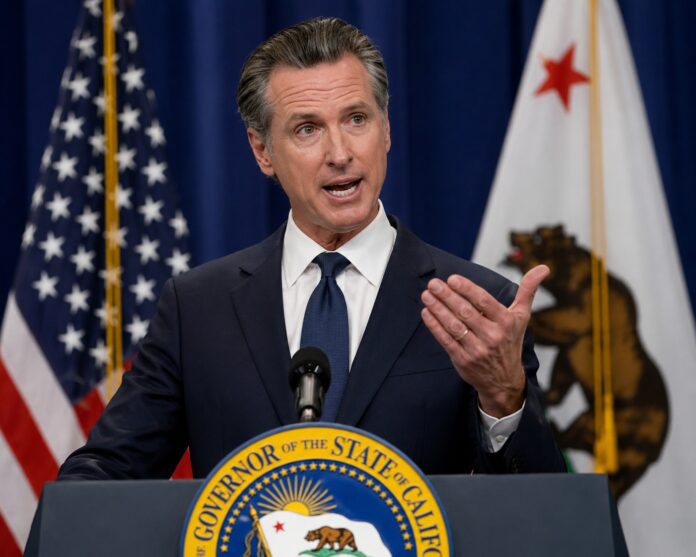
California Gov. Gavin Newsom signed a controversial measure dubbed the “Stop Nick Shirley Act” into law yesterday, despite warnings from critics that the legislation could chill investigative reporting by imposing significant penalties for publishing certain information about workers at immigration-related nonprofit organizations.
Newsom, however, will be out of office by the time Assembly Bill 2624 takes effect. The new law is scheduled to become effective on October 1, 2027, nearly 10 months after Newsom leaves the governor’s office because of term limits, meaning any First Amendment challenges arising from its implementation will come under his successor.
The legislation broadens California’s existing “Safe at Home” program to include employees of nonprofit organizations that provide assistance to individuals navigating the U.S. immigration system.
Opponents contend that the expansion could have significant consequences for journalists investigating potential wrongdoing at such organizations, potentially preventing reporters from seeking out and questioning employees of nonprofits suspected of fraud.
Assemblywoman Mia Bonta, the Alameda Democrat who introduced the legislation in February, has disputed that characterization. She maintains that the measure distinguishes legitimate journalism from the type of doxxing and harassment that the Safe at Home program is designed to prevent.
“Our immigrant service providers are living in fear because of extremists looking to demonize the work that they do and the populations they serve,” the assemblywoman said Saturday. “That is an intolerable consequence of the anti-immigrant rhetoric that exists right now.”
Under the new law, individuals who distribute or publish information or “images” involving covered immigration workers in a manner the law says “incites violence or threats” could face substantial criminal and financial penalties. Those punishments range from fines of $10,000 to $50,000 and from one year in jail to possible imprisonment in state prison.
Republican Assemblyman Carl DeMaio of San Diego is among those who have strongly opposed the measure, arguing that its real effect will be to frighten people away from investigating suspected misconduct. DeMaio said the legislation targets those “trying to shine light on bad behavior.”
It was DeMaio who gave the legislation the politically charged nickname “Stop Nick Shirley Act,” a reference to independent journalist and YouTuber Nick Shirley.
California’s Safe at Home program already extends protections to several categories of people considered vulnerable, including survivors of domestic violence, victims of elder abuse, and workers providing reproductive and gender-affirming health care. The program protects participants in part by “providing substitute mailing addresses for people considered particularly vulnerable to targeted attacks and violent threat,” according to the California Post.
Shirley has attracted millions of views for videos in which he follows and questions immigrant-service workers while alleging fraudulent activity, including investigations involving nonprofit organizations in the Somali community in the Minneapolis metropolitan area.
The young independent journalist has emerged as a vocal opponent of AB 2624, claiming lawmakers pursued the legislation only after he “exposed widespread fraud in immigrant communities” in both California and Minnesota.
Shirley traveled to San Diego after videos he produced about alleged fraud in Minnesota went viral earlier this year, bringing his investigative approach to California.
Newsom responded to Shirley’s presence in February by saying that Somali daycare providers in the area were “under siege.”
Shirley himself became the target of a highly unusual confrontation Wednesday while he was conducting an interview outside the California State Capitol in Sacramento.
During the encounter, Terry Schanz, chief of staff to Democratic Assemblywoman Tina McKinnor, approached while holding a printed flyer and asked: “Did you guys hear that Nick Shirley has a small penis allegedly?”
The incident created an uncomfortable contrast with the stated rationale behind the legislation. “The episode is an awkward backdrop” for the Stop Nick Shirley bill “whose supporters say is designed to combat harassment and doxxing,” the California Post wrote. The outlet also reported that Schanz receives $17,319 per month in taxpayer-funded compensation.
Multiple complaints against Schanz have since been filed with the California Legislature’s human resources department over the incident.