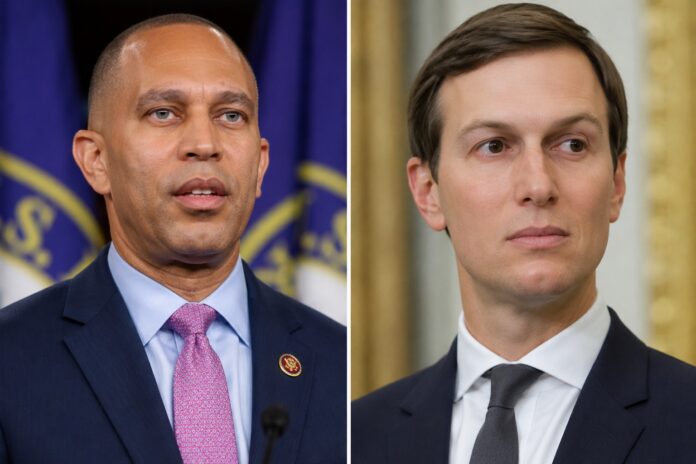
House Minority Leader Hakeem Jeffries quietly met with Jared Kushner in recent weeks for a private discussion about areas where Democrats and the Trump administration could potentially find common ground, even as Jeffries and President Donald Trump publicly wage an increasingly bitter political battle ahead of November’s midterm elections.
The meeting between Jeffries, who could become House speaker if Democrats capture the chamber, and Kushner, Trump’s son-in-law and an informal presidential adviser, included discussions about housing, immigration and the high cost of living, according to The New York Times, which cited five people familiar with the conversation.
Neither Jeffries’ office nor a representative for Kushner had publicly confirmed the meeting as of Sunday. The revelation comes against the backdrop of increasingly personal attacks between Trump and the Democratic leader as both parties fight for control of the House.
According to one person familiar with the gathering, the two met at a private location in New York City that was made available by a mutual friend. The discussion was described as a wide-ranging exchange of ideas rather than an attempt to negotiate a specific agreement.
Jeffries and Kushner have maintained a relationship dating back to Trump’s first term, when they worked together on criminal justice legislation. During their recent conversation, Kushner reportedly suggested that Jeffries also sit down with White House chief of staff Susie Wiles.
The behind-the-scenes contact presents a striking contrast with the highly confrontational rhetoric being exchanged publicly by Trump and Jeffries.
Trump has repeatedly gone after the Democratic leader, calling Jeffries a “low-IQ thug” and declaring in a May Truth Social post that he is “a danger to our Country.”
Jeffries has leveled his own attacks against Trump, accusing the president of corruption and promising voters that a Democratic House majority will “hold the crooks accountable.” The Washington Post first reported the remark following a Jeffries campaign appearance in Pennsylvania in July.
Despite the private outreach, substantial political and policy differences remain that could make bipartisan cooperation difficult.
Earlier this summer, Trump refused to sign bipartisan housing legislation because the Senate had failed to approve the SAVE America Act. The housing legislation ultimately became law without the president’s signature.
Immigration represents another possible area for negotiations, though previous attempts at bipartisan agreements have repeatedly broken down. Trump has on several occasions indicated that he would consider reaching an immigration deal with Democrats, but no agreement has materialized. During the 2024 campaign, Trump also urged congressional Republicans to walk away from a bipartisan Senate border security proposal.
At other moments, however, Trump has suggested that he could have a productive relationship with Jeffries despite their public clashes.
Asked by Punchbowl News earlier this month about the possibility of Jeffries becoming speaker, Trump said, “I’d probably get along with him very well.” The president pointed to their only face-to-face meeting of his second term, an Oval Office discussion last fall during the government shutdown.
Jeffries, in comments provided to the Times, did not acknowledge that the Kushner meeting had occurred. He instead accused Republicans of governing with a take-it-or-leave-it attitude and said Democrats were seeking sweeping changes aimed at addressing Americans’ cost-of-living concerns.
The Democratic leader has similarly avoided committing himself to another effort to impeach Trump. Asked about the possibility last month, Jeffries told the Times that Democrats have “not ruled anything in and not ruled anything out in terms of accountability.”
Should Democrats win control of the House in November and elevate Jeffries to the speakership, he would face competing pressures: finding ways to work with the Trump administration on government funding and other essential legislation while simultaneously facing demands from Democratic voters and lawmakers for aggressive investigations and confrontation with the president.